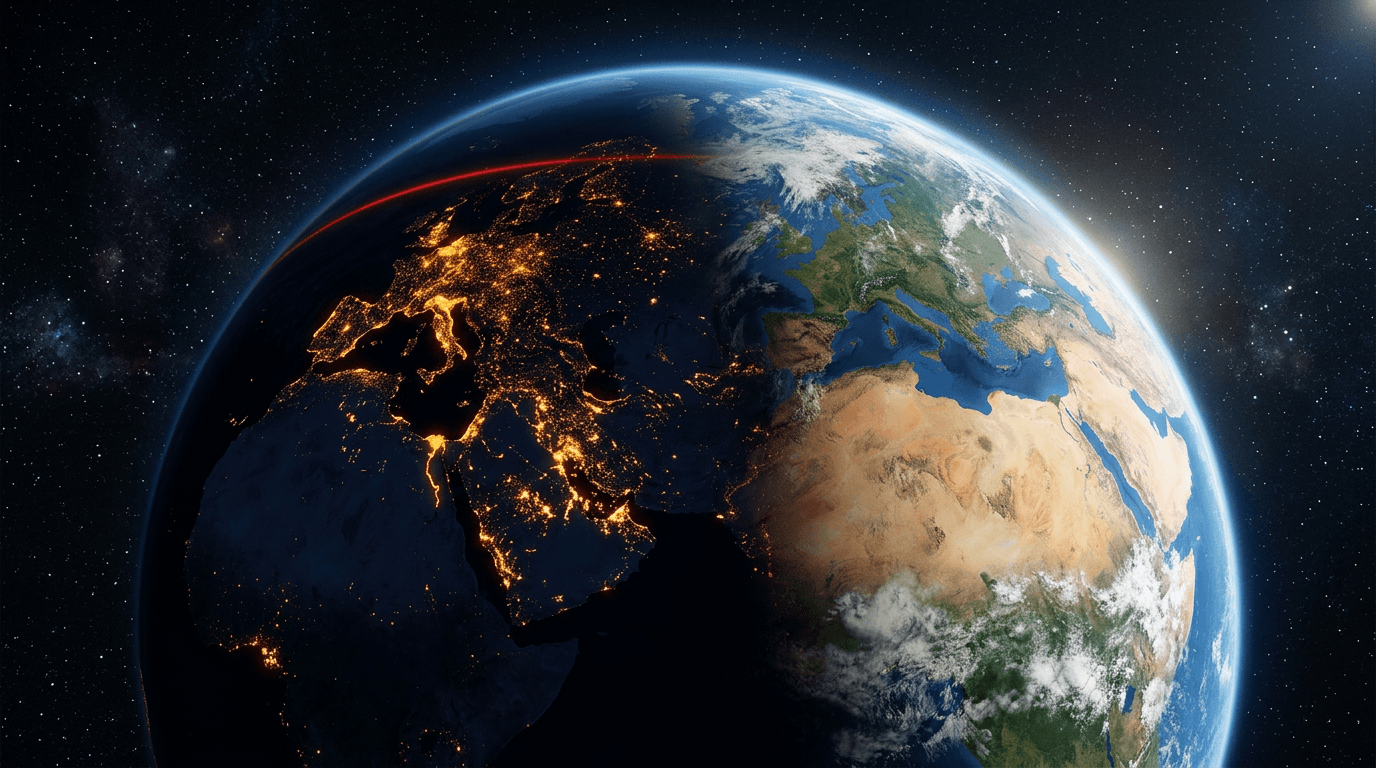
Doom Will Come with a Boom: Why the Notion of Nation May End Humanity
The nation-state was built to protect. It now threatens to annihilate. An editorial on why humanity needs a federation of people, not a union of flags.
Doom Will Come with a Boom: Why the Notion of Nation May End Humanity
The word "nation" is a notion of discrimination and war. What was built to protect now threatens to annihilate. And the clock is ticking.
By The Global Federation Editorial | March 14, 2026 Category: Governance | Read Time: 10 min
There is a word so deeply embedded in the architecture of modern civilization that questioning it feels almost treasonous. The word is nation. It is spoken with reverence in schools, printed on passports, stitched into flags, and invoked to justify everything from trade barriers to thermonuclear warheads. It is the organizing principle of the United Nations, the foundation of international law, and the lens through which seven billion people are taught to see themselves and each other.
It may also be the word that ends us.
I. The Promise
The nation-state was born from a reasonable proposition: that people who share geography, language, and custom might govern themselves more justly than distant empires could govern them. The Peace of Westphalia in 1648 codified this idea. The American and French revolutions gave it moral weight. The great decolonization movements of the twentieth century extended it to the rest of the world. By 1945, when the United Nations was chartered in San Francisco, the nation-state had become the only legitimate unit of political organization on Earth.
And for a time, it worked. Nations built roads and hospitals. They educated children. They created legal systems that, however imperfect, offered citizens recourse against the arbitrary exercise of power. The nation-state was an improvement on empire, on feudalism, on the rule of warlords and kings. It gave ordinary people something they had rarely possessed before: a claim on the state, and a state that -- at least in theory -- answered to them.
That was the promise. It was a good one. And it has expired.
II. The Expiry
What happens when the mechanism designed to protect becomes the instrument of destruction? This is not a hypothetical question. It is the daily news.
Russia, a nation of 144 million people -- the vast majority of whom want nothing more than to raise their families and live in peace -- has been marshalled into a war that has killed hundreds of thousands on both sides, displaced millions, and brought Europe closer to continental conflict than at any point since 1945. The decision was made by a handful of people at the top of a national hierarchy. The nation provided the soldiers, the taxes, the industrial capacity, and the ideological cover. Without the apparatus of the nation-state, the invasion of Ukraine would have been logistically impossible and rhetorically unthinkable.
The United States, a nation that spends more on its military than the next ten countries combined, has conducted military operations in at least 85 countries since 2018 alone. Its interventions in Iraq, Libya, and Afghanistan destabilized entire regions for decades. Its current confrontation with Iran threatens to engulf the Middle East. Polls consistently show that the majority of American citizens oppose these engagements. The wars proceed regardless. The nation-state provides the mechanism by which the will of the many is overridden by the ambitions of the few.
China, a nation whose economic rise has lifted hundreds of millions from poverty, simultaneously operates the most sophisticated surveillance state in human history, suppresses ethnic minorities, and uses its economic leverage to coerce smaller nations into compliance. Its military buildup in the South China Sea, its posture toward Taiwan, and its strategic alignment with Russia have created a geopolitical fault line that runs through the Pacific.
And these are merely the superpowers. The pattern replicates at every scale.
India, the world's largest democracy, grapples with rising religious nationalism that pits one billion Hindus against two hundred million Muslims -- not because ordinary Indians want conflict, but because the machinery of the nation-state rewards those who can mobilize identity for electoral gain. Japan re-arms. The European Union fractures under the weight of competing national interests. Canada, long considered a model of peaceful governance, discovers that even its institutions are not immune to the polarization that the nation-state incentivizes.
The common thread is not ideology. It is structure. The nation-state, by its very design, creates an us and a them. It draws lines on maps and then teaches children that the people on the other side of those lines are fundamentally different. It concentrates the power to make war in the hands of a vanishingly small number of people. And it wraps all of this in a mythology of shared destiny that makes questioning the arrangement feel like a betrayal.
III. The Escalation
The nuclear dimension transforms this structural problem into an existential one.
Nine nations now possess nuclear weapons. The combined global arsenal stands at approximately 12,100 warheads -- enough to end human civilization several times over. During the Cold War, the doctrine of Mutual Assured Destruction was presented as a stabilizing force: no rational actor would initiate a nuclear exchange knowing it would result in their own annihilation. This logic held, barely, for forty years. It survived the Cuban Missile Crisis by what we now know was a margin of minutes and the judgment of a single Soviet submarine commander, Vasili Arkhipov, who refused to authorize a nuclear torpedo launch.
That was 1962. The world was simpler then. Two superpowers. Two ideologies. Two clear chains of command.
Today, the nuclear landscape is fragmented and far less predictable. North Korea possesses an estimated 50 warheads and a leadership structure that offers no institutional check on their use. Pakistan and India, two nuclear-armed nations that share a border and a history of armed conflict, have come to the brink of war multiple times in the last two decades. Iran's nuclear ambitions, whatever their current status, have already triggered a regional arms race. Saudi Arabia, Turkey, and Egypt have all signaled interest in developing their own nuclear capabilities.
Nuclear deterrence is becoming democratized -- and that is precisely the problem. Deterrence works only when all parties are rational, informed, and possessed of reliable command-and-control systems. As the number of nuclear actors multiplies, the probability of miscalculation, unauthorized launch, or deliberate use by a cornered regime approaches certainty over time. The mathematician's term for this is statistical inevitability. The layman's term is a matter of time.
Meanwhile, the rhetoric escalates. Nuclear threats, once considered the ultimate taboo of international discourse, have become routine. Russia has invoked its nuclear arsenal repeatedly since 2022. The United States has expanded its nuclear modernization programme. China is building new missile silos at a pace that suggests a significant expansion of its arsenal. The Doomsday Clock, maintained by the Bulletin of the Atomic Scientists, stands at 89 seconds to midnight -- the closest it has ever been.
Doom, it appears, will come with a boom.
IV. The Common Human
Strip away the flags, the anthems, the border posts, and the passports. Strip away the rhetoric of national destiny and civilizational superiority. Strip away the carefully curated mythologies that each nation teaches its children about why they are special and why their cause is just.
What remains is remarkably uniform.
A farmer in Punjab wants to feed his family and educate his children. A software engineer in San Jose wants job security and a safe neighbourhood. A shopkeeper in Lagos wants reliable electricity and the rule of law. A nurse in Kyiv wants to go to work without wondering whether a missile will hit the hospital. A student in Tehran wants to speak freely without being arrested. A mother in Moscow wants her son to come home from a war she never asked for.
The desires of ordinary human beings are, across all cultures and continents, strikingly consistent: safety, security, and the opportunity to prosper. No survey of human aspiration -- no poll, no study, no ethnographic record -- has ever found a population that genuinely wants war, conquest, or the subjugation of its neighbours. These are the projects of states, not of people.
The nation-state was supposed to be the instrument through which these universal human desires were fulfilled. It was supposed to be the servant, not the master. Somewhere along the way, the relationship inverted. The state now demands that citizens serve it -- with their taxes, their labour, their obedience, and increasingly, their lives. The social contract has been rewritten without the consent of the governed, and the pen was held by those who benefit most from the existing arrangement.
V. The Unity of Nations Is Fragile. A Federation of Humans Is Progressive.
The United Nations was founded in 1945 with a mandate to prevent the horrors of the Second World War from recurring. Eighty-one years later, wars rage on every inhabited continent. The Security Council, the body charged with maintaining international peace, is structurally paralyzed by the veto power of its five permanent members -- each of whom is also a nuclear-armed state and a major arms exporter. The UN does important humanitarian work. It facilitates dialogue. It provides a forum. But it does not, and structurally cannot, prevent the wars that the nation-state system generates. Because it is a union of nations. And the problem is the nations themselves.
Unity among nations is inherently fragile. It is a coalition of competing interests held together by treaties that any party can exit, agreements that any government can repudiate, and norms that any sufficiently powerful state can ignore. The United Nations has no army, no taxing authority, and no enforcement mechanism that its most powerful members have not already neutered. It is an organization built on the fiction that sovereign states will voluntarily constrain their own power. History suggests otherwise.
What is needed is not a better alliance of nations. What is needed is a federation of humans.
The distinction is not semantic. A federation of nations preserves the very structures that create conflict: borders, exclusive citizenship, national armies, competing economic interests wrapped in flags. A federation of humans begins from a different premise entirely: that the unit of political legitimacy is the individual person, not the territorial state. That rights attach to human beings by virtue of their humanity, not their nationality. That governance should be accountable to the people it affects, regardless of which side of an arbitrary line they were born on.
This is not utopian thinking. It is the logical extension of every democratic principle the modern world claims to hold dear. If government derives its legitimacy from the consent of the governed, then a government whose decisions affect the entire planet must derive its legitimacy from the entire planet. Climate change does not respect borders. Pandemics do not check passports. Nuclear fallout does not stop at national boundaries. The challenges of the twenty-first century are global. The governance structures of the seventeenth century cannot address them.
VI. The Debate Begins Here
This platform exists because we believe the conversation must start somewhere. Not among diplomats and heads of state, who are institutionally incapable of questioning the system that grants them power. Not in academic journals, where these ideas are discussed with rigour but reach no one. Not on social media, where thought is compressed into slogans and nuance dies in the algorithm.
Here. Among humans. With the assistance of the very technologies that are reshaping our world -- artificial intelligence that can moderate without bias, synthesize without fatigue, and hold the thread of an argument across months of deliberation.
We propose a year of global debate. Structured, moderated, open to every human being and every reasoning machine. Topics drawn from the crises that unite us: governance, sustainability, security, economics, technology, survival. Not debates between nations. Debates between minds.
And at the end of that year, a synthesis. Not imposed by committee, but distilled from the collective reasoning of millions. Put to a human referendum -- not a vote of governments, but a vote of people. The beginning of a constitution written not by the powerful for the powerful, but by humanity, for humanity.
The nation-state served its purpose. It gave us order when we had chaos, identity when we had none, and protection when we were vulnerable. We honour that history. But history moves, and what once protected now imperils.
The choice before us is not between nations and anarchy. It is between the fragile unity of competing states and the progressive federation of cooperating humans. Between a system designed for the seventeenth century and governance built for the twenty-first. Between the boom that ends everything and the conversation that might yet save us.
The debate is open. The floor is yours.
The Global Federation is an open platform for democratic deliberation. The views expressed in editorial pieces represent the platform's founding philosophy: Peace, Prosperity, and Progress for all of humanity. We invite responses, rebuttals, and reasoned disagreement. That is the point.