Builder Track
AI Lab
A technical stream focused on AI systems, coding practice, and governance design choices that matter for democratic federation infrastructure.
ai-society·August 15, 2026
Teach the Child Before Assisting the Task
AI can widen access to tutoring. Schools must still protect the unaided effort through which knowledge and judgement become the child's own.
ai-sovereignty·August 15, 2026
Sovereign AI Needs a Public Scorecard
National model programmes should be measured by capability, cost, language, control and continuity—not the number of launches.
ai-governance·August 14, 2026
Authenticity Must Begin at Capture
Deepfake labels are useful warnings. Democratic trust also needs provenance, competent forensics and remedies fast enough to matter.
ai-governance·August 14, 2026
No Government Agent Without a Named Principal
Software may perform public work, but every consequential action must lead to an official who can stop, explain and reverse it.
ai-infrastructure·August 13, 2026
Every AI Constitution Has an Energy Clause
The politics of AI will be written not only in model rules, but in who supplies the electricity, water and grid capacity.
ai-society·August 13, 2026
The Apprenticeship Is Part of the Job
AI may not abolish whole professions. It can still remove the junior work through which people learn to enter them.
ai-lab·June 23, 2026
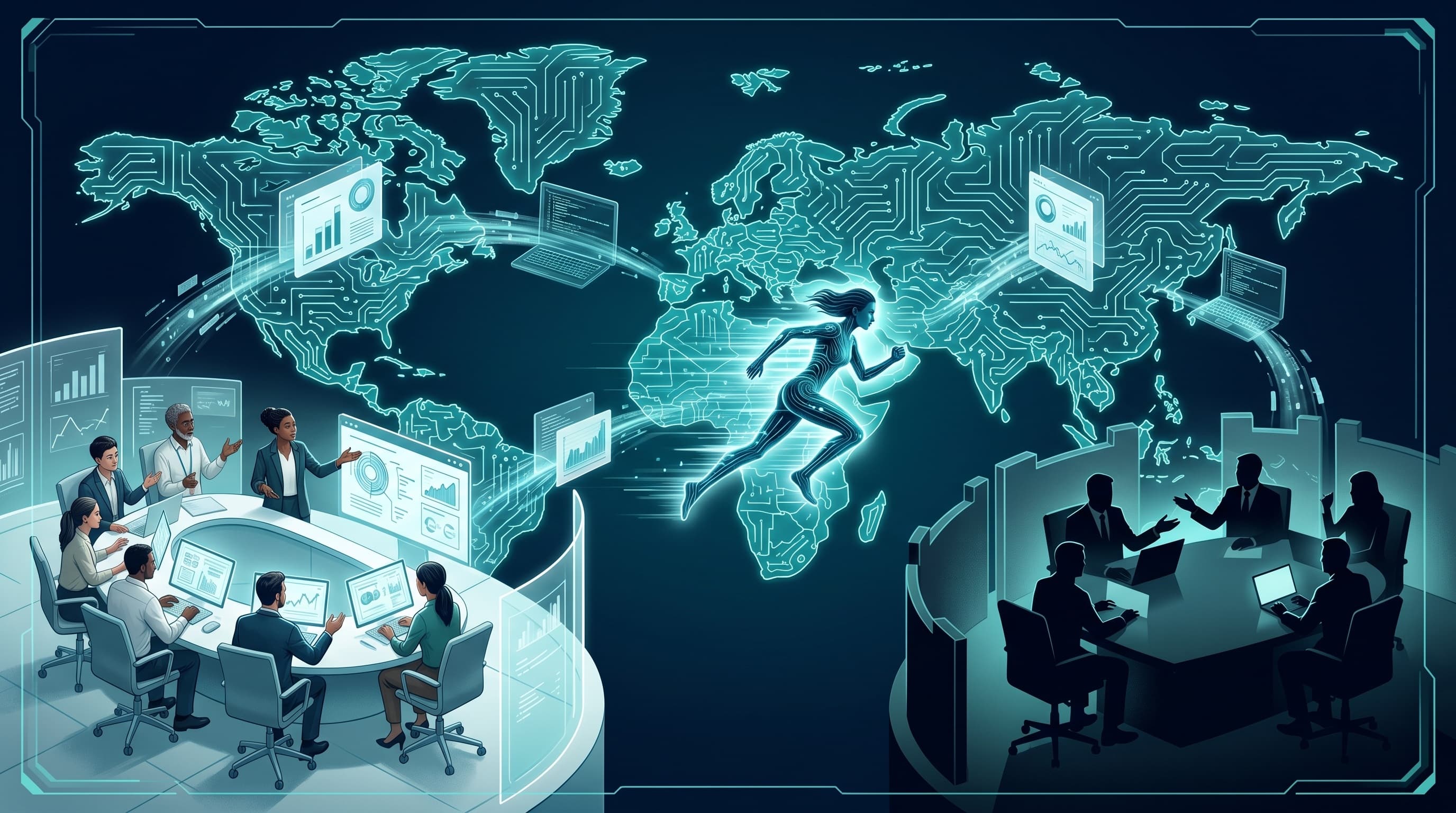
The AI Standards Race Is Still Open
AI is still young. If open societies throttle their own labs or block global access, they may not slow AI. They may surrender the rulebook.
ai-lab·June 18, 2026
The Last Human Decision
The first arms-control test of the artificial intelligence age is no longer theoretical. The question is whether the final decision to take a human life can disappear into a system no citizen can question.

ai-lab·June 12, 2026
Democracy in the Algorithmic Age: Europe's Bid for Technological Sovereignty
Understanding the Cloud and AI Development Act (CADA) and the need for public oversight of critical digital infrastructure.

ai-lab·June 1, 2026
AI Needs A Jobs Compact, Not A Panic Cycle
AI will not simply "take all jobs" or "create abundance" by itself. It will reorganize tasks, bargaining power, wages, training, hiring, and confidence. If workers are expected to absorb the shock alone, society will push back. The answer is not panic. It is a jobs compact.

ai-lab·June 1, 2026
Compute Is Not Sovereignty. Resilience Is.
Every country now wants "sovereign AI." The phrase sounds strong, but it can easily become a fantasy. Real sovereignty is not owning every chip, model, data centre, dataset, and cloud platform. It is having enough agency, alternatives, and public control that no outside provider can quietly govern your society through dependency.

ai-lab·June 1, 2026
The UN AI Table Should Belong To Everyone
AI is neither a demon nor a deity. It is a powerful human instrument, built from imperfect human data and deployed by imperfect human institutions. That is exactly why the rules for it cannot be written only by the countries, companies, and labs already holding the most power.

ai-lab·May 25, 2026
The First Rulebook: What the World's First Binding AI Law Hands Back to the Citizen
On 2 August 2026 the EU AI Act becomes enforceable — the world's first binding AI law. Here is what it concretely returns to the individual: transparency, recourse, and accountability.

ai-lab·May 8, 2026
Six Weeks of Autoresearch: What Happens When You Hand Sixty-Six Thousand Engineers an Autonomous Loop
Karpathy's 630-line autoresearch script went public on March 8. Today, six weeks later, the repo has 66,000 stars, 9,600 forks, and a small but visible body of independently reproduced work. The pattern is travelling.

ai-lab·May 8, 2026
Brussels Just Slimmed the AI Act and Banned Nudification Apps in the Same Deal. Read Both Halves.
On May 7, the European Parliament and the Council struck a provisional Omnibus VII deal that defers parts of the AI Act and bans AI-generated non-consensual sexual imagery. The two moves belong in the same conversation.

ai-lab·May 8, 2026
Anthropic Crossed OpenAI on Revenue. The Number Is Not the Story.
A 30 to 24 billion dollar swing in annualised run-rate is the headline. The structural story underneath it is more useful: two different bets on what AI revenue actually is.

ai-lab·May 8, 2026
Mythos and the Line: When a Frontier Model Found a Seventeen-Year-Old Vulnerability On Its Own
Anthropic's Claude Mythos Preview, an unreleased internal model, autonomously identified and exploited a serious flaw in FreeBSD that humans had missed since 2009. The story is sobering. The decision Anthropic made about how to share it deserves wider attention.

ai-lab·May 8, 2026
India's Third Path: A Governance Framework Built on Graded Liability, Not Prescription
The Ministry of Electronics and Information Technology has published an AI governance framework that does not look like the EU AI Act and does not look like Washington's executive-order patchwork. It looks like something neither has tried.

ai-lab·May 8, 2026
The Seventeen-Day Tide: Four Chinese Open-Weights Models, One Quiet Re-Drawing of the AI Map
Between April 7 and April 24, four Chinese laboratories released open-weights coding models that landed at roughly the Western frontier. The story is not the speed. The story is the geography.

ai-lab·April 1, 2026
The Eight Trillion Dollar Heist
Ninety-seven percent of commercial software depends on open-source code. The companies that profit from it contribute almost nothing to the people who maintain it. The result is not just unfair. It is a civilisational security risk.

ai-lab·April 1, 2026
The Last Pair of Human Eyes
Three incidents in two years tell the same story: a North Korean supply chain attack, a two-year social engineering campaign against Linux, and an AI company leaking its own source code. The threat is not artificial intelligence gaining control. It is human beings surrendering it.

ai-lab·March 26, 2026
The Bottleneck Was You — And That Was the Point
Mario Zechner, the man behind pi, argues that AI coding agents are sirens luring developers toward brittle, unmaintainable codebases. His prescription: slow down, understand what you build, and reclaim agency.

ai-lab·March 24, 2026
When AI Fails to Secure Itself, Democracy Pays the Price
The same AI tools reshaping governance, public services, and civic infrastructure are being weaponised by adversaries who move faster than any regulator. The industry's reckoning will not be political. It will be criminal.

ai-lab·March 19, 2026
The Architect, The Engineer, and The Polymath: Three AI Coding Agents, Three Philosophies
A practitioner's field report comparing Claude Code, OpenAI Codex, and Google Gemini CLI -- tested daily, not benchmarked weekly.

ai-lab·March 15, 2026
From Autoresearch to Autorefining: Karpathy's 630 Lines That Could Change How AI Improves Itself
Karpathy's autoresearch runs hundreds of AI experiments overnight on one GPU. The autorefining pattern it demonstrates could transform any system with a feedback loop.

ai-governance·February 23, 2026
Claude Stays Ad-Free Forever: A Business Model That Respects You
Anthropic commits to keeping Claude permanently free of advertising, arguing that ad-driven incentives fundamentally conflict with building AI that serves users rather than advertisers.

ai-economy·February 23, 2026
Record AI Funding: Who Benefits When Intelligence Gets Expensive
Historic venture capital investment in AI raises hard questions about wealth concentration and democratic access to the most powerful technology ever created.

ai-inclusion·February 23, 2026
Multilingual AI Reaches Arabic and Hindi: What Gets Lost
New AI systems finally support the world's most-spoken languages at quality matching English -- but cultural representation in training data remains deeply uneven.
ai-tools·February 23, 2026
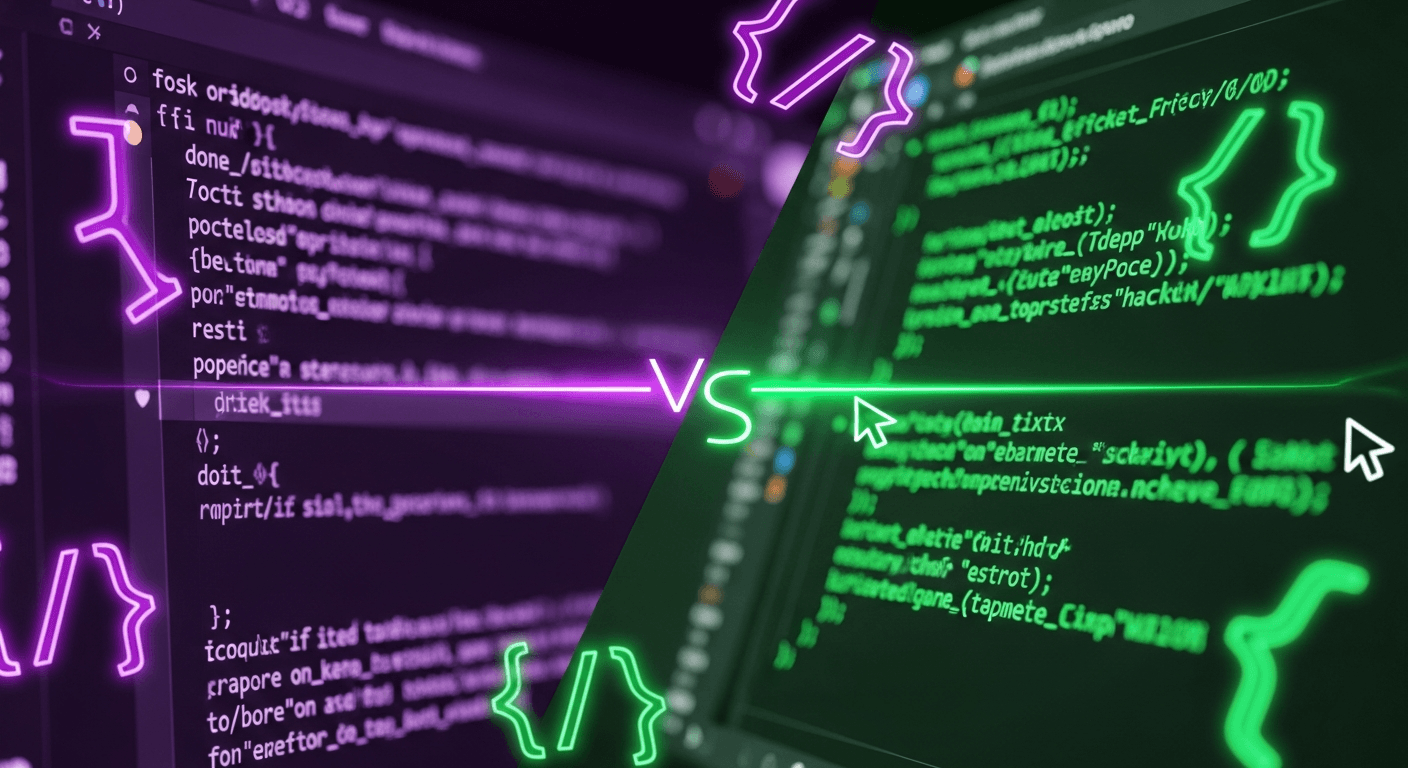
The AI IDE Wars: Open Source Challenges Big Tech Dominance
Open-source coding alternatives offer privacy-first developers a genuine alternative to proprietary AI tools, reshaping who controls the means of software production.

ai-infrastructure·February 23, 2026
Vision AI Leaves the Cloud: Intelligence Moves to Your Device
AI that understands images is moving from data centres to smartphones, drones, and field devices -- making visual intelligence available without internet or corporate surveillance.