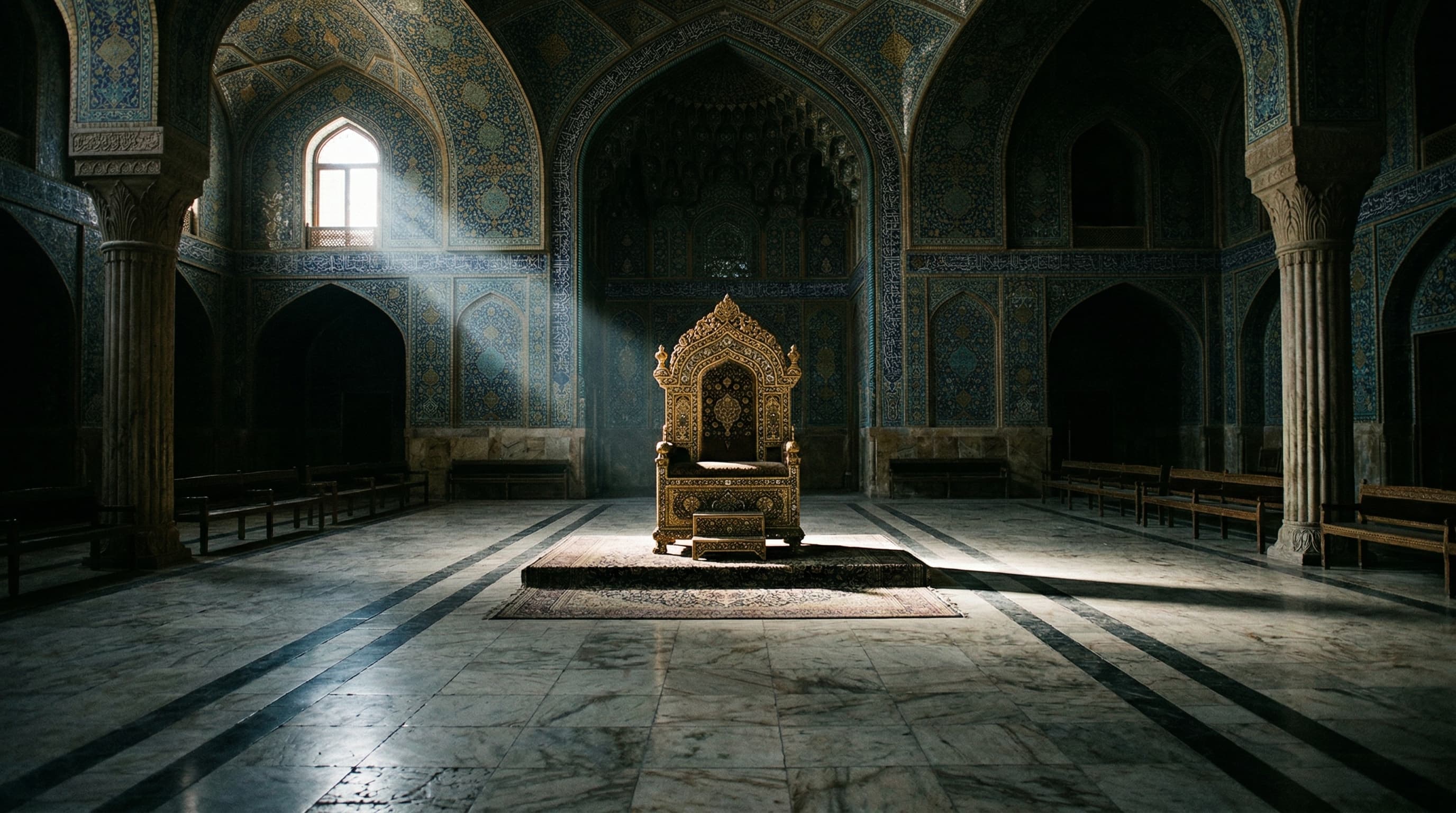
Iran's Succession Crisis: Dynasty Dressed as Theocracy
The assassination of Ayatollah Khamenei was supposed to break the regime. Instead, it handed the keys to his son -- and 88 million Iranians were never consulted.
Iran's Succession Crisis: Dynasty Dressed as Theocracy
The assassination of Ayatollah Khamenei was supposed to break the regime. Instead, it handed the keys to his son -- and 88 million Iranians were never consulted.
By TGF Editorial Desk | March 26, 2026 Category: Peace | Read Time: 9 min
On February 28, 2026, a joint US-Israeli airstrike dropped thirty bombs on the compound of Iran's Supreme Leader, Ayatollah Ali Khamenei. By March 1, the Islamic Republic confirmed what the world already suspected: Khamenei, who had held the position of Supreme Leader for thirty-six years, was dead.
A forty-day mourning period was declared by President Masoud Pezeshkian. Hezbollah retaliated with rockets into northern Israel. Israel struck back at Beirut's southern suburbs and the Bekaa Valley. Pakistan saw protests erupt in Shia-majority areas. The "axis of resistance" -- the loose coalition of Iranian-backed groups stretching from Tehran to Beirut -- lost its ideological anchor in a single night.
Nine days later, on March 9, the Assembly of Experts named Mojtaba Khamenei, the former Supreme Leader's second son, as the new Supreme Leader of Iran. The IRGC had secured its candidate. The principalists had secured continuity. The Basij had secured their patron.
And 88 million Iranians had secured nothing at all.
What the Succession Reveals
The office of Supreme Leader was designed, at least in theory, as a meritocratic clerical appointment. The Assembly of Experts -- 88 senior clerics elected by popular vote, though candidates are pre-screened by the Guardian Council -- is constitutionally tasked with selecting, supervising, and if necessary dismissing the Supreme Leader. The process is supposed to identify the most qualified religious jurist to serve as the guardian of the Islamic Republic's values.
What happened on March 9 bore little resemblance to that design.
In the chaotic aftermath of the assassination, with the country in mourning and the security apparatus on maximum alert, the IRGC moved with the kind of speed that suggested the outcome had been predetermined long before the bombs fell. Mojtaba Khamenei, who had spent years cultivating relationships within the Revolutionary Guard's senior ranks and the intelligence services, was presented to the Assembly as the continuity candidate. The Assembly, operating under extraordinary pressure and with IRGC hardliners controlling physical access to its proceedings, ratified the appointment.
The speed of the transition is itself revealing. When Ayatollah Khomeini died in 1989, the selection of his successor -- Ali Khamenei -- involved genuine deliberation and was, by several accounts, a contested process. Khamenei was not the obvious choice. He was elevated from a relatively modest clerical rank, a fact that generated theological controversy for years. The 1989 succession, for all its flaws, at least carried the appearance of institutional deliberation.
The 2026 succession carried the appearance of a coronation.
The Dynasty Question
Iran is not, technically, a monarchy. The 1979 Revolution was fought in part against the Pahlavi dynasty and the principle of hereditary rule. The Islamic Republic's founders embedded anti-dynastic safeguards into the constitutional structure -- the Assembly of Experts, the Guardian Council, the elected presidency -- precisely to prevent power from concentrating in a single family.
Yet the installation of Mojtaba Khamenei represents the first father-to-son transfer of supreme power in the Republic's history. And the circumstances under which it occurred -- crisis conditions, IRGC orchestration, compressed timeline, no public consultation -- undermine any claim that this was a deliberative selection rather than a hereditary transfer with institutional window dressing.
The comparison to monarchy is not rhetorical excess. In monarchies, legitimacy derives from lineage. In the velayat-e faqih system -- the guardianship of the Islamic jurist -- legitimacy is supposed to derive from religious scholarship, moral authority, and the consent (however indirect) of the people. When the office passes from father to son under the aegis of a military organisation, both theological and democratic legitimacy are in question.
Mojtaba Khamenei is not widely regarded as a senior religious scholar. His authority within the clerical hierarchy is modest compared to figures like Ayatollah Javadi Amoli or the late Ayatollah Montazeri, who was originally designated as Khomeini's successor before being sidelined. His power base is the IRGC and the intelligence services -- institutions of coercion, not persuasion. The theological establishment in Qom has been notably restrained in its endorsement.
What Iranians Have Been Saying
The succession did not occur in a vacuum. It occurred against the backdrop of the largest sustained protest movement in Iran since 1979.
Beginning in late 2025 and intensifying through early 2026, protests erupted in more than 200 cities across Iran. The movement, building on the momentum of the 2022 Mahsa Amini protests, drew participants from across ethnic, class, and generational lines. Students, workers, bazaar merchants, ethnic minorities in Kurdistan and Khuzestan -- the breadth of participation reflected a crisis of legitimacy that extended well beyond any single grievance.
The protests articulated demands ranging from women's rights and economic justice to fundamental questions about the nature of governance itself. Slogans calling for an end to theocratic rule were widespread. The security forces responded with lethal force, mass arrests, and internet shutdowns -- the standard toolkit of a state that has lost the argument and retained only the apparatus.
When Khamenei was killed, the reaction on the streets was not uniform. In Isfahan, Karaj, Kermanshah, Qazvin, Sanandaj, Shiraz, and Izeh, crowds gathered in what witnesses described as spontaneous celebration. In other areas, genuine mourning was observed. The split was itself a data point: a country in which the death of the head of state produces celebrations in half a dozen cities is a country in which the social contract has fractured beyond the reach of any succession process.
The question is not whether Iranians wanted Mojtaba Khamenei. The question is whether anyone asked them.
Regional Consequences
The assassination and its aftermath have reshaped the strategic landscape of the Middle East in ways that will take years to fully resolve.
The "axis of resistance" -- Iran's network of allied and proxy forces including Hezbollah, various Iraqi militias, and the Houthis in Yemen -- has lost all three of its structural pillars simultaneously. The ideological authority emanated from the Supreme Leader's office. The logistical coordination ran through IRGC channels that were severely disrupted by the strikes. And the geographic connection through Syria, already weakened by years of civil war and shifting alliances, has been effectively severed.
Hezbollah's immediate retaliation -- rockets into northern Israel, met by Israeli raids on Beirut and the Bekaa -- demonstrated that the network retains operational capability. But operational capability without strategic coordination is the definition of a decaying alliance. Each node will increasingly act on its own calculations rather than as part of a coherent whole.
For the Gulf states, the succession introduces a new variable. A Khamenei dynasty backed by the IRGC is a more militarised, less theologically constrained actor than its predecessor. The elder Khamenei, whatever his other characteristics, operated within a framework of clerical authority that imposed certain limits -- or at least the appearance of limits -- on Iranian behaviour. A Supreme Leader whose primary constituency is the Revolutionary Guard may prove less susceptible to those constraints.
For the broader region, the critical unknown is whether the new leadership will consolidate through escalation or accommodation. Historically, new authoritarian leaders facing legitimacy deficits tend toward external confrontation as a means of rallying domestic support. The risk of a more aggressive Iranian posture -- not despite the weakness of the new leader, but because of it -- should not be underestimated.
The Democracy Deficit
What happened in Iran in March 2026 is a concentrated version of a pattern visible across the world: decisions of enormous consequence made by a narrow elite, ratified by captured institutions, and imposed on populations whose preferences were neither solicited nor considered.
The Assembly of Experts is, in constitutional theory, an elected body. In practice, the Guardian Council pre-screens all candidates, ensuring that only those acceptable to the existing power structure can stand. The electorate chooses among pre-approved options. The Assembly then selects a Supreme Leader who serves for life and holds authority over the judiciary, the military, state media, and the foreign policy apparatus. The democratic content of this process is vanishingly thin.
But the critique extends beyond Iran. The United States and Israel launched the strike that created the succession crisis. In neither country was there a legislative vote authorising the specific operation. In neither country was there meaningful public deliberation about the consequences of decapitating the Iranian state -- consequences that include the very dynastic succession now unfolding. The populations that will live with the fallout of this decision were, on all sides, excluded from making it.
This is the recurring pattern of twenty-first century geopolitics: actions taken by small groups of decision-makers, consequences borne by millions, accountability distributed so thinly that it effectively vanishes.
What Comes Next
The forty-day mourning period provides a window of enforced restraint. What follows it is less predictable.
Inside Iran, the protest movement has not disappeared. It has been driven underground by the security crackdown, but the underlying conditions that produced it -- economic stagnation, social repression, demographic pressure from a young and educated population with limited horizons -- remain unchanged. A succession that consolidates IRGC power rather than addressing popular demands may succeed in the short term through coercion. It is unlikely to succeed in the medium term through legitimacy.
The international community faces a choice it has not yet articulated clearly: engage with the new leadership as a fait accompli, or condition engagement on measurable reforms in governance and human rights. The precedents are not encouraging. The global response to previous Iranian crackdowns -- expressions of concern, limited sanctions, eventual normalisation -- has consistently prioritised stability over accountability.
And the Iranian people -- the 88 million whose future was decided in a closed room by a military organisation on a timeline measured in days -- face the oldest question in political history: how long can a system survive when it derives its authority from force rather than consent?
The answer, historically, is longer than anyone would like and shorter than the system believes.
The TGF Lens
The Global Federation exists to build the infrastructure for a different kind of politics -- one in which the people affected by decisions have a voice in making them. Iran's succession crisis is a stark illustration of why that infrastructure matters.
No existing international institution offered the Iranian public a mechanism to participate in the selection of their own leader. No transnational body challenged the process or demanded transparency. The Assembly of Experts met, the IRGC prevailed, and the world moved on to the next headline.
TGF does not presume to dictate Iran's political future. That is the sovereign right of Iranians. But sovereignty that is exercised by a military clique on behalf of a dynastic family is not sovereignty at all. It is occupation by other means.
The question this moment poses is not unique to Iran. It is the question of our era: in a world where decisions are made by the few and consequences are borne by the many, where are the mechanisms through which ordinary people can reclaim their agency?
That question deserves an answer. And the people who deserve to give it are the ones no one is asking.
Sources: Al Jazeera (confirmation of Khamenei death and Mojtaba succession, March 2026); Foreign Affairs, "The New Khamenei" (analysis of IRGC role in succession); Washington Post (succession timeline and Assembly of Experts analysis); 2025-2026 Iranian protests documentation (200+ cities, cross-demographic participation).
This article is published under TGF's Peace pillar. The Global Federation advocates for democratic governance, peaceful conflict resolution, and the right of all peoples to self-determination.