No Kings: The Movement That Refuses to Be Silenced
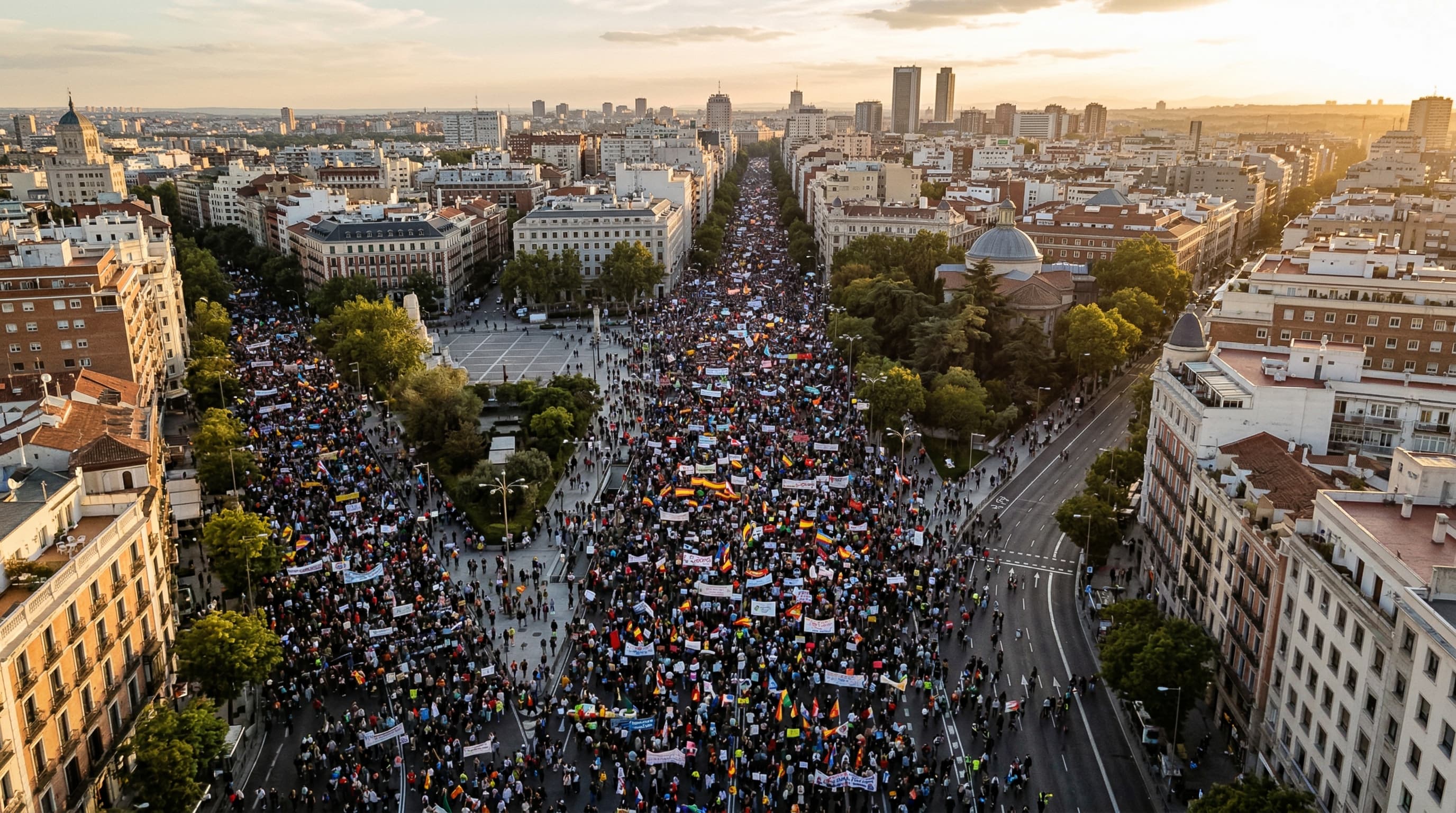
On March 28, more than three thousand events across all fifty US states -- and protests in at least seven French cities -- will mark the largest coordinated pro-democracy mobilisation in a generation. The No Kings movement is not asking permission. It is asking a question: what happens when citizens decide that democracy is not a spectator sport?
No Kings: The Movement That Refuses to Be Silenced
When three thousand protests happen simultaneously across every state in a nation, it is no longer a protest. It is an answer.
By TGF Editorial Desk | March 26, 2026 Pillar: Peace | Read Time: 9 min
Something is shifting in the United States, and the world would do well to pay attention.
On March 28, 2026, more than 3,100 events will take place across all fifty American states under the banner "No Kings." The organisers -- a broad coalition led by the 50501 Movement, Indivisible, and the AFL-CIO, with support from the ACLU, MoveOn, SEIU, the Human Rights Campaign, the National Education Association, United We Dream, and over fifty other organisations -- are projecting turnout in the vicinity of nine million people. If that figure materialises even partially, it will constitute the single largest pro-democracy demonstration in American history.
Time Magazine has already described the event as potentially the biggest anti-Trump protest the country has ever seen. But framing this solely as an anti-Trump phenomenon misses what is actually happening. The No Kings movement is not simply opposing a president. It is opposing a trajectory -- one that the data now confirms extends well beyond partisan politics into the structural foundations of democratic governance itself.
The erosion, by the numbers
The Varieties of Democracy Institute, widely regarded as the most rigorous quantitative tracker of democratic health worldwide, published its 2026 report with a finding that should have dominated headlines: the United States has plunged from 20th to 51st out of 179 countries in its democracy rankings. That is not a gentle slide. That is a freefall.
Freedom House, which has tracked political rights and civil liberties globally since 1972, titled its own 2026 annual report "The Growing Shadow of Autocracy." The United States -- once a benchmark democracy whose score other nations were measured against -- appears in the report not as a model but as a warning.
These are not the assessments of partisan organisations. V-Dem is based at the University of Gothenburg in Sweden. Freedom House was founded in 1941 by Eleanor Roosevelt and Wendell Willkie. Their methodologies are transparent, peer-reviewed, and applied uniformly across every country they assess. When both institutions flag the same nation in the same year with the same diagnosis, the finding is not a talking point. It is a dataset.
What triggered this
The No Kings movement did not emerge from theory. It emerged from bodies.
The deaths of Renee Good, Keith Porter, and Alex Pretti during Immigration and Customs Enforcement operations have become focal points for a coalition that was already organising around broader democratic concerns. Each name represents a specific failure of accountability. Each death occurred in circumstances that raised questions about the proportionality, legality, and oversight of federal enforcement operations. And each galvanised communities that might otherwise have remained on the margins of political engagement.
"With every ICE raid, every escalation abroad, and every abuse of power at home, Americans are rising up in opposition to Trump's attempt to rule through fear and force," said Ezra Levin, co-executive director of Indivisible, one of the core organising bodies behind the March 28 mobilisation.
The quote captures something important about the movement's architecture. This is not a single-issue protest. The coalition spans labour unions, civil liberties organisations, immigrant rights groups, teachers, healthcare workers, and LGBTQ advocacy networks. What unites them is not a shared policy platform but a shared diagnosis: that the mechanisms of democratic governance -- independent oversight, rule of law, institutional restraint, the separation of powers -- are under stress that has moved beyond normal political friction into something qualitatively different.
Three rallies, each larger than the last
March 28 will be the third No Kings rally. The movement has grown with each iteration -- not merely in attendance, but in geographic reach, organisational depth, and demographic breadth.
The first rally established the name and the premise. The second expanded the coalition and tested cross-state coordination. The third is operating at a scale that requires the logistics of a national campaign: 3,100 events, all fifty states, simultaneous actions in major cities and small towns, legal observer networks, media coordination centres, and contingency planning for counter-protests and potential confrontations with law enforcement.
This is not spontaneous rage. This is institutional capacity being built in real time, event by event, with each rally serving as both a demonstration and a rehearsal for whatever comes next.
Beyond American borders
The movement has crossed the Atlantic. Solidarity protests are confirmed in at least seven French cities: Paris, Lyon, Nice, Toulouse, Bordeaux, Rennes, and Strasbourg. The French mobilisation is organised independently but coordinates messaging with the US coalition -- a pattern that mirrors the way pro-democracy movements in Hong Kong, Belarus, and Myanmar drew international solidarity actions during their own crises.
The international dimension matters for two reasons. First, it signals that the decline of American democracy is not perceived abroad as merely an American problem. When the world's most powerful democracy weakens its own institutions, the effects radiate outward -- through alliances, trade relationships, multilateral organisations, and the normative framework that other democracies use to justify their own commitments to the rule of law. A less democratic America emboldens authoritarians everywhere, from Budapest to Brasilia to Beijing.
Second, it demonstrates that the impulse to defend democratic norms is not culturally specific. French citizens marching in solidarity with American demonstrators are not expressing affection for America. They are expressing a conviction that democracy is a shared project -- that its erosion anywhere diminishes it everywhere. This is precisely the premise that undergirds the entire post-1945 international order, and it is being articulated not by diplomats in conference rooms but by ordinary people on streets in Rennes and Toulouse.
The Federation perspective
The Global Federation exists to build the infrastructure through which citizens participate in the decisions that shape their lives -- especially when those decisions are made at scales that transcend any single nation, any single election, any single leader.
The No Kings movement, viewed from this vantage, is doing something more significant than protesting a government. It is stress-testing a principle: that sovereignty belongs to the people, not to the office; that democratic participation is not limited to casting a ballot every four years; and that when institutions fail to check power, citizens retain the right -- and the responsibility -- to do so themselves.
This is not a radical proposition. It is, in fact, the founding proposition of the American republic. It is also the founding proposition of the French republic, and of every democratic constitution written since. The word "republic" comes from res publica -- the public thing. The No Kings movement is, at its core, a reassertion that the state is public property, not private franchise.
What makes this moment distinctive is not the principle but the scale. Nine million people coordinating across 3,100 events is not a protest march. It is a civic infrastructure -- one that, if it persists and deepens, could reshape the relationship between citizens and power in ways that outlast any single administration.
What comes next
The honest assessment is that marches alone do not reverse democratic decline. History offers no shortage of massive demonstrations that produced momentary spectacle and long-term nothing. The 2003 Iraq War protests drew millions globally and changed no policy. Occupy Wall Street reshaped discourse but captured no institutions. The Women's March of 2017 was the largest single-day protest in American history and did not prevent a single executive order.
The No Kings movement appears to understand this. Its organisational infrastructure -- the 50501 Movement's focus on sustained grassroots engagement, Indivisible's chapter-based model borrowed from the Tea Party's playbook, the AFL-CIO's institutional staying power -- suggests a coalition that is thinking beyond the event and toward the work that follows it. Voter registration drives are embedded in the rally logistics. Legal defence networks are already operational. Communications infrastructure has been tested across two previous mobilisations.
The question is not whether March 28 will be large. It will be. The question is whether the energy of a single day can be converted into the durable, unglamorous, sustained civic engagement that actually bends democratic trajectories. Registering voters. Running for school boards. Showing up at city council meetings. Building the local institutions that make national movements credible.
Democracy is not a noun. It is a verb. It is not something a nation possesses. It is something a nation does, daily, through the accumulated actions of millions of citizens who choose participation over passivity. The No Kings movement is, at minimum, a massive and unmistakable declaration that a significant portion of the American public is choosing to do that work.
Whether the institutions listen is another matter. But the record will show that the citizens spoke -- in every state, in allied nations, in numbers that no serious observer can dismiss.
The rest is up to the republic.
Published by The Global Federation
Peace, Prosperity & Progress