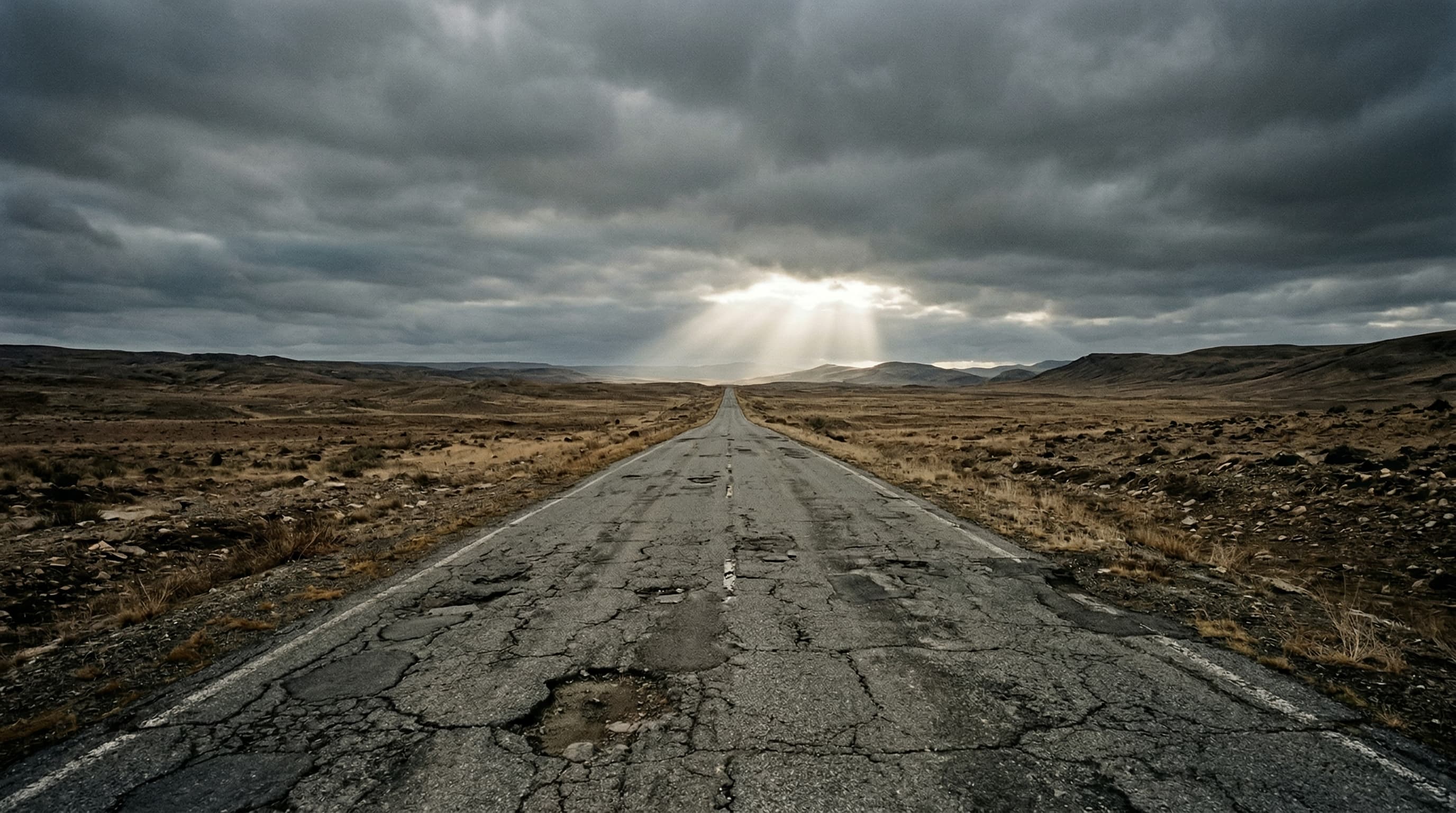
The 1978 Line: Global Democracy Has Lost Nearly Five Decades of Progress
Three independent institutions have reached the same conclusion: the average person on Earth now lives under democratic conditions equivalent to 1978. The regression took decades to build and years to accelerate. Understanding what that line means -- and what still lies on this side of it -- is the first step toward reversing it.
The 1978 Line
Global democracy has regressed to 1978 levels. Three independent reports confirm it. 3.3 billion people are living through it. This is what that number actually means.
TGF Editorial Desk | March 26, 2026
Part 1 of 3: The Democracy Crisis Trilogy
The number
In 1978, the world looked like this: China was two years past the Cultural Revolution. Argentina was under military junta. South Korea was ruled by Park Chung-hee's authoritarian regime. Spain had only just held its first free elections after Franco. Most of sub-Saharan Africa was governed by single-party states or military rulers. The Soviet Union controlled half of Europe. Iran was one year away from revolution. South Africa was deep in apartheid.
Democracy, in 1978, was the exception. It was the aspiration of billions and the reality of a relative few.
The decades that followed changed that. The fall of the Berlin Wall. The end of apartheid. Democratization across Latin America, Eastern Europe, parts of Asia and Africa. By the early 2000s, a majority of the world's population lived under some form of democratic governance. The trend seemed irreversible. It was not.
The V-Dem Institute at the University of Gothenburg -- the world's largest democracy dataset, covering 202 countries -- has published its latest assessment. Democracy for the average global citizen has fallen back to 1978 levels. Not to 2010. Not to 1995. To 1978.
That is not a dip. It is the erasure of a generation of democratic progress.
What three reports are telling us
The V-Dem finding does not stand alone. Three independent institutions, using different methodologies, have converged on the same conclusion.
V-Dem's Democracy Report identifies 44 countries currently undergoing autocratization -- up from 42 the previous year. Those 44 countries are home to 41 percent of the world's population: roughly 3.3 billion people. Nearly half of humanity lives in countries where democratic institutions are actively being dismantled, hollowed out, or overridden.
Freedom House, which has tracked political rights and civil liberties since 1973, titled its 2026 report "The Growing Shadow of Autocracy." The metaphor is precise: democracy has not disappeared, but something is steadily blocking the light. Freedom House documented the largest declines in the United States, Bulgaria, and Italy. The United States -- which for decades served as both a model and a guarantor of democratic norms -- is now among the countries pulling the global average down.
Bright Line Watch, which surveys more than 500 American political scientists and legal scholars, reported that the United States now falls "midway between liberal democracy and dictatorship." These are not activists. They are scholars whose careers are built on understanding democratic systems. When 500 of them reach this consensus, it is a clinical finding.
Three methodologies. Three institutions. One conclusion: the trend is real, it is accelerating, and it is not confined to the places Western commentators usually point to.
Where it is retreating fastest
The geography of democratic backsliding in 2026 defies old narratives. This is not a story about fragile states struggling to consolidate young democracies. The most significant erosion is happening in established democracies -- countries where institutions were assumed to be durable.
The United States offers the most dramatic case. V-Dem's data shows the US democracy ranking plunging from 20th to 51st out of 179 countries in a single year. The downgrade was driven by specific, measurable actions: concentration of executive power, systematic overstepping of legal boundaries, circumvention of legislative authority, and sustained attacks on media independence and free expression.
India, the world's largest democracy by population, presents its own contradictions. V-Dem has tracked steady democratic decline under Prime Minister Modi's government over the past decade -- restrictions on press freedom, sedition laws against critics, weakening of judicial independence. Yet India now chairs International IDEA's Council of Member States for 2026. A country experiencing documented democratic erosion is presiding over the international body tasked with strengthening democracy worldwide.
Turkey under Erdogan, Hungary under Orban, and Russia under Putin represent longer-running cases where autocratization has proceeded methodically. The playbook is consistent: capture the judiciary, constrain the press, rewrite electoral rules, marginalize civil society, consolidate executive authority -- all while maintaining the formal architecture of elections and parliaments. The structure remains. The substance is removed from within.
The speed problem
What makes the current moment different from previous democratic recessions is velocity.
V-Dem's researchers made a comparison that should concern every citizen of every democracy on Earth: what is happening in the United States in 2025-2026 took ten years to accomplish in India, ten years in Turkey, and four years in Hungary.
One year.
The implications are severe. Democratic institutions are designed to absorb shocks, to self-correct through elections, courts, and civic pressure. But that resilience is calibrated for a certain pace of assault. When the assault comes faster than the correction mechanisms can respond, the institutions do not collapse dramatically. They simply stop functioning as designed while continuing to exist on paper.
The rollback of democracy-promotion initiatives abroad, the purging of independent oversight bodies, the politicization of law enforcement, and the systematic undermining of the civil service represent what democratic theorists call "executive aggrandizement" -- the accumulation of power through technically legal means that subvert constitutional constraints.
The speed compresses the window in which citizens, courts, and legislatures can respond. In Hungary, civil society had four years to organize resistance. In India, a decade. In the United States, the window may be measured in months.
What citizens are still doing
Here is where the numbers tell only part of the story.
Democratic backsliding is measured by institutions. Democratic resilience is measured by people. And people are not passive in this equation.
The Global Democracy Coalition has announced Regional Forums across Africa, the Americas, Asia-Pacific, and Europe for 2026. These are not academic conferences. They are organizing spaces where civil society groups, election monitors, journalists, and reform advocates are building cross-border networks. The recognition that democratic erosion is a global phenomenon -- not a series of isolated national crises -- is itself a strategic advance.
The Global Forum on Modern Direct Democracy is heading to Gaborone, Botswana -- the first time in Southern Africa. Botswana has maintained democratic governance since independence in 1966, one of the longest continuous democracies in Africa. The signal: democracy is not a Western import to be defended in Washington and Brussels. Its future may be shaped as much in Gaborone and Nairobi and Taipei as in any Western capital.
In the United States, movements like No Kings have mobilized hundreds of thousands of citizens around a principle that, until recently, did not require a protest movement to defend: that no executive is above the law. The fact that it now does is a marker of regression. But the mobilization is also a marker of response. Courts are still functioning. Journalists are still reporting. Civil society is still operating, even under pressure.
The Democracy Without Borders initiative continues to advocate for a United Nations Parliamentary Assembly -- giving citizens direct representation in global governance rather than relying solely on state-appointed diplomats. It is a long-term project. But long-term projects are precisely what the current crisis demands. Quick fixes will not reverse structural erosion. Institutional innovation might.
Why this matters now
The 1978 line is not a curiosity. It is a measurement of something real that is happening to real people.
For the woman in Turkey who cannot criticize her government online without risking prosecution. For the journalist in India facing sedition charges for reporting facts. For the student in Hungary whose university was forced to relocate. For the American civil servant fired for refusing to violate the law. For the 3.3 billion people in 44 countries watching their rights contract in real time.
Democracy is not an abstraction. It is the set of rules that determine whether your voice counts, whether your government answers to you, whether the law protects you equally, and whether power has limits. When those rules erode, the consequences are personal and concrete.
The Global Federation exists precisely for this moment. Not because any single platform can reverse a global democratic recession. But because the first requirement for defending something is seeing it clearly. The data is clear. The trend is clear. The question is whether enough citizens, in enough countries, will organize quickly enough to bend it back.
This is the first article in a three-part series. The second will examine the playbook -- the specific, repeatable strategies authoritarian leaders use to dismantle democratic institutions while maintaining the appearance of legitimacy. The third will focus on what works: the movements and institutional innovations that have successfully defended or restored democratic governance in the 21st century.
The 1978 line is where we are. It is not where we have to stay.
Series: The Democracy Crisis Trilogy
- Part 1: The 1978 Line -- The data, the context, and what it means (you are here)
- Part 2: The Autocrat's Playbook -- How democracies are dismantled from within (forthcoming)
- Part 3: The Counter-Current -- What is working, and what must be built (forthcoming)
Sources: V-Dem Institute, University of Gothenburg, Democracy Report 2026; Freedom House, "The Growing Shadow of Autocracy" (2026); Bright Line Watch Expert Survey; NPR; International IDEA; Democracy Without Borders; Council on Foreign Relations.
The Global Federation is a platform for democratic engagement, built on the belief that governance belongs to the governed. Read the TGF Manifesto. Join the conversation.