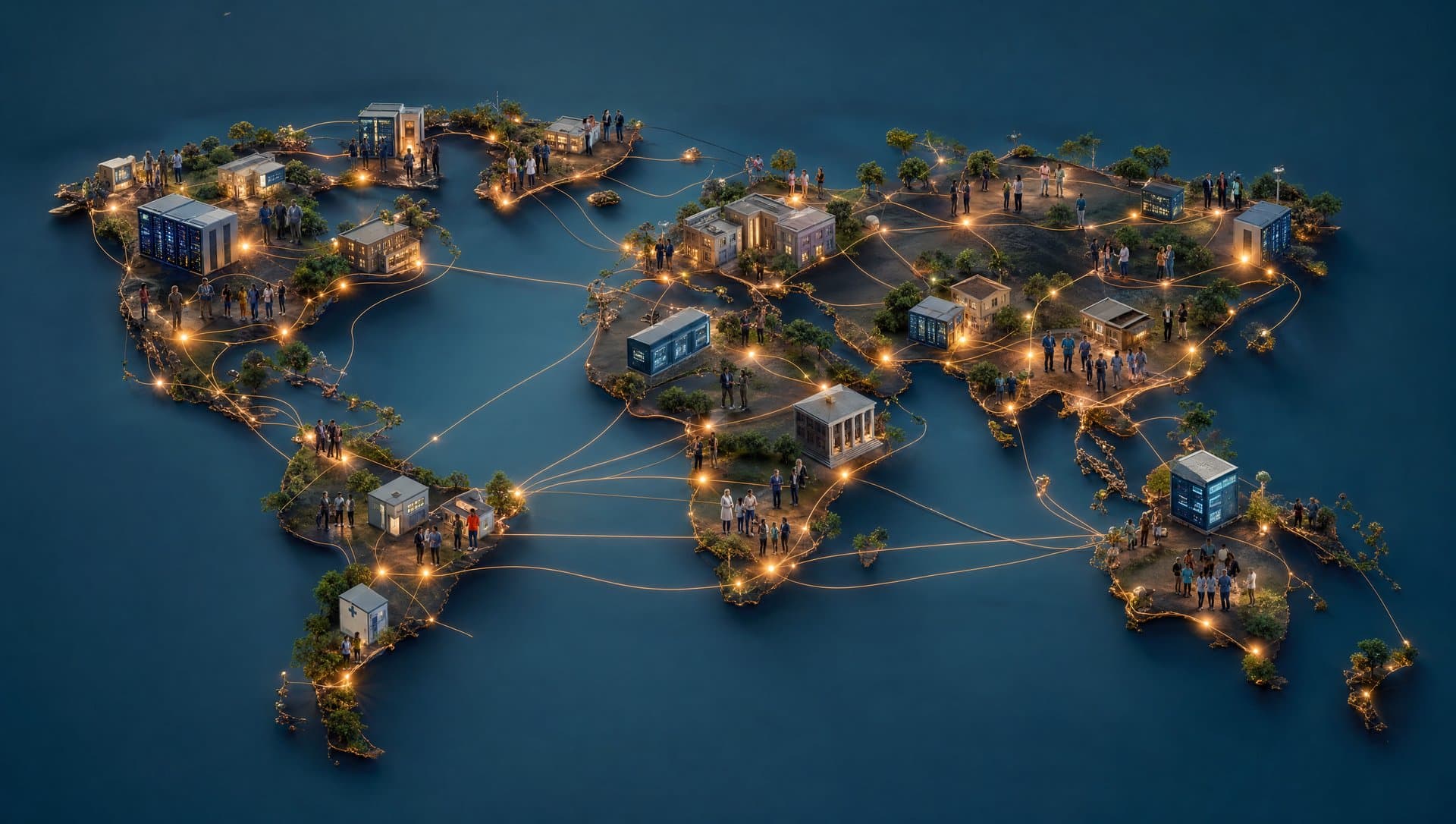
Compute Is Not Sovereignty. Resilience Is.
Every country now wants "sovereign AI." The phrase sounds strong, but it can easily become a fantasy. Real sovereignty is not owning every chip, model, data centre, dataset, and cloud platform. It is having enough agency, alternatives, and public control that no outside provider can quietly govern your society through dependency.
The new slogan in technology policy is "sovereign AI." It appears in speeches, strategy papers, investment announcements, procurement plans, and conference panels. It carries the emotional weight every political slogan wants: control, dignity, independence, national purpose.
It also hides a problem.
If sovereign AI means a country should have agency over the systems that shape its economy, public services, security, language, culture, and citizens' rights, the ambition is legitimate. No society should sleepwalk into a future where its schools, hospitals, courts, welfare systems, businesses, media, and public agencies depend entirely on tools it cannot inspect, contest, or leave.
But if sovereign AI means every country must build the full stack alone - chips, minerals, data centres, energy systems, networks, foundation models, cloud platforms, training data, talent pipelines, applications, standards, and regulators - then the phrase becomes theatre. Very few countries can do that. Many that try will spend scarce public money chasing an illusion while becoming more dependent in quieter ways.
The more honest position is this: compute is not sovereignty. Resilience is sovereignty.
Sovereignty is the ability to make meaningful choices under pressure. It is the ability to say no to a vendor, switch providers, audit a system, protect a citizen, keep public services running, support local languages, negotiate from strength, and prevent a digital dependency from becoming a political dependency.
That kind of sovereignty is harder than buying GPUs. It is also more useful.
The fantasy of full independence
Artificial intelligence is often presented as software, but the real system is physical, legal, financial, and geopolitical. It depends on minerals, energy, advanced chips, semiconductor equipment, cooling systems, data centres, high-speed networks, cloud platforms, research talent, model architectures, data pipelines, safety evaluation, and application distribution.
No country can separate itself from all of that.
Brookings' 2026 report on AI sovereignty states the problem clearly: full-stack AI sovereignty is structurally infeasible for almost any country because AI is a transnational stack with choke points across minerals, energy, compute hardware, networks, digital infrastructure, data assets, models, applications, talent, and governance. The report proposes a more practical alternative: managed interdependence.
That phrase deserves to leave the policy paper and enter public language.
Managed interdependence means a country does not pretend it can live outside the world. Instead, it maps its dependencies, decides which layers are truly strategic, diversifies suppliers and partners, builds domestic capacity where feasible, keeps systems portable, and uses standards and procurement rules to avoid lock-in.
This is not surrender. It is adulthood.
The opposite is not sovereignty but dependency dressed as pride. A government can announce a national model while renting foreign compute, relying on imported chips, hosting workloads on a foreign cloud, training on language data it did not steward, and buying safety evaluations it cannot independently reproduce. The flag on the launch stage may be local. The dependency underneath may not be.
Why countries are right to worry
The sovereignty impulse is not foolish. It comes from real vulnerabilities.
AI is becoming part of public infrastructure. It can influence education, health care, agriculture, taxation, welfare delivery, policing, immigration, labour markets, cybersecurity, and military planning. A country that cannot control, audit, or replace the systems used in those domains has a problem larger than technology.
There is also a cultural question. A model that barely understands a country's languages, humour, social relations, laws, agriculture, climate, textbooks, dialects, and informal economy will not serve that country well. It may process the population while failing to understand it.
Then there is bargaining power. If only a few firms and jurisdictions control the compute, models, and cloud infrastructure needed for advanced AI, everyone else negotiates from weakness. That weakness can show up in price, data access, service terms, safety obligations, censorship pressure, export controls, or sudden loss of access.
The World Economic Forum has warned that AI infrastructure is becoming a strategic concern rather than a purely technical one, shaped by geopolitics, financing, public-service digitisation, compute demand, and data storage. Its 2026 work on shared infrastructure argues that limited access to compute, power, and secure connectivity can narrow participation, especially for developing economies.
Those concerns are real. But the response must match the scale of the problem rather than the romance of the slogan.
The infrastructure divide is already visible
Stanford's 2026 AI Index reports that national AI strategies are expanding quickly, especially among emerging economies that did not have formal AI policies five years ago. That sounds encouraging. More countries are waking up to the question.
But the same report shows why strategies are not enough. AI sovereignty is rising as a policy principle, while the infrastructure underneath it is unevenly distributed. Europe and Central Asia expanded state-backed AI supercomputing clusters from 3 to 44 between 2018 and 2025. South Asia, Latin America, and the Middle East and North Africa have only reached between 2, 3, and 8 clusters each.
That gap matters because AI capability is not created by aspiration alone. It requires compute, energy, talent, data, institutions, and procurement competence. A government can publish a beautiful strategy and still be unable to test the model it buys for public services. A university can produce brilliant researchers and still lose them if there is no infrastructure to work on. A local startup can build useful tools and still be crushed by cloud costs or foreign platform terms.
This is how the next dependency forms. Not with an invasion. Not with a treaty. With invoices, terms of service, unavailable chips, proprietary interfaces, non-portable workloads, closed models, and public agencies that cannot leave once they have entered.
The citizen rarely sees this layer. But the citizen feels the consequence.
If a welfare system depends on an imported AI tool, who audits the error rate? If a hospital deploys a model trained elsewhere, who checks whether it works on local patient data? If a language is poorly represented, who pays to build the corpus? If a school system adopts an AI tutor, who decides whether it reflects local curriculum and civic values? If a foreign provider changes price or access, can the public service continue?
Those are sovereignty questions. The number of GPUs is only one part of the answer.
AI companies need society too
The mythology of AI sometimes treats companies as if they were sovereign civilisations floating above ordinary politics. They are not.
AI companies need energy grids, water, land, data centres, roads, cables, universities, chip supply chains, public research, consumers, workers, courts, contracts, regulators, and trust. They need people with jobs who can buy services. They need governments that allow deployment. They need societies that do not turn against them.
This matters because the sovereignty debate is not only between states. It is also between societies and firms.
AI adoption will succeed when people believe it improves life without stripping them of agency. It will fail when people experience it as a machine for job loss, surveillance, price extraction, automated denial, cultural flattening, and institutional evasion.
If AI creates mass unemployment, social depression, or a collapse in consumer confidence, society will push back. In democratic systems, that pushback will be visible: elections, unions, lawsuits, regulations, municipal restrictions, consumer boycotts, procurement bans, and public anger. In non-democratic systems, the pushback may be suppressed for longer, but damage to the common good still weakens legitimacy and stability.
That is why companies should welcome resilient sovereignty rather than fear it. A public sector with audit rights, clear rules, stable procurement, local capacity, and exit options is not an enemy of innovation. It is a better customer. A society that trusts AI enough to use it is a better market than one that adopts it under pressure and then revolts after harm accumulates.
What resilience looks like
Resilience begins with dependency mapping. Governments should know which parts of their AI stack they control, which parts they rent, which parts they cannot replace, and which parts are critical to public services. The map should include compute, cloud, chips, data, software, models, cybersecurity, talent, energy, and legal jurisdiction.
Second, resilience requires portability. Public workloads should not be trapped inside a single vendor's ecosystem without workable exit paths. Procurement contracts should demand data portability, model documentation where relevant, audit access, incident reporting, and transition plans.
Third, resilience requires local language capacity. AI that does not work in a country's actual languages is not sovereign. Language capacity is not just scraping text. It requires community stewardship, paid data creation, local universities, public archives, linguistic expertise, and respect for cultural context.
Fourth, resilience requires public-interest infrastructure. Not every country needs a frontier foundation model. Many need reliable AI tools for agriculture, education, health, climate adaptation, courts, disaster response, translation, and small business productivity. A smaller model that solves a real public problem may be more sovereign than a symbolic national model no one uses.
Fifth, resilience requires trusted partnerships. Regional compute pools, shared safety labs, digital public infrastructure, open-source collaboration, and trusted cross-border hosting may give countries more agency than isolated national projects. The World Economic Forum's discussion of shared infrastructure and "digital embassies" points in this direction: infrastructure can be hosted or shared under legal, technical, and operational safeguards, but only if trust is continuously proven.
Sixth, resilience requires regulators who can understand the systems they regulate. Law without technical capacity becomes paperwork. Technical capacity without law becomes consultancy. Public authority needs both.
Finally, resilience requires democratic review. If AI infrastructure is built with public money, public resources, or public-service dependency, citizens deserve to know what is being bought, who benefits, what risks are accepted, and how mistakes are corrected.
The danger of authoritarian sovereignty
There is a darker version of sovereign AI. It uses the language of national control to expand state control over the individual.
A government can claim it needs domestic AI for independence, then use it for surveillance, predictive policing, censorship, social scoring, political targeting, or automated discrimination. A local model can still violate rights. Domestic infrastructure can still be oppressive. Sovereignty for the state is not the same as sovereignty for the citizen.
This is where the common AI doctrine matters. AI is not perfect. It is built on human data and human institutions. If those institutions are abusive, AI can scale abuse. If those institutions are careless, AI can scale carelessness. If those institutions are democratic and accountable, AI can help them serve people better.
The public question is therefore not "foreign or domestic?" It is "accountable or unaccountable?"
An accountable foreign partnership may serve citizens better than an unaccountable domestic system. A domestic model with transparency, appeal rights, and local-language strength may serve citizens better than a black-box import. The point is not purity. The point is agency.
A citizen's test for AI sovereignty
The language of sovereignty often belongs to ministers, executives, and security officials. It should also belong to citizens.
A citizen can ask simple questions.
Can my government explain which AI systems are used in public decisions?
Can affected people appeal?
Can independent experts audit the system?
Does the system work in our languages and conditions?
Can the public agency switch vendors without losing the service?
Are the data rights clear?
Are jobs and training part of the adoption plan?
Are local firms and universities being strengthened, or only foreign suppliers?
Is the infrastructure resilient if geopolitics changes?
Does the system protect the citizen from both corporate and state abuse?
If the answer is no, the system is not sovereign in any meaningful civic sense, no matter where the server sits.
The right kind of pride
Nations are right to want dignity in the AI age. Communities are right to want their languages, knowledge, and institutions represented. Governments are right to fear dependency on a handful of foreign firms and geopolitical choke points. Workers are right to ask whether AI productivity will become shared prosperity or concentrated wealth.
But dignity is not achieved by pretending interdependence does not exist. It is achieved by managing it well.
The world does not need hundreds of symbolic AI fortresses. It needs resilient public systems, shared standards, transparent markets, local capacity, language commons, fair contracts, open alternatives, and citizens with rights when machines enter consequential decisions.
AI is a great human stride, but it is still human. That means it carries our brilliance and our flaws. It can widen possibility, but only if societies keep enough power to shape it. It can create prosperity, but only if consumers, workers, students, patients, and small firms are not reduced to passive data points in someone else's stack.
Compute matters. Chips matter. Data centres matter. Models matter.
But sovereignty is not a warehouse full of servers. Sovereignty is the ability of a society to choose, correct, negotiate, leave, rebuild, and protect its people.
That is resilience. And resilience is the form of sovereignty worth building.
The Global Federation covers artificial intelligence as a civic question: not whether the technology advances, but whether the institutions around it keep enough power with the people it touches.