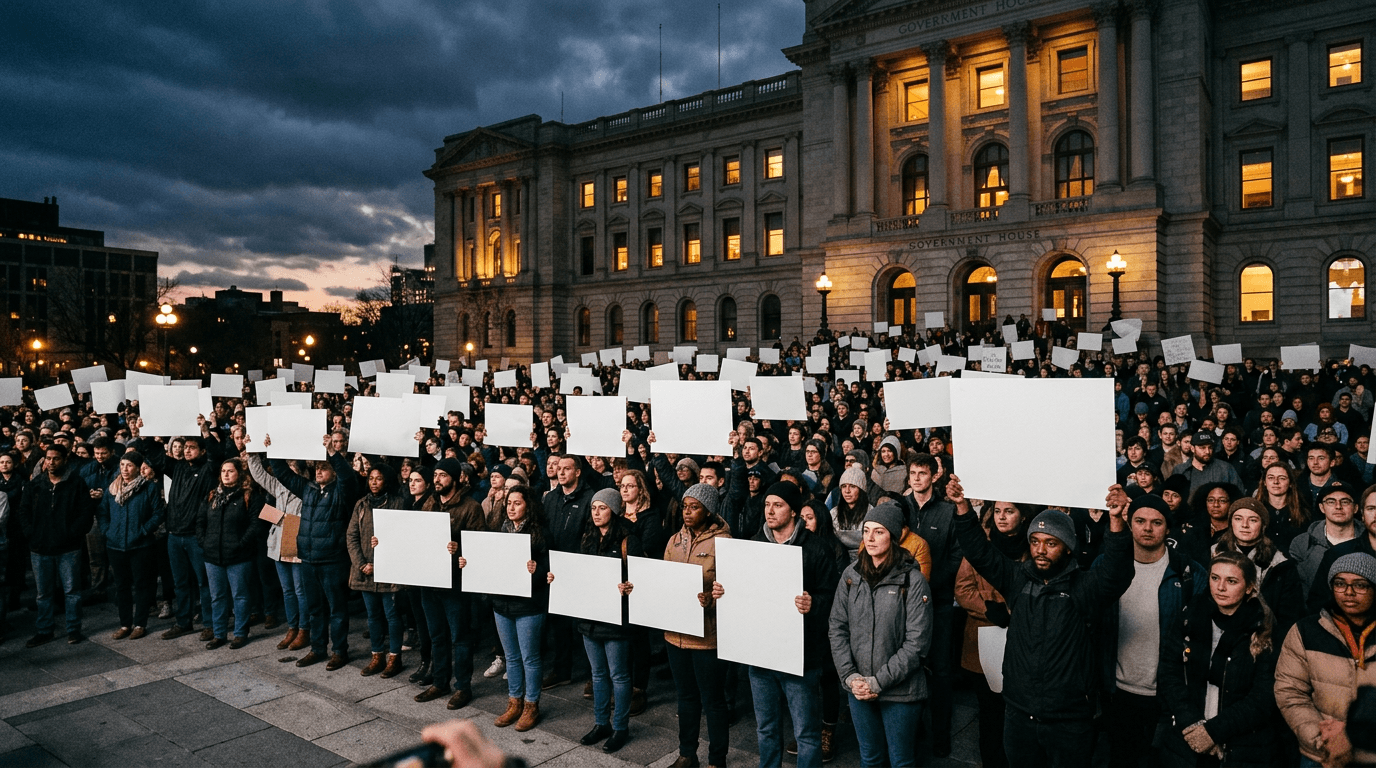
60% Oppose, Yet the War Proceeds: The Democratic Deficit in Modern Warfare
From Vietnam to Iraq to Iran, the pattern holds: citizens oppose, governments proceed. What mechanisms can bridge the gap between democratic will and war-making power?
60% Oppose, Yet the War Proceeds: The Democratic Deficit in Modern Warfare
When majorities say no and governments say yes, the gap between citizen will and state action becomes the central crisis of democratic governance.
By The Global Federation Editorial | March 3, 2026 Category: Politics | Read Time: 8 min
On Sunday morning local time, an Iranian strike hit a makeshift operations center at the Shuaiba port in Kuwait. Six American service members were killed. Eighteen more were seriously wounded. By Monday, the Iranian Red Crescent reported over 787 dead across Iran since Operation Epic Fury began on Saturday, February 28. Over a thousand strikes had been recorded against more than 500 sites. Israel struck Iran's Presidential Office and the Supreme National Security Council headquarters.
And across the United States, a CNN/SSRS poll released March 2 found that 59% of Americans disapprove of the decision to strike Iran. Strong disapproval runs roughly double that of strong approval -- 31% versus 16%. A majority, 56%, believe a long-term military conflict is now likely. Fifty-four percent say Iran will become a greater threat as a result of the strikes, not a diminished one.
The war proceeds anyway.
The Consent Gap
The distance between public opinion and military action is not new, but it has rarely been so precisely measurable in real time. Three separate polls -- CNN, ABC News, and others -- all converge on the same finding: most Americans did not want this war. The disapproval is not confined to partisan opponents. While 77% of Republicans approve of the strikes, only 32% of independents and 18% of Democrats agree. In a country where independents often decide elections, a two-thirds disapproval rate among that group is not a marginal concern. It is a structural indictment.
The War Powers Resolution of 1973 was designed to prevent precisely this scenario. Passed in the aftermath of Vietnam and the broader collapse of public trust in executive war-making, the resolution requires the president to notify Congress within 48 hours of committing forces to hostilities and prohibits armed forces from remaining engaged beyond 60 days without congressional authorization. Members of Congress have already demanded a swift vote on a war powers resolution following the Iran strikes, which were launched without prior congressional approval.
But the mechanism is largely toothless. Presidents of both parties have accumulated broad authority to initiate military action without legislative consent. Even if a war powers resolution were to pass the narrowly divided Congress, a presidential veto would almost certainly follow, and the two-thirds majority needed to override it does not exist. The constitutional check on war-making has, in practice, become a constitutional courtesy -- observed in the breach.
A Pattern, Not an Exception
The Iran situation fits a pattern that stretches back decades. In August 1968, Gallup found for the first time that a majority of Americans -- 53% -- believed it had been a mistake to send troops to Vietnam. By early 1968, only 32% approved of President Johnson's handling of the war. The conflict continued for seven more years.
In January 2003, a CBS News/New York Times poll found that 63% of Americans wanted President Bush to pursue a diplomatic solution to Iraq, against 31% who favored immediate military action. Gallup International polling across 41 countries found that support for a war conducted without UN authorization did not rise above 11% in any country surveyed. On February 15, 2003, an estimated 36 million people in nearly 3,000 protests across more than 600 cities took to the streets in what social movement researchers have called the largest coordinated protest event in human history. Rome alone saw three million marchers.
The invasion of Iraq proceeded on March 20, 2003. The war lasted eight years, claimed hundreds of thousands of lives, and destabilized an entire region for a generation.
The pattern is consistent: public opposition crystallizes, is documented, is expressed in the streets and in the polls, and is then functionally ignored by the executive apparatus. The question is no longer whether this happens. The question is whether any existing democratic mechanism can prevent it.
Why Domestic Mechanisms Fail
The reasons are structural, not incidental. Modern war-making has migrated away from the deliberative processes that democratic theory assumes. Three dynamics drive this migration.
First, the speed of military operations outpaces legislative deliberation. Operation Epic Fury began with strikes on a Saturday. Congressional hearings, floor debates, and votes operate on timelines measured in weeks. By the time a war powers resolution reaches a vote, the military campaign has established facts on the ground that make reversal politically and operationally difficult.
Second, the classification of intelligence creates information asymmetry. The executive branch controls the intelligence that justifies military action. Legislators receive briefings but cannot independently verify claims or share classified assessments with the public. The Iraq War's weapons-of-mass-destruction debacle demonstrated how this asymmetry can be exploited, but the structural incentives remain unchanged.
Third, the political cost of opposing a war in progress is higher than the cost of opposing a war before it starts. Once American service members are in harm's way, the political calculus shifts. Opposing the war risks being framed as opposing the troops. This dynamic -- well understood by executive strategists -- creates a ratchet effect: each escalation makes the next one harder to contest.
House Speaker Johnson has publicly argued that limiting the president's war-making authority through the War Powers Act is itself "dangerous" and "frightening." This framing -- that democratic accountability in military affairs is a threat rather than a safeguard -- captures the inversion that has taken hold. The emergency becomes permanent, the exception becomes the rule, and the constitutional requirement for legislative consent becomes an obstacle to be managed rather than a principle to be honored.
The Transnational Dimension
The democratic deficit in war-making does not stop at national borders. When the United States strikes Iran, the consequences cascade across the Persian Gulf, the global energy market, and the security calculations of every neighboring state. The people of Kuwait, where American service members were killed in an Iranian counterattack, did not vote on this war. Neither did the civilians in Iran's cities and towns.
Yet no transnational mechanism exists through which affected populations can register opposition, demand accountability, or influence the course of a conflict that reshapes their lives. The United Nations Security Council, the closest approximation to a global deliberative body on matters of war and peace, remains subject to the veto power of its five permanent members -- the very states most likely to initiate large-scale military operations.
The European Citizens' Initiative, often cited as the world's first transnational participatory democracy instrument, allows EU citizens to propose legislation by collecting one million signatures across seven member states. But it is limited to the European Union's jurisdiction and has no mechanism for addressing military conflicts initiated by non-EU powers. Citizens' assemblies -- where participants drawn by lot deliberate on policy questions -- have shown promise in national contexts, from Ireland's constitutional reforms to France's climate convention. None has been convened on questions of war and peace at the international level.
The Stanford Encyclopedia of Philosophy's entry on global democracy frames the core problem directly: as decisions are taken beyond the state, national leaders are often unable to control the forces that affect domestic institutions and citizens. Individuals within each state have neither a direct nor indirect say in how global rules are forged.
The Federation Perspective
The Global Federation was built for this moment -- not as a solution to war itself, but as an infrastructure for the democratic voice that existing institutions suppress.
TGF's proposal and referendum system allows global citizens to draft, debate, and vote on binding resolutions that express collective will on matters of transnational consequence. A citizen in Tehran, a student in New York, a dockworker in Kuwait City -- each has an equal vote on proposals that address the conflicts affecting their lives. This is not symbolic. The Federation's constitutional drafting process is designed to produce a framework of principles that member-citizens ratify directly, not through intermediaries whose incentives diverge from those of their constituents.
The 59% of Americans who oppose the Iran strikes have no institutional channel through which to translate that opposition into constraint on executive action. The millions of Iranians enduring the bombardment have even fewer options. TGF exists to build that channel -- not to replace national governments, but to create a parallel layer of democratic legitimacy that can hold power accountable when domestic mechanisms fail. The February 15, 2003 protests showed that transnational public opinion exists and can be mobilized. What was missing then, and what remains missing now, is an institution that can convert that mobilization into binding democratic expression.
The Federation's model draws on tested democratic innovations: citizens' assemblies for deliberation, digital referenda for decision-making, and a constitutional framework that enshrines the principle that no government may wage war over the sustained, documented opposition of its own citizens without forfeiting a measure of its democratic legitimacy. This is not utopian. It is the logical extension of principles that democracies already claim to uphold.
What Can Citizens Do?
The immediate options are limited but not nonexistent. In the United States, citizens can contact their representatives to demand a vote on the war powers resolution. They can support organizations tracking civilian casualties and demanding transparency in military operations. They can refuse to accept the framing that opposing a war means opposing the people ordered to fight it.
Beyond national borders, the work is longer-term but no less urgent. Join the Federation. Draft proposals. Vote on the resolutions that other citizens bring forward. Participate in the constitutional conventions that will define the rules of a democratic order that extends beyond the nation-state. The gap between citizen will and state action will not close on its own. It will close when citizens build the institutions that make governments answer for the wars they wage in our names.
The 59% are not powerless. They are unorganized. That is a problem with a solution.