Direct Democracy Goes to Africa: The Global Forum Heads to Botswana in a Historic First
The 13th Global Forum on Modern Direct Democracy convenes in Botswana this October, where the kgotla tradition of citizen assemblies predates European parliaments by centuries.
Direct Democracy Goes to Africa: The Global Forum Heads to Botswana in a Historic First
The thirteenth edition of the world's largest direct democracy gathering will convene at the University of Botswana this October, bringing constitutional reform, climate governance, and youth inclusion to a continent where citizen assemblies predate European parliaments by centuries.
By The Global Federation Editorial | March 3, 2026 Category: Politics | Read Time: 8 min
When the organizers of the Global Forum on Modern Direct Democracy announced that the thirteenth edition of the conference would be held in Gaborone, Botswana, from October 7 to 10 this year, they did more than pick a venue. They made a statement. After nearly two decades of convening in Aarau, Seoul, San Francisco, Montevideo, Tunis, San Sebastian, Rome, Taipei, and most recently Bucharest, the forum is heading to Southern Africa for the first time -- and to a country whose tradition of participatory governance predates the modern nation-state by centuries.
The choice is not accidental. Botswana is Africa's longest-running continuous multiparty democracy, having held uninterrupted free elections since independence in 1966. Freedom House has categorized it as "Free" since 1973. But the deeper draw is not electoral regularity. It is the kgotla.
The Kgotla: Where Direct Democracy Already Lives
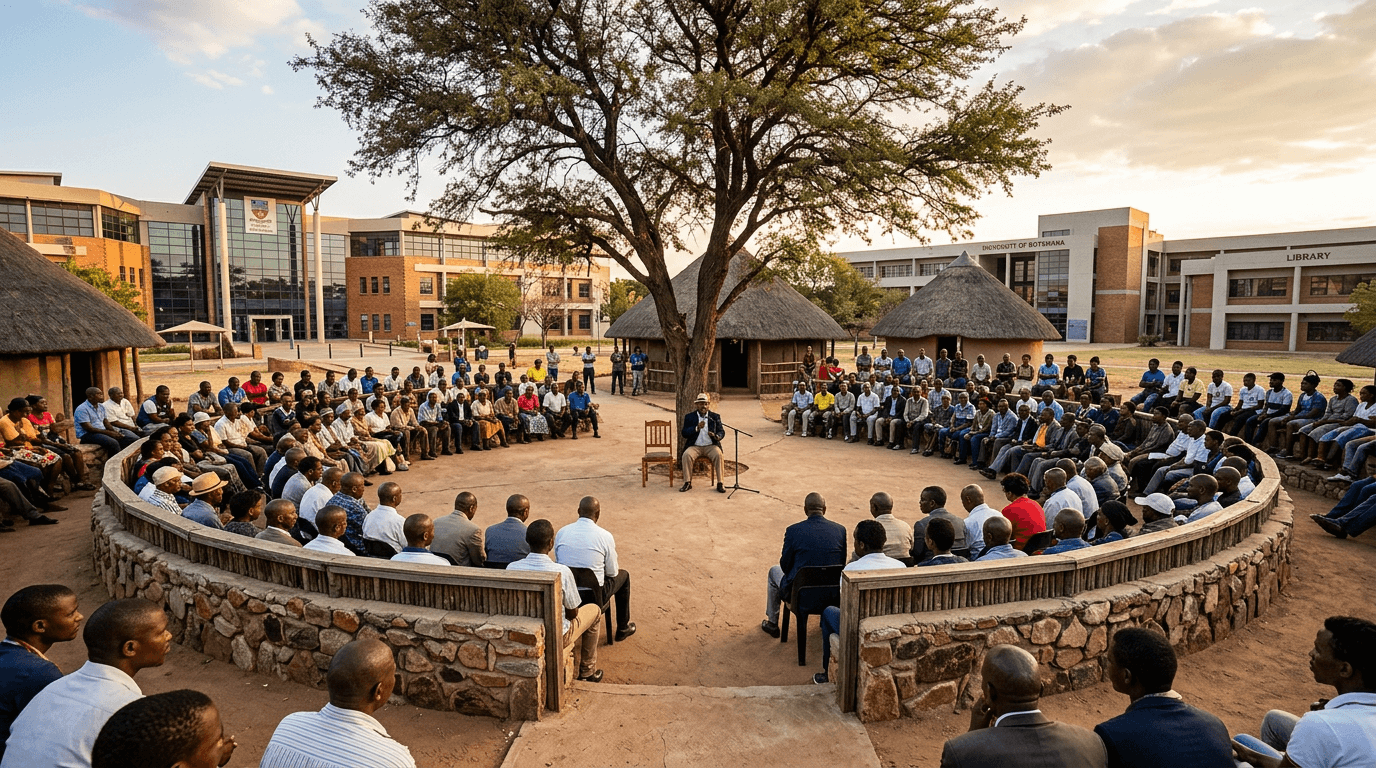
In every Tswana village, town, and city district, the kgotla -- a public assembly space -- has served for generations as the arena where citizens meet to debate policy, hold leaders accountable, and reach consensus on governance questions. The institution predates colonialism. Some scholars trace its roots back millennia. In these assemblies, every individual has the right to speak. Chiefs propose; the community deliberates; consensus is the objective.
It is a tradition that Western advocates of deliberative democracy might recognize as strikingly modern. Citizens who participate in monthly dikgotla -- the plural form -- develop political literacy, engage directly in the policymaking process, and carry that civic confidence into national elections. In Botswana, direct participation at the local level has effectively supplemented representative democracy at the national level, producing one of the most stable and least corrupt governance records on the continent.
That this year's Global Forum will examine how indigenous institutions like the kgotla can inform modern participatory governance is not a side panel. It is the intellectual centerpiece of the gathering. The organizers are betting that the next chapter of direct democracy scholarship will be written not in Zurich or San Francisco, but in settings where communal deliberation never needed a theoretical framework because it was already practice.
The Forum's Agenda: A Blueprint for Contested Times
The 2026 programme, which opens with an optional pre-conference session on October 6-7, is organized around five thematic pillars: constitutional reform, youth inclusion, democratic resilience, natural resource governance, and climate-linked democracy. Each one carries weight that extends well beyond academic interest.
Constitutional reform is live territory across the African continent, where several nations are renegotiating the foundational terms of their governance. Youth inclusion is not a soft-focus aspiration but a demographic imperative: Africa has the youngest population of any continent, and the Global Youth Participation Index, launched in June 2025 across more than 130 countries, found that the global average youth participation score sits at just 60 out of 100, with political participation scoring even lower at 50. South Africa leads the African continent in youth civic engagement, but the gap between formal political access and meaningful influence remains wide nearly everywhere.
Natural resource governance is perhaps the most consequential pillar for the host region. The "resource curse" -- the paradox by which mineral and hydrocarbon wealth correlates with weaker governance, reduced accountability, and in some cases outright authoritarianism -- has shaped the political economy of much of the continent. Research consistently shows that democratization and citizen participation mediate the adverse effects of resource wealth on economic growth. Botswana itself is often cited as the exception: a diamond-rich nation that channeled extractive revenues into public investment rather than patronage networks, in part because of the accountability structures embedded in its political culture.
The climate-linked democracy pillar reflects a growing recognition that environmental policy cannot be decoupled from democratic process. Who decides how a country manages its forests, coastlines, and carbon budgets is a governance question as much as an ecological one. Tanzania, Uganda, and Mozambique have already experimented with citizen assemblies for consultation on energy transition and disaster risk reduction. The forum will examine whether these experiments can be scaled and institutionalized.
Africa's Democratic Moment -- and Its Contradictions
The timing of the forum's African debut is both opportune and delicate. The continent's democratic trajectory is not a simple arc. Afrobarometer's 2025 survey of over 53,000 respondents across 39 countries found that nearly three-quarters of Africans voted in their last national election, and almost half attended a community meeting at least once. These are not the numbers of a disengaged populace.
Yet democratic backsliding is real. Military coups returned to the Sahel. Civil liberties contracted in several East African states. The 2024 Botswana election itself -- in which the Botswana Democratic Party lost its parliamentary majority for the first time in 57 years to the Umbrella for Democratic Change -- was both a triumph of electoral competition and a reminder that long-dominant parties can calcify into complacency.
The forum arrives in a Botswana that is navigating the politics of transition, not as a failing state but as a maturing democracy confronting the pressures that come with generational change, economic diversification away from diamonds, and a young population demanding more than procedural representation.
Digital democracy initiatives are adding a new dimension. The Sub-Saharan Africa Digital Democracy Hackathon, organized by Magamba Network in partnership with CIVICUS, has brought together civil society innovators, developers, and activists to build technology-driven solutions for democratic participation. The African Studies Association's 2026 programme includes dedicated panels on digital citizenship and platform-mediated political engagement. These are not peripheral developments. They represent the infrastructure through which the next generation of democratic participation may be built.
The Wider Democratic Landscape
The Gaborone forum does not exist in isolation. India has assumed the chairship of International IDEA's Council of Member States for 2026, bringing the perspectives of the world's most populous democracy to an organization of 35 member states focused on strengthening democratic institutions globally. The World Federalist Movement has been deliberating on climate protection, nuclear disarmament, strengthening international law, regulating artificial intelligence, and advancing global democracy -- an agenda that overlaps substantially with the Gaborone programme. Chinese Foreign Minister Wang Yi has called for improved global governance through institutional reform, a signal that even non-democratic powers recognize the inadequacy of current governance architecture.
These parallel developments underscore a reality that the direct democracy movement has sometimes been slow to acknowledge: the conversation about citizen participation is no longer a Western preoccupation. It is a global negotiation, shaped by competing models, uneven power dynamics, and the urgent practical question of how societies govern shared resources -- water, carbon budgets, mineral wealth, digital infrastructure -- in a period of compounding crises.
The Global Forum's decision to hold its thirteenth edition in Botswana is a recognition that the most promising experiments in participatory governance may not emerge from the established democracies of Europe and North America, but from societies that have practiced communal deliberation for centuries and are now integrating those traditions with the demands of modern statehood.
The Federation Perspective
For The Global Federation, the Gaborone forum reads less like a conference programme and more like a constitutional outline. The five thematic pillars -- constitutional reform, youth inclusion, democratic resilience, resource governance, climate democracy -- map directly onto the questions that TGF's own constitution-drafting process is grappling with. How do citizens exercise meaningful authority over the extraction and allocation of natural resources? What institutional forms give young people not just a voice but a vote? How do democratic systems maintain resilience when the pressures of climate change, economic inequality, and digital disruption converge?
The kgotla model is particularly instructive. TGF's architecture is built on the premise that deliberation must be substantive, not decorative -- that citizen assemblies should produce binding policy inputs, not advisory opinions that elected officials are free to ignore. Botswana's centuries-long experiment with communal deliberation demonstrates that this is not a utopian aspiration. It is a governance technology that has been tested, refined, and sustained across generations, in a resource-rich environment where the temptation toward extractive politics was real and largely resisted.
TGF should be present at the Gaborone forum, not merely as observers but as participants. The Federation's global membership, its commitment to cross-border democratic architecture, and its work on climate-linked governance place it squarely within the forum's intellectual community. More importantly, the relationships built at gatherings like this -- between African civil society organizations, digital democracy practitioners, constitutional scholars, and citizen-led movements -- are the connective tissue from which global democratic institutions are actually built. Conferences do not change the world. But the networks they catalyze sometimes do.
What Can Citizens Do?
The 2026 Global Forum on Modern Direct Democracy is open to activists, civil society organizations, researchers, and citizens. Registration details and the full programme will be published through the International Democracy Community and Democracy International. A save-the-date form is already available.
For TGF members, this is an invitation to engage directly. Attend, if you can. Follow the proceedings, if you cannot. Bring the insights from Gaborone into your local TGF chapter discussions. The questions that will be debated at the University of Botswana in October -- about who governs, how resources are shared, whether young people have genuine power, and what democracy owes to the planet -- are not abstract. They are the questions on which the Federation's own legitimacy depends. The answers will not come from any single forum. But they are more likely to be good answers if the people asking them represent not just the usual capitals, but the full breadth of democratic experience that this world has to offer.