Energy Sovereignty vs. Energy Interdependence: The Hormuz Lesson
Energy interdependence without federated governance is a hostage situation. The Hormuz crisis exposes why shared maritime corridors and energy reserves are security imperatives.
Energy Sovereignty vs. Energy Interdependence: The Hormuz Lesson
When one nation can strangle the world's fuel supply, interdependence without governance is just vulnerability by another name.
By The Global Federation Editorial | March 3, 2026 Category: Global Strategy | Read Time: 9 min
On Monday morning, a senior Islamic Revolutionary Guard Corps official confirmed what shipping insurers, commodity traders, and foreign ministries had feared for days: the Strait of Hormuz is closed, and any vessel that attempts to pass will be "set ablaze." Within hours, Maersk, MSC, Hapag-Lloyd, and CMA CGM -- the four carriers that move the bulk of global containerised freight -- suspended all Hormuz crossings. Protection and indemnity insurers pulled coverage effective March 5. Brent crude surged between 10 and 13 percent. The benchmark freight rate for Very Large Crude Carriers on the Middle East-to-China route hit an all-time high of $423,736 per day, nearly double Friday's close.
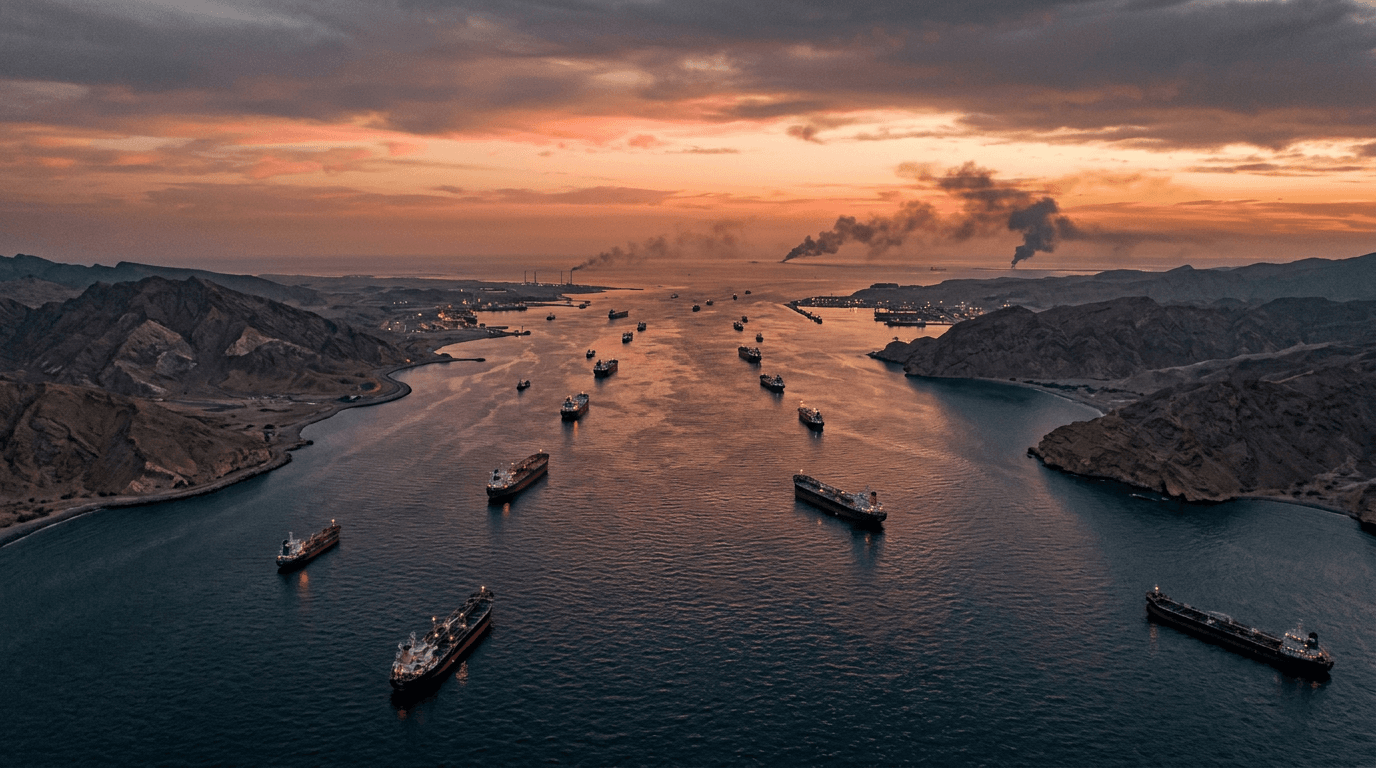
The Strait of Hormuz is 33 kilometres wide at its narrowest. Through it passes roughly 20 million barrels of oil per day, approximately one-fifth of global consumption, and energy trade valued at some $500 billion annually as of 2024. A third of the world's fertiliser trade transits the same waters. At least five tankers have been damaged, two crew members killed, and approximately 150 vessels now sit stranded in the surrounding waters while the rest of the world's tanker fleet begins the long reroute around the Cape of Good Hope -- adding weeks to delivery schedules and billions to landed costs.
This is not a hypothetical stress test. This is the global energy system failing in real time.
A Chokepoint the World Chose Not to Govern
The legal architecture governing the Strait of Hormuz rests primarily on the United Nations Convention on the Law of the Sea, which guarantees "transit passage" through international straits -- continuous, expeditious, and not subject to suspension by coastal states. The framework is elegant on paper. In practice, it has a critical flaw: neither the United States nor Iran has ratified UNCLOS. The two states most capable of escalating or de-escalating a Hormuz crisis operate outside the treaty's binding jurisdiction.
This legal vacuum has persisted for decades. Scholars at the Regional Strategic and Defence Institute and the American Society of International Law have repeatedly flagged the absence of rapid-response protocols and real-time enforcement mechanisms for transit passage violations. Proposals for a regional maritime agreement that includes both coastal and user states have circulated in academic and diplomatic channels for years. None has been adopted.
The result is a chokepoint governed by deterrence rather than law -- and deterrence, as the events of this week demonstrate, has an expiry date.
History Repeats, but the Stakes Compound
Maritime chokepoint crises are not new. They are, however, growing more consequential as global supply chains tighten.
In 1956, Egypt's nationalisation of the Suez Canal and the subsequent Anglo-French-Israeli invasion closed the waterway for five months, forcing hundreds of vessels around the Cape of Good Hope and triggering a historic surge in oil prices. In March 2021, the container ship Ever Given ran aground in the Suez Canal for six days, blocking over 400 vessels and halting an estimated $60 billion in trade. The insurance and litigation costs alone exceeded $1 billion. The Houthi campaign against Red Sea shipping beginning in late 2023 pushed carriers off the Suez route for months, compressing delivery windows and inflating freight rates across Europe and Asia.
Each episode exposed the same structural weakness: the global economy's dependence on a handful of narrow waterways, protected by no standing international authority with the mandate or capacity to keep them open.
The Hormuz crisis of March 2026 is the most severe of these episodes. Unlike the Suez blockages, which disrupted trade flows, a sustained Hormuz closure threatens energy supply at the point of extraction. The Gulf states that line the strait -- Saudi Arabia, the UAE, Kuwait, Qatar, Bahrain, and Iraq -- collectively account for roughly 30 percent of global crude production. India and China, the world's third- and second-largest economies, face acute supply risks across crude oil, liquefied petroleum gas, and liquefied natural gas. A protracted disruption would sustain or elevate global oil and gas prices, driving broad-based inflation through every economy that burns hydrocarbons or eats food grown with petrochemical fertiliser.
The IEA Toolbox: Necessary but Insufficient
The International Energy Agency, formed in 1974 in direct response to the Arab oil embargo, maintains the most developed multilateral mechanism for energy crisis response. Its 31 member countries hold collective emergency oil stocks exceeding 1.2 billion barrels. The IEA coordinated two strategic petroleum reserve releases during the disruptions following Russia's invasion of Ukraine in 2022. An Emergency Response Exercise is scheduled for 2026, with a remote session in the first half of the year and an in-person exercise in Paris in November.
These are meaningful instruments. They are also structurally limited. The IEA's membership skews heavily toward OECD economies. India, the country most exposed to a Hormuz closure given its dependence on Gulf crude, is an IEA Association country but not a full member with stock-holding obligations. China is not a member at all. The IEA framework was designed to cushion short-term supply shocks among wealthy importers, not to govern a sustained disruption affecting producing and consuming nations simultaneously.
Moreover, the United States -- historically the IEA's anchor member and the holder of the world's largest strategic petroleum reserve -- withdrew from the agency in early 2026 under the current administration's broader retreat from multilateral institutions. The timing could hardly be worse. The IEA's emergency coordination function depends on American participation, both for the volume of reserves and for the diplomatic weight required to orchestrate a collective release.
OPEC+ faces its own constraints. Several of its largest producers -- Saudi Arabia, the UAE, Iraq, Kuwait -- are among the nations directly struck by Iranian retaliation. Their production and export infrastructure is under threat. The cartel cannot pump its way out of a crisis when its own loading terminals may be within missile range.
The Renewable Transition as Security Doctrine
Every Hormuz crisis strengthens the strategic case for renewable energy -- not as an environmental aspiration, but as a hard security imperative.
The arithmetic is straightforward. Replacing imported fossil fuels through three established levers -- electric vehicles, heat pumps, and renewable power generation -- could cut net fossil fuel imports by 70 percent globally, saving an estimated $1.3 trillion per year, according to analysis from Ember and the International Renewable Energy Agency. The world added a record 585 gigawatts of new renewable power capacity in 2024, the largest single-year expansion ever. In all IEA scenarios, solar photovoltaic capacity more than triples from 2023 to 2030.
These are not projections from the margins. They are central-case forecasts from the world's leading energy institutions. Yet progress remains uneven, and the geopolitics of the transition carry their own dependencies. China manufactures approximately 80 percent of global solar panel components and dominates battery technology and wind turbine production. Trading one chokepoint for another -- fossil fuels through Hormuz for critical minerals and manufactured components through Chinese ports -- is not energy sovereignty. It is a lateral move on the same board.
Genuine energy security requires distributed manufacturing, diversified supply chains for critical minerals, and domestic deployment at a pace that reduces import exposure before the next chokepoint crisis arrives. The nations investing most aggressively in that transition will find themselves least exposed when the next strait closes.
The Federation Perspective
The Global Federation was founded on the recognition that problems which cross borders require governance that crosses borders. The Hormuz crisis is a textbook case.
No single nation caused this disruption. No single nation can resolve it. The strait is an international waterway by legal designation, yet it is governed by no standing international body with the authority, the assets, or the mandate to keep it open during a conflict. The IEA can release reserves but cannot reopen a shipping lane. UNCLOS can declare transit passage a right but cannot enforce that right against a state with cruise missiles. The United Nations Security Council can convene but cannot act when its permanent members are participants in the underlying conflict.
What is needed -- and what the Federation's Constitutional Working Groups have been drafting proposals for -- falls into four categories. First, federated maritime corridor governance: a standing international authority for critical straits and canals, funded by user-state contributions, with enforcement powers agreed by treaty. Second, international strategic energy reserves that include the major consuming nations outside the IEA, particularly India and China, with binding stock-holding obligations and pre-agreed release triggers. Third, federated crisis response protocols that activate automatically when shipping through a designated chokepoint falls below a defined threshold, bypassing the Security Council veto. Fourth, a coordinated renewable energy transition framework that treats energy independence not as a national industrial policy but as a shared security architecture, with technology transfer obligations, diversified critical mineral supply chains, and joint manufacturing capacity.
These are not utopian proposals. They are engineering problems with political prerequisites. The political prerequisites are what the Federation exists to build.
What Can Citizens Do?
The Hormuz crisis will be felt in fuel prices, food prices, and heating bills within weeks. It is already being felt in freight markets and commodity exchanges. Citizens in every country touched by this disruption -- which is to say, nearly every country -- have a direct stake in the governance failures that allowed it.
Federation citizens can act on three fronts. Support and amplify the Federation's proposals for shared maritime corridor governance and international energy reserves -- these drafts need public backing to move from working groups to formal proposals. Demand transparency from national governments about strategic reserve levels, energy import dependencies, and contingency plans for sustained chokepoint disruptions. And advocate at every level -- local, national, international -- for the renewable energy transition, not as a climate measure alone, but as the single most effective long-term strategy for removing the world's energy supply from the firing line.
The Strait of Hormuz is 33 kilometres wide. The lesson it teaches is that the global economy cannot run through a corridor that narrow without the governance to match.