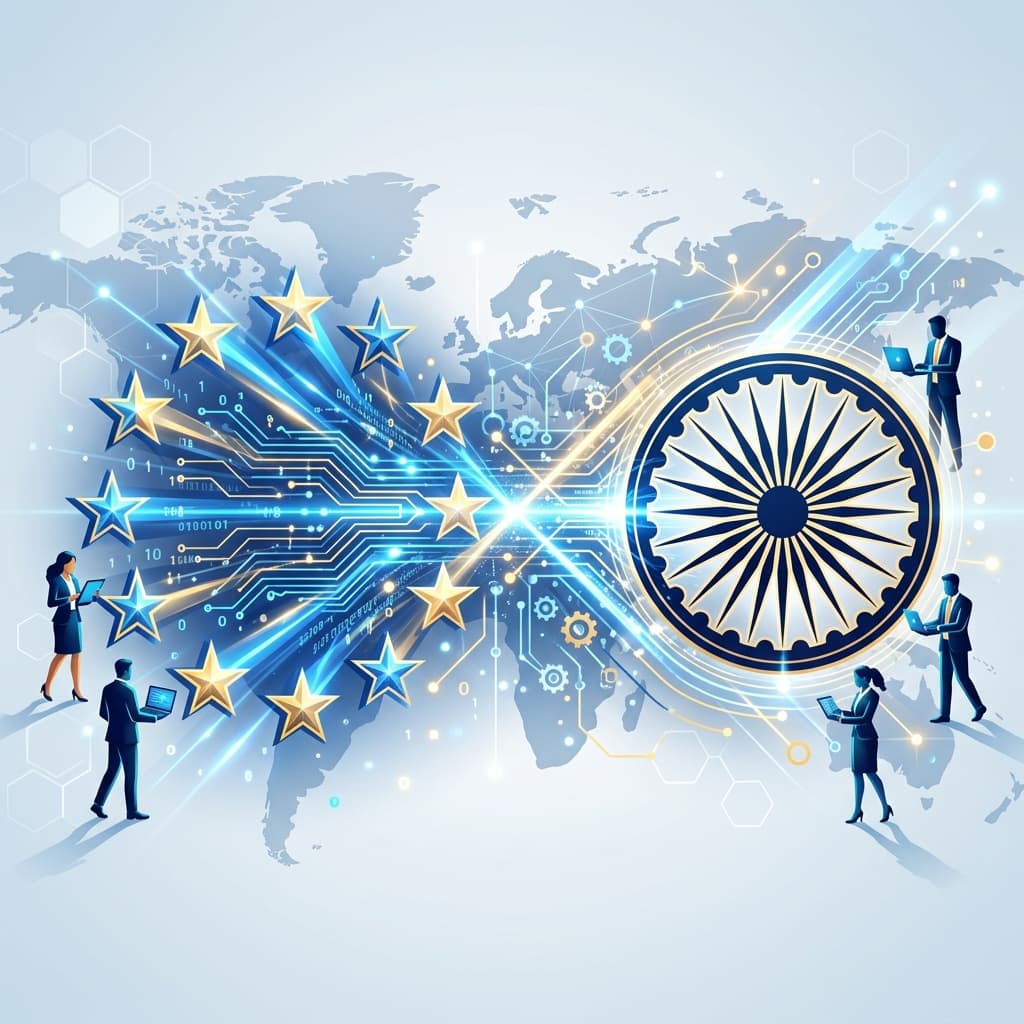
The Democratic Tech Alliance: Inside the EU-India Tech Business Forum
How cross-border partnerships between the world's largest democracies are shaping a rules-based, open digital future.
I. An Alliance of Necessity
The global technology landscape is polarizing. On one side stands the proprietary, corporate-dominated model of Silicon Valley, which treats users as data commodities. On the other stands the state-controlled, authoritarian surveillance model of Beijing, which treats technology as a tool of absolute social control.
For the rest of the world—and particularly for democratic nations—neither model is acceptable.
A third path must be forged: one that respects individual rights, promotes open standards, and treats technology as a shared public utility. This is the strategic significance of the first EU-India Tech Business Forum, which convened in New Delhi on June 4, 2026.
Bringing together policymakers, technology leaders, and civil society representatives under the auspices of the EU-India Trade and Technology Council (TTC), the forum marks the beginning of an operational alliance to secure the digital supply chains and governance frameworks of free societies.
II. The Agenda of the New Delhi Summit
The Delhi forum focused on moving beyond diplomatic agreements to build concrete, collaborative projects in three key sectors:
1. Semiconductor Supply Chain Resilience
In an era where microchips are the brains of all modern machinery, reliance on a single geographic node for manufacturing is a systemic risk. The EU and India are coordinating their respective chips initiatives—the European Chips Act and India's Semiconductor Mission—to establish secure, distributed supply chains. This involves shared research in chip design, joint ventures in packaging facilities, and talent exchange programs to address engineering shortages.
2. Standards for Human-Centric AI
As AI systems automate critical sectors from healthcare to judicial decisions, the rules governing their deployment must reflect democratic values. The forum focused on aligning regulatory approaches to AI safety, focusing on transparency in training data, audits for algorithmic bias, and mandatory human-in-the-loop overrides for high-risk applications.
3. Open-Source Digital Infrastructure
A major point of cooperation is India's Digital Public Infrastructure (DPI) model—popularly known as the "India Stack" (featuring UPI, ONDC, and open health systems). Unlike proprietary systems, DPI is built on open APIs and public rails, allowing private companies to compete while maintaining public control. The EU is looking to integrate these open-source principles into its own digital public services, creating a template for cross-border, interoperable public technology.
III. The TGF Perspective: A Commons-Based Alternative
The Global Federation views the EU-India Tech Business Forum as a vital step toward a global digital commons. Technology should connect humanity, not divide it into corporate fiefdoms or national panopticons.
A true democratic tech alliance must embrace three core values:
- Open-Source Standards: Proprietary lock-ins undermine public control. By prioritizing open-source code in public contracts, democracies can ensure that critical software is auditable, adaptable, and free from corporate leverage.
- Decentralized Data Sovereignty: Data belongs to the individuals who generate it, not the servers that host it. Interoperable data governance models must protect privacy while allowing for cooperative research.
- Digital Inclusivity: The alliance must not become an exclusive club for wealthy nations. The open-source DPI templates developed by India and the EU must be shared globally as public assets, empowering developing nations to build their own digital services without falling into dependency.
IV. Beyond Corporate and Authoritarian Controls
The success of the EU-India partnership will depend on its ability to resist the lobbying of monopolistic technology firms and the pressure of geopolitical rivalries.
A democratic tech alliance is not just about competing in the market; it is about rewriting the rules of the market. By building secure hardware, setting human-centric standards, and scaling digital public infrastructure, the EU and India are demonstrating that a free, open, and rules-based digital future is not only possible—it is already being constructed.
Published by The Global Federation Peace, Prosperity & Progress