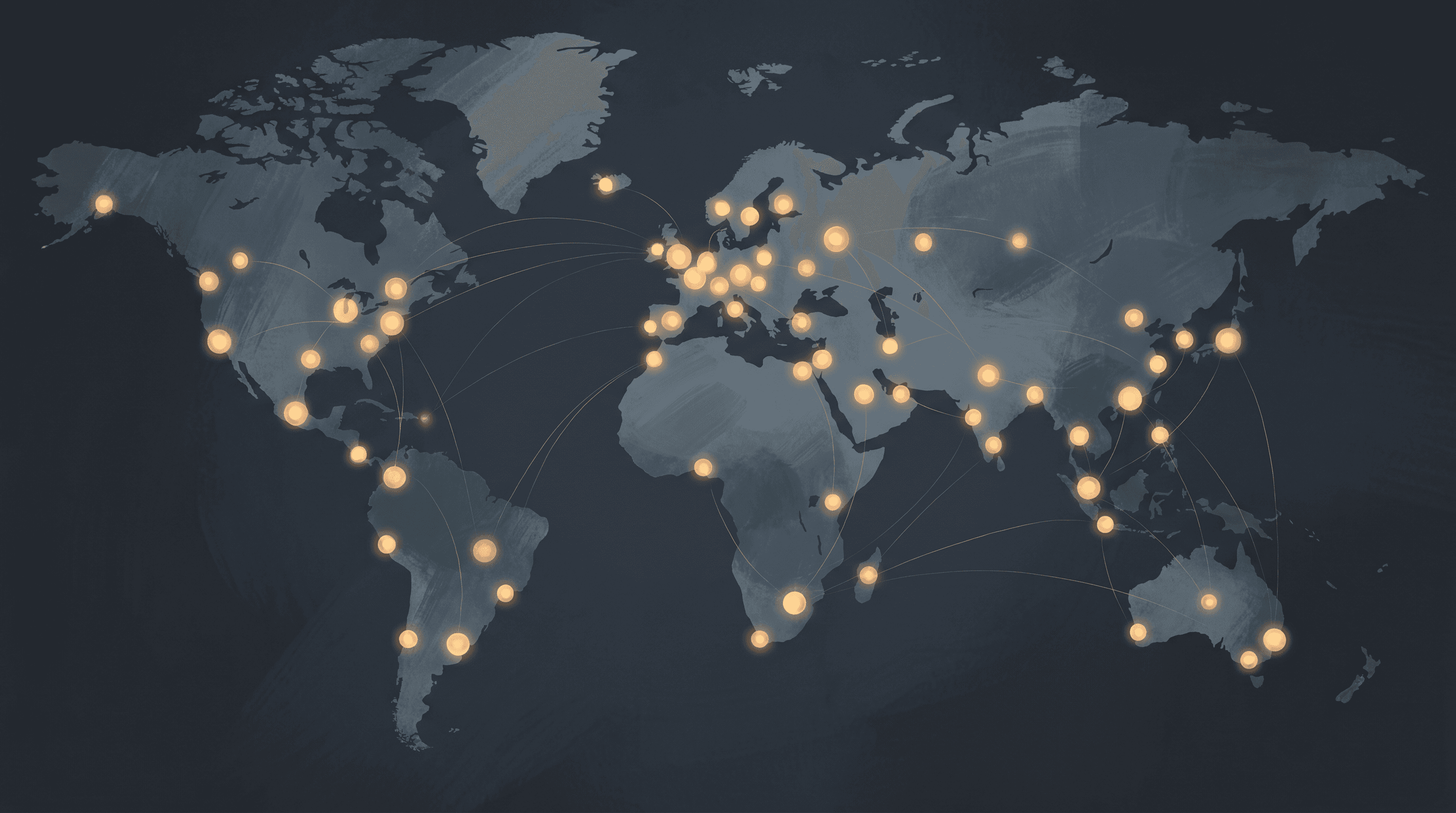
Everyone Is Convening. Is Anyone Connecting? The Year Democracy Talked to Itself
Democracy forums are multiplying across Africa, the Americas, Asia-Pacific, and Europe. The diagnosis is settled. What remains scarce is the infrastructure that connects parallel conversations into coordinated action.
This year, democracy advocates, civil-society actors, youth leaders, and policymakers are gathering in numbers that would, in a different era, signal a movement at full strength. The Global Democracy Coalition is convening Regional Forums across Africa, the Americas, Asia and the Pacific, and Europe. The Council of Europe is running its World Forum for Democracy. International IDEA continues publishing the Global State of Democracy report. The V-Dem Institute's tenth edition of its Democracy Report, "Unraveling the Democratic Era?", documents what is being lost. Freedom House's Freedom in the World 2026 names the countries where it is being taken.
The problem is not that people are not paying attention. The problem is that they are paying attention in separate rooms.
The diagnosis is done
A decade of research has produced a clear picture. Autocratic governments are not merely holding ground — Freedom House reports they are actively collaborating, sharing tools and tactics for restricting civil-society activity and limiting the space in which human-rights defenders can operate. Governments in Georgia, Mali, and Russia are among those deploying increasingly restrictive laws to monitor, criminalise, or simply exhaust the people who would otherwise hold them to account. Elections, once treated as proof of democratic health, have become moments of concentrated risk: digital repression, disinformation, surveillance, and civic-space closures cluster around them.
Youth-led civic movements are running into the structural reality that the digital platforms where they organise are controlled by commercial interests with their own power dynamics. The civic conversation happens on borrowed infrastructure.
All of this is documented, tracked, and presented at conferences. The question worth asking now is not what is wrong. The question is what keeps the people who know what is wrong from acting in concert.
Why convening is not connecting
A Regional Forum in Nairobi and a Regional Forum in Lima and a World Forum in Strasbourg will draw some of the same people, produce some of the same conclusions, and generate reports that sit in adjacent folders on the same hard drives. That is not a criticism of the people running these gatherings. It is a description of a structural gap.
Convening is relatively easy to fund. It has a visible output — a programme, a communique, a list of attendees. Connection is harder to fund and harder to show. It requires building something that persists after the closing plenary: shared intelligence on which tactics are working, common early-warning when a new restrictive law is being drafted somewhere, mechanisms for fast-moving solidarity when a civil-society organisation comes under attack.
The connective tissue that democracy needs is not another forum. It is the architecture that makes forums matter past the week they happen.
What connection actually requires
Three things tend to be missing when parallel conversations fail to become coordinated action.
The first is a shared operating picture. Researchers at V-Dem, Freedom House, and International IDEA produce rigorous data, but the people in the field — the activist in Tbilisi, the election monitor in Freetown, the journalist in Manila — are not always reading the same reports or feeding their observations back into a common system. Knowledge travels upward to institutions and laterally across academic networks, but it does not always travel horizontally across practitioners in different regions facing the same threat pattern.
The second is a trust layer. Coordination requires that the people doing it trust each other enough to share information that is sensitive, to be honest about what is not working, and to act on someone else's analysis without waiting to commission their own. That trust is built through sustained relationship, not through annual attendance at the same conference. It requires investment in the in-between time — the months between forums — which is precisely the time that goes unfunded.
The third is a common action vocabulary. Democratic decline does not present itself the same way in every country, but the tactics used to accelerate it are remarkably consistent. When practitioners in different regions have a shared language for naming those tactics — for describing what a civic-space closure looks like in its early stages, or how a disinformation campaign targeting local elections is typically structured — they can share countermeasures faster and adapt them to local conditions more accurately. Without that vocabulary, every community re-discovers the same threats from scratch.
The coordination problem is not new, but the window is narrow
None of this is an original observation. People who work on democratic governance have been naming the coordination deficit for years. What is different now is the quality of the threat environment and the pace at which restrictive practices spread across borders. Autocratic governments have built something resembling a coordination layer of their own — sharing legislative templates, surveillance technology, and diplomatic cover. The asymmetry between a coordinated erosion effort and a fragmented defence response is one of the defining features of this political moment.
The Regional Forums happening this year are not the wrong response. Bringing together advocates and policymakers across four regions is exactly the kind of work that needs to happen. The question is whether the organisations running those forums are also asking what infrastructure gets built when the forums close — what list, what channel, what protocol, what early-warning system — and whether they are willing to resource it the same way they resource the event itself.
What genuine connection looks like
It is worth being specific about what would have to change.
A practitioner in West Africa tracking a new social-media censorship pattern would need a channel to reach a practitioner in Southeast Asia who faced the same pattern six months earlier — not a form submission to a research institution, but a working relationship with a person. A civil-society organisation under sudden legal pressure would need access to legal and communications support within days, not the timeline of a grant cycle. A youth movement preparing to contest an election would need real-time intelligence on the disinformation environment, drawn from a network with experience across multiple elections, not just the national context.
None of this is technically difficult. All of it is institutionally difficult, because it requires sustained funding for infrastructure that produces no visible event, and it requires the organisations that are most trusted in this space to invest in coordination rather than competition for the same donor relationships.
The Global Democracy Coalition's Regional Forums, the World Forum for Democracy, and the reporting from V-Dem, Freedom House, and International IDEA are all pointing at the same target. The infrastructure question is whether anyone is building the network that connects those arrows into a single direction.
The standard that should apply
If 2026 produces another cycle of well-documented forums and well-written reports without a substantive improvement in how democracy defenders communicate, share intelligence, and act in solidarity across regions, then the convenings will have been necessary and insufficient. Necessary, because building relationships and shared understanding does take face-to-face time. Insufficient, because the problem is not that people have not met — it is that meeting has not yet produced the connective infrastructure that makes collective action possible.
The standard worth applying to this year's gatherings is not "did participants leave inspired?" It is "does anything persist when the meeting ends?"
The Global Federation publishes at the intersection of civic action and democratic renewal. The Democracy Desk covers governance, civil society, and the conditions under which people remain able to hold power to account.
Sources:
- Global Democracy Coalition Regional Forums 2026 — International IDEA
- World Forum for Democracy 2026 — Council of Europe
- Inside the next Democracy Playbook — Brookings
- 2026 State of Civil Society Report — CIVICUS
- Freedom House annual report: the state of democracy worldwide — Council on Foreign Relations