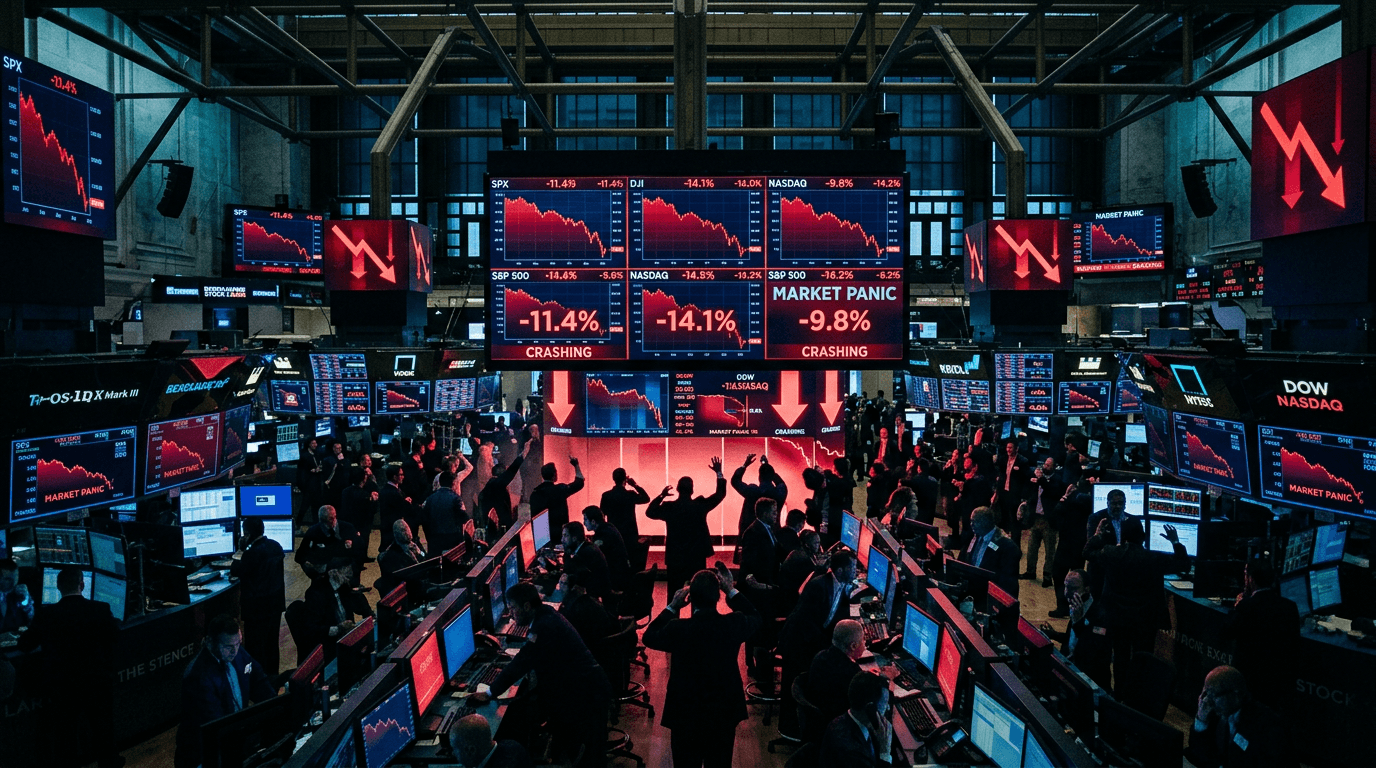
Global Markets in Freefall: Who Governs the Fallout?
KOSPI down 7.2%, Nikkei down 3%, Brent crude up 13%. When markets crash from geopolitical conflict, ordinary citizens bear the cost. The case for federated economic governance.
title: "Global Markets in Freefall: Who Governs the Fallout?" slug: "global-markets-freefall-governance" excerpt: "Asian indices plunged, oil surged past eighty dollars, and insurance markets abandoned the Gulf. The economic shock wave from the Hormuz closure reaches every pension fund, food price, and small business on the planet -- yet no institution exists to coordinate the response." type: article status: published category: economy tags: ["markets", "governance", "hormuz", "oil", "economic-crisis", "g20", "federation", "pensions", "food-prices"] published_at: "2026-03-03T12:00:00Z" hero_image: "../images/2026-03-03-global-markets-freefall-governance.png" sources:
- "CNBC, oil supertanker rates and insurance cancellations, 3 March 2026"
- "Al Jazeera, Asia stock market plunge and maritime insurance coverage, 3 March 2026"
- "Bloomberg, oil tanker idling and P&I Club cancellations, 2 March 2026"
- "Janes Defence, fertiliser and food production risk analysis, March 2026"
- "Brookings Institution, Evolving Role of the G20 in Global Economic Governance, 2025"
- "G20 Eminent Persons Group, Report on Global Financial Governance, 2024"
Global Markets in Freefall: Who Governs the Fallout?
As Asian indices crater and oil prices spike, the absence of any coordinated global economic response leaves billions of ordinary citizens exposed to a crisis none of them chose.
By The Global Federation Editorial | March 3, 2026 Category: Economy | Read Time: 8 min
On Monday morning in Tokyo, the Nikkei 225 shed 3.06 per cent in its steepest single-session decline in months, closing at 56,279. In Seoul, the damage was worse: the KOSPI collapsed 7.2 per cent as semiconductor heavyweights Samsung Electronics and SK Hynix each dropped more than six per cent. Across the region, the MSCI Asia-Pacific Index slid roughly two per cent. By the time European pre-market indicators flickered to life, it was clear that the economic aftershock of "Operation Epic Fury" -- the joint US-Israeli strikes on Iranian nuclear facilities and the subsequent closure of the Strait of Hormuz -- had arrived in every time zone simultaneously.
The question that no government, central bank, or multilateral body has yet answered is disarmingly simple: who is responsible for managing what comes next?
The Numbers Behind the Panic
The headline figures are severe, but the second-order data tells the fuller story. Brent crude surged as much as 13 per cent, touching $82 per barrel. Barclays analysts warned that a prolonged closure could push spot prices above $120. The benchmark freight rate for Very Large Crude Carriers -- the ships that move two million barrels at a time from the Gulf to East Asia -- hit an all-time record of $423,736 per day on Monday, a 94 per cent increase from Friday's close.
The insurance market, which quietly underwrites every shipment that crosses the world's oceans, delivered its own verdict. Multiple members of the International Group of Protection and Indemnity Clubs, which collectively insure roughly 90 per cent of global ocean-going tonnage, issued formal 72-hour cancellation notices for war risk coverage in Iranian waters and the Persian Gulf. War risk premiums on individual voyages jumped from 0.2 per cent to one per cent of hull value -- a fivefold increase that adds hundreds of thousands of dollars to every transit. For a tanker worth $100 million, the premium for a single voyage leapt from approximately $200,000 to $1 million.
The practical effect is a blockade by actuarial table. Vessel transits through the Strait of Hormuz have fallen from a historical average of 138 per day to roughly 28 -- an 80 per cent reduction. Over 40 VLCCs carrying an estimated 80 million barrels of crude now sit idle within the Gulf, unable to secure the coverage required to sail.
Beyond Oil: Fertiliser, Food, and the Cascade
Energy markets attract the headlines, but the Hormuz closure threatens something more fundamental: the global food system. Nearly 40 per cent of the world's nitrogen fertilisers originate in the Middle East, and the strait is the primary export route for Qatari liquefied natural gas, which powers fertiliser plants across South and Southeast Asia. Analysts at Janes forecast that global urea supplies could fall by 30 per cent and sulphur supplies by 44 per cent if the closure persists beyond two weeks.
The arithmetic is unforgiving. Nitrogen fertiliser underpins nearly half of global food production. A sustained disruption to supply would compress crop yields for the late 2026 growing season across South Asia and Latin America -- regions where food expenditure already consumes the majority of household income. The US Department of Agriculture had already projected a 3.1 per cent increase in domestic food prices for 2026 before the crisis began. Beef and veal prices were up more than 15 per cent year-on-year, with the national cattle herd at a 70-year low. Layer a fertiliser shock on top of existing inflationary pressure, and the trajectory points toward the kind of food price spikes that have historically destabilised governments from Cairo to Colombo.
Shipping reroutes compound the problem. Vessels diverting around the Cape of Good Hope add roughly two weeks and significant fuel costs to every journey between the Gulf and Europe or East Asia. Those costs do not vanish into spreadsheets. They surface at checkout counters, in utility bills, and in the import costs borne by every small business that relies on globally sourced goods.
The Governance Vacuum
Here is the structural problem: capital flows are global, supply chains are global, the energy system is global, and the consequences of this crisis are global -- but the institutions charged with economic governance remain stubbornly national.
The G20 was designated the "premier forum for international economic cooperation" at the Pittsburgh summit in 2009, a distinction earned during the previous financial crisis. Seventeen years later, the G20's capacity to coordinate a real-time economic response to a geopolitical supply shock remains largely aspirational. A 2025 Brookings Institution report on the G20's evolving role noted that the international community still "resorts to ad hoc crisis-driven measures" in the absence of an effective coordination mechanism. The G20 Eminent Persons Group on Global Financial Governance was even blunter: the global safety net for a severe crisis is not covered by the permanent resources of the International Monetary Fund, and there is no guarantee that the emergency liquidity swaps between central banks that helped in 2008 will be available next time.
The IMF itself is mid-reform. Its 17th General Review of Quotas, intended to give developing economies greater representation, was supposed to produce a new formula by June 2025. That deadline has passed without resolution. The World Bank's parallel shareholder review is similarly incomplete. Both institutions are recalibrating their governance at precisely the moment the global economy needs them to act.
Meanwhile, the countries most exposed to the Hormuz shock -- energy-importing nations across South and Southeast Asia, sub-Saharan Africa, and the Pacific Islands -- have the least representation in the institutions that might coordinate a response. They sit outside the G7. They are underweighted at the IMF. They have no mechanism to demand coordinated action on the energy and food price shocks now bearing down on their populations.
The Federation Perspective
The Global Federation's founding premise is that the great challenges of the 21st century -- climate, conflict, economic instability -- are transnational in nature and require governance structures that match their scale. The Hormuz crisis is a case study in what happens when that governance does not exist.
Consider the chain of consequence. A military operation launched by two nations closes a waterway. Insurance markets in London and Bermuda withdraw coverage. Freight rates set in Singapore spike. Fertiliser shipments from Qatar stall. Food prices in Bangladesh and Peru begin to climb. Pension funds in Scandinavia and Japan mark down their energy-sector holdings. A teacher in Nairobi pays more for cooking fuel. A factory in Vietnam cannot source raw materials. None of these individuals or institutions had any role in the decision to launch strikes, nor do they have any formal channel through which to demand economic protection from the fallout.
This is not a failure of any single government. It is a structural absence. There is no federated economic stabilisation mechanism -- no standing body with the mandate, the resources, and the legitimacy to coordinate a rapid, equitable response when geopolitical conflict generates economic shock waves. The IMF can lend. The G20 can convene. Central banks can swap. But none of these instruments is designed to protect ordinary citizens from the immediate, cascading costs of a crisis like this one. They protect sovereign balance sheets. They stabilise banking systems. The grocery bill, the pension statement, and the small business loan are someone else's problem -- and that someone else is usually the citizen who can least afford it.
A modest proposal: a standing Global Economic Stabilisation Council, operating under a federated mandate, with the authority to trigger coordinated fiscal and monetary responses when defined thresholds of disruption are met. Not a replacement for national regulators, but a layer above them -- the same relationship a federal government has to its constituent states. Such a body would not prevent crises. It would ensure that when crises arrive, the response is faster than a G20 communique and broader than a bilateral swap line.
What Can Citizens Do?
The honest answer is that no individual action offsets a supply shock of this magnitude. But collective voice matters. Citizens can demand that their governments push for concrete reform of the international financial architecture -- not in the next review cycle, but now. They can support platforms and movements that advocate for federated governance mechanisms, including those that give ordinary people a seat at the table where economic crisis response is planned.
The Global Federation exists precisely for this purpose: to build the democratic infrastructure through which citizens can participate in decisions that affect them, even -- especially -- when those decisions are made at a scale that transcends any single nation. When markets fall and no one governs the fallout, the absence of that infrastructure is not an abstraction. It is the gap between the crisis and the response, and ordinary people live in that gap.