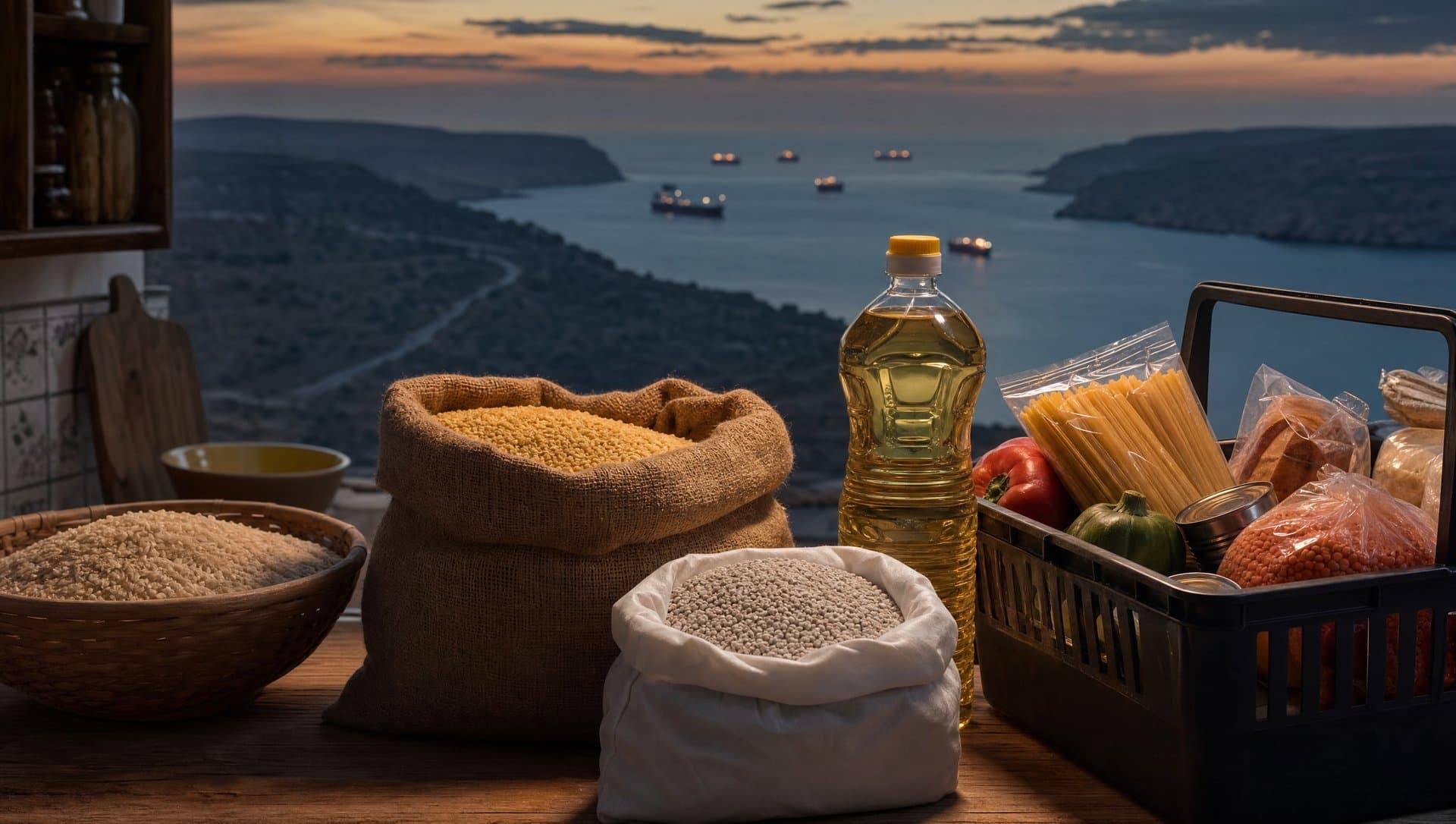
Hormuz Is A Food Story Now
A maritime chokepoint is becoming a kitchen-table crisis. The Strait of Hormuz is usually discussed in the language of oil, tankers, navies, and geopolitics. But the deeper danger now runs through fertilizer, planting decisions, food prices, debt, wages, and the household budget of people who had no vote in the conflict.
The Strait of Hormuz is often described as an energy chokepoint. That is true, but too narrow.
In the public imagination, Hormuz means tankers, crude oil, naval escorts, Gulf politics, insurance premiums, and shipping lanes. Those matter. But a crisis in Hormuz does not stop at the fuel pump. It moves into fertilizer plants, farm budgets, transport costs, government debt, school meals, household cooking oil, and the price of bread.
That is why Hormuz is a food story now.
The danger is not only that oil becomes expensive. The danger is that energy, fertilizer, shipping, credit, and food prices move together in the wrong direction, at the wrong time, for the people least able to absorb the shock.
The Food and Agriculture Organization warned on 20 May 2026 that the closure of the Strait of Hormuz is not a temporary shipping disruption, but the beginning of a systemic agrifood shock that could trigger a severe global food price crisis within six to 12 months. The agency's economists describe the chain clearly: energy disruption, fertilizer disruption, seeds and input decisions, lower yields, commodity price increases, and then food inflation.
That sequence is important because it means the worst effects may arrive late. A household may not see the full price surge today. A farmer may still have some stock. A government may still have reserves. But planting decisions made now, credit denied now, fertilizer missed now, and export restrictions imposed now can become a food crisis months later.
The clock is not abstract. It is agricultural.
The price of one narrow throat
Hormuz is a narrow strip of water between Iran and Oman, linking the Persian Gulf to the Gulf of Oman and the Arabian Sea. Its importance is not symbolic. It is physical. Fuel, natural gas, fertilizer inputs, and other essential flows move through it in volumes large enough that disruption cannot be shrugged off as a regional problem.
UN Geneva reported in April that FAO economists saw 30 to 35 percent of crude oil, 20 percent of natural gas, and 20 to 30 percent of other fertilizers not moving as expected through the corridor. In the same warning, FAO stressed that global food markets appeared stable for the moment because of existing stocks and good harvests, but that this stability should not be mistaken for safety.
That is the trap of food-system crises. They do not always announce themselves immediately. They accumulate.
A farmer facing higher fuel costs may delay planting or reduce irrigation. A farmer facing higher fertilizer prices may use less. A trader facing insurance uncertainty may avoid a corridor. A government facing currency pressure may struggle to finance imports. A poor household facing higher transport and food costs may cut meals before official hunger statistics move.
By the time the crisis is obvious, many decisions that caused it have already been made.
Food inflation is political
Food inflation is never only an economic statistic. It is a political accelerant.
When fuel prices rise, nearly everything becomes more expensive. When fertilizer prices rise, the next harvest becomes less secure. When transport costs rise, remote communities pay more. When governments subsidize everything, public finances strain. When they subsidize nothing, households strain. When central banks respond to inflation by tightening monetary policy, growth slows and debt burdens become harder to manage.
This is the cruel geometry of chokepoint shocks. The first explosion is in shipping and energy. The aftershock lands in the home.
The World Economic Forum's May 2026 Chief Economists' Outlook captures the scale of anxiety. Nearly nine in ten surveyed chief economists expect global growth to weaken over the next 12 months. The same survey says 94 percent expect global inflation to rise as the Hormuz closure drives up energy and food costs and disrupts supply chains. Chief economists ranked the duration of the Hormuz closure as more disruptive than last year's tariff turmoil, with a prolonged closure potentially approaching the severity of the COVID-19 shock in its effects across supply chains, energy, and food costs.
The recession risk may remain low. That is not reassuring enough. A world can avoid formal recession while millions of households experience crisis. Growth can be positive while food insecurity worsens. Markets can adjust while children eat less.
TGF's question is therefore simple: who carries the cost of resilience failure?
The fertilizer problem is the food problem
The central link between Hormuz and food is fertilizer.
Modern food systems are deeply dependent on energy-intensive inputs. Natural gas is crucial for nitrogen fertilizer. Sulfur matters for phosphate fertilizer. Diesel powers machinery, irrigation, transport, and cold chains. When energy and input flows tighten together, the farmer is asked to make decisions under pressure.
FAO's May warning says the shock unfolds in stages: energy, fertilizer, seeds, lower yields, commodity price increases, and then food inflation. The agency warned that decisions now by farmers and governments on fertilizer use, imports, financing, and crop choices will determine whether a severe global food price crisis emerges within six to 12 months.
That means the policy window is before the empty shelf, not after.
The agency's immediate recommendations are practical: secure alternative land and sea corridors, avoid export restrictions on energy and agricultural inputs, exempt food aid from trade curbs, activate targeted social protection, avoid regressive blanket subsidies, expand farmer credit, support food and fertilizer import financing, and diversify ports, corridors, storage, and logistics systems over the long term.
This is not dramatic language. It is operational. That is its strength.
Food security is not protected by speeches about solidarity after prices rise. It is protected by boring, early competence: credit lines, port capacity, import finance, farmer registries, fertilizer efficiency, alternative routes, reserves, and no panic export bans.
Export restrictions make everyone poorer
In a crisis, governments are tempted to hoard. It is politically understandable. It can also be globally destructive.
When major producers restrict exports of food, fertilizer, or energy to protect domestic markets, they may temporarily calm their own politics while intensifying shortages elsewhere. Import-dependent countries are priced out. Poorer households pay first. Fragile states lose room to manoeuvre. Other governments respond with their own restrictions, and a manageable shock becomes a cascade.
The lesson from previous food crises is clear: panic restrictions transmit fear through the system.
FAO is right to warn against export restrictions, especially on fertilizers and energy. Humanitarian food flows must be exempt from trade curbs. Food aid should not become collateral damage in a shipping and sanctions dispute.
This is where global governance either matters or fails. The world does not need another declaration after the crisis peaks. It needs a coordination mechanism before countries start making the individually rational choices that become collectively disastrous.
Debt turns the shock into a trap
For debt-stressed countries, Hormuz is not only an import problem. It is a balance-of-payments problem.
UNCTAD warned in April that the Hormuz disruption is deepening strain across trade, prices, and finance. It said global merchandise trade growth could slow sharply in 2026, inflation pressures are rising, investors are pulling back from developing countries, currencies are weakening, and borrowing costs are rising. It also noted that 3.4 billion people live in countries already spending more on debt service than on health or education.
That number is the moral centre of the story.
A country already spending more on creditors than on clinics and classrooms has little room to absorb higher food and fuel import bills. It cannot easily subsidize households, support farmers, defend the currency, finance imports, and pay debt at the same time. A chokepoint shock becomes a governance shock.
The household pays through prices. The farmer pays through inputs. The state pays through debt. The poor pay through reduced meals, medicine, transport, and opportunity.
This is why the food story cannot be separated from the financial story. Food security is not only harvests and ports. It is fiscal space.
Resilience is cheaper before the shock
The world knows the pattern. A corridor closes. Prices move. Aid agencies warn. Governments improvise. The poorest households absorb the delay. Later, everyone agrees resilience would have been cheaper.
Then the cycle begins again.
Hormuz should end that cycle, or at least make the excuse harder to use.
Resilience means diversified transport routes, not dependence on one maritime throat. It means regional fertilizer reserves and warehousing. It means farmer credit that arrives before planting decisions are locked in. It means soil mapping and precision fertilizer use to reduce waste. It means irrigation systems less dependent on diesel. It means strategic food-import financing for countries that cannot outbid richer buyers. It means social protection systems that can identify vulnerable households quickly and send support before malnutrition rises.
It also means respecting farmers as frontline decision-makers. Farmers are not abstractions in food-security models. They are the people deciding whether to plant, which crop to plant, how much fertilizer to apply, whether to borrow, whether to sell livestock, whether to risk a season. If they are forced into bad decisions by high input costs and late finance, the world will meet those decisions later as lower supply.
Resilience is therefore not a slogan. It is timing.
The household is where geopolitics becomes real
The person standing in a market does not experience Hormuz as a strategic waterway. They experience it as a higher price, a smaller basket, a skipped purchase, a delayed medicine, a school lunch under threat, a remittance stretched too thin, or a farm loan that no longer covers inputs.
That is the TGF lens. Global systems are judged by their consequences for ordinary people.
No household should be forced to understand tanker insurance to afford food. No farmer should be ruined because fertilizer flows were treated as a secondary effect of an energy dispute. No debt-stressed government should be left alone to choose between creditors, clinics, and bread. No humanitarian shipment should be trapped in the logic of a conflict it did not create.
The politics of Hormuz may be made by states. The price is paid by societies.
The action list is already known
The good news is that this is not a mystery. The action list is visible.
Secure alternative corridors where possible, even if they only reduce part of the pressure.
Avoid export restrictions on food, fertilizer, energy, and critical inputs.
Exempt food aid and humanitarian logistics from trade curbs.
Provide targeted support to vulnerable households rather than broad subsidies that drain budgets and often benefit wealthier consumers.
Expand farmer credit, import financing, and low-interest emergency lines before planting decisions are lost.
Support fertilizer efficiency, crop diversification, intercropping, soil mapping, and precision nutrient application.
Reactivate food-import financing and food-shock facilities for poorer countries.
Use grants, not only loans, for countries already in debt distress.
Build regional reserves, warehousing, port capacity, and transport redundancy.
Accelerate energy diversification in agriculture, including electric and solar-powered irrigation where feasible.
Most of these policies are not glamorous. That is a good sign. Glamour is what systems reach for when competence is late.
A food system worthy of the name
Hormuz has revealed something uncomfortable. The world's food system is global, but its resilience is not global enough. The system can move commodities across oceans, price risk in milliseconds, and feed cities far from farms. But it can still be shaken by one narrow waterway because energy, fertilizer, transport, finance, and household welfare remain tied together too tightly.
That is not an argument against trade. It is an argument against fragile trade.
A food system worthy of the name should be able to absorb a regional shock without turning it into a global household emergency. It should not require poor countries to wait for markets to settle while planting windows close. It should not require aid agencies to compete with fuel and fertilizer price spikes. It should not ask farmers to preserve future harvests without credit.
The Strait of Hormuz is a warning. It says that peace is not only the absence of war, prosperity is not only growth, and progress is not only technology. Peace is secure routes for food and aid. Prosperity is households that can afford staples. Progress is a system that learns from shocks before the next one arrives.
Hormuz is a food story now because food is where the abstraction ends.
The question is whether the world acts while the crisis is still preventable, or waits until the bill reaches the kitchen.
The Global Federation reports on global systems through their consequences for ordinary people, because resilience is measured at the kitchen table, not only in the situation room.