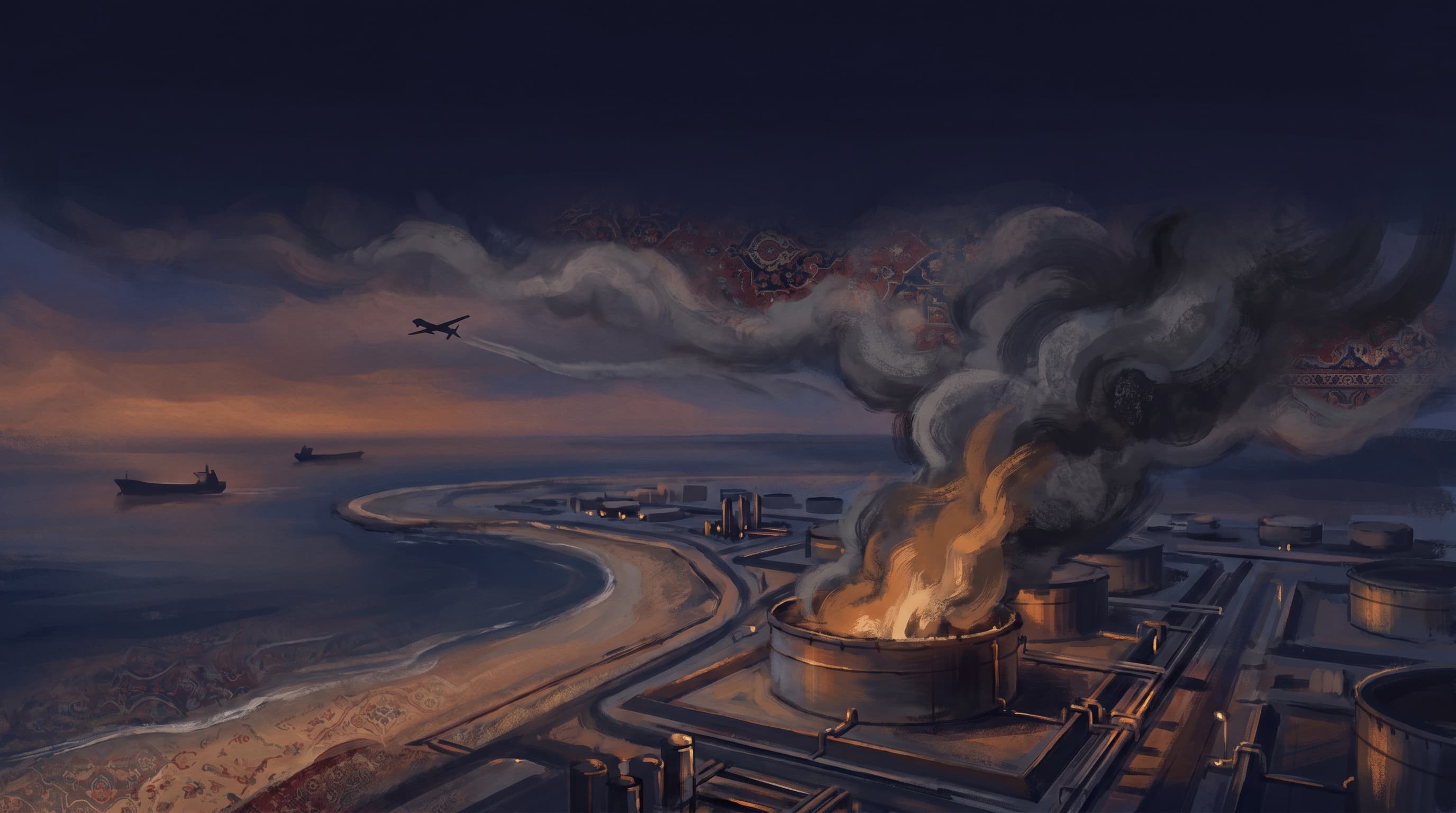
Iran's Hour of Hubris: When Underdog Becomes Arsonist
An Iranian drone burned three Indian workers at Fujairah on May 4. Tehran has just spent moral capital it cannot replace, in a transaction whose receipt will arrive in English, Mandarin, and Russian.
Iran's Hour of Hubris: When Underdog Becomes Arsonist
On May 4, 2026, an Iranian drone set fire to the VTTI oil terminal at Fujairah. Three Indian workers were burned. They had no quarrel with the regime in Tehran. Their countries had cast no vote in the war Iran is fighting. And in choosing to make their bodies collateral in a strike on the United Arab Emirates, the Islamic Republic spent moral capital it cannot replace, in a transaction whose receipt will be presented, with interest, the moment a more competent administration takes the helm in Washington.
The fire was reported within the hour by Al Jazeera, Bloomberg, The National in Abu Dhabi, Khaleej Times, NPR, and CNN. The terminal sits inside the Fujairah Petroleum Industries Zone, owned through the VTTI joint venture by IFM Global Infrastructure Fund, Vitol Group, and Abu Dhabi National Energy Co. The same day, two drones struck the ADNOC tanker Barakah in the Strait of Hormuz. Emirati presidential adviser Anwar Gargash called it "maritime piracy."
This article takes Persian civilization seriously. It watches with concern a regime in Tehran that inherited the moral standing earned by a people across three thousand years, and is now burning that inheritance at a port where workers from across South Asia, North Africa, and the Levant go to feed their families.
The Burning Terminal
The forensic record of May 4 is public. UAE air defences engaged 12 ballistic missiles, 3 cruise missiles, and 4 drones launched against Emirati territory that day, according to Bloomberg and Al-Monitor. One additional missile crashed into the sea. The interceptors held for the most part. They did not hold at Fujairah. A drone reached the VTTI terminal at the Fujairah Petroleum Industries Zone and ignited what Al Jazeera described as a "large fire." Three Indian nationals were moderately injured. The Khaleej Times named them only by nationality, which is how news from this war typically arrives: by passport, not by name.
The Habshan-Fujairah pipeline carries up to 1.7 million barrels per day from the UAE's onshore fields to the Gulf of Oman. It was constructed precisely to bypass the Strait of Hormuz, the 33-kilometre corridor through which roughly a fifth of the world's oil normally moves. With the Strait substantially closed by the IRGC since early March, Fujairah is no longer an alternative. It is the alternative. The terminal that burned on Monday is, operationally, the spine of Gulf energy export under wartime conditions. To strike it is to make an argument about what one is willing to do to global civilians in pursuit of a war the United States and Israel began.
The strike on the Barakah completed the picture. The ADNOC tanker was empty. That detail will matter to the marine biologists. It will not matter to the underwriters in London who are, even now, repricing Gulf hull insurance for the rest of the year. CNBC reported the United States said it had sunk boats in the Strait of Hormuz the same day. Trump warned against targeting US ships, in the syntax he uses for everything. The Barakah was not a US ship.
May 4 was Day 66. UAE air defences alone had intercepted a cumulative 537 ballistic missiles, 2,256 drones, and 26 cruise missiles by April 9, per The National. The May 4 barrage adds further to that ledger. Casualties on Emirati soil stand at 13 killed and 224 injured, drawn from 31 nationalities. The dead include four Pakistanis, two Bangladeshis, an Egyptian, an Indian, a Nepali, a Palestinian, a Moroccan, and two Emirati servicemembers. This is the demography Tehran has decided is acceptable collateral.
The Underdog's Advantage Iran Has Just Squandered
For most of this war, Iran has held a moral position it had not earned in decades. The United States walked away from the JCPOA in 2018 without cause beyond domestic political theatre. Israel has prosecuted a campaign against Iranian nuclear infrastructure that has, at multiple junctures, exceeded the proportionality even sympathetic legal scholars were willing to defend. The civilian toll in Gaza, the targeting of named Iranian scientists, the strike on the Iranian Presidential Office in February: these acts created a record. Much of the Global South read it and concluded that Iran, whatever the regime's domestic conduct, was being attacked rather than attacking.
Indian columnists who would not have given the Islamic Republic the time of day in 2023 were writing calibrated columns about asymmetric warfare in 2026. Brazilian foreign-policy academies were hosting panels on the legitimacy of Iranian self-defence. African foreign ministries quietly aligned with the Gulf were holding their tongue. None of this was endorsement. It was a hearing, and a hearing is the most valuable currency a sanctioned regime ever holds.
The hearing rested on a single claim: that Iran's military activity, however unwelcome, was directed at the parties that had attacked it. Strike Tel Aviv, strike Haifa, strike US bases on Arab soil, and the underdog narrative survives. The strike on Al Udeid in March, where early-warning radars were degraded, was a strike on a US asset. The narrative held.
Fujairah is not Tel Aviv. The VTTI terminal is not a US base. The Indian welder who walked out of his shift on Monday with second-degree burns is not a member of CENTCOM. He is a labourer from Kerala or Punjab or Tamil Nadu whose remittance permits a family of seven to send a daughter to school. The strike on his place of work is not asymmetric warfare against the principal aggressor. It is a strike on a third party, calibrated to inflict pain on the global energy economy in the hope that the global energy economy will demand the United States stand down.
It will not. That is not how the global energy economy works, and it has never been how the global energy economy works. What it will do, instead, is begin the process of withdrawing the hearing.
The Hour of Hubris
There is a phrase in the older diplomatic literature, hubris of the small power, that describes the moment a state under pressure mistakes the patience of others for weakness. Iran is in that moment. The April 8 ceasefire, which Tehran broke the same day with 17 ballistic missiles and 35 drones, was not a sign that the West had lost its nerve. It was a sign that the West, in its present American configuration, had lost its competence. The difference will be priced in.
The Islamic Republic reads the absence of a coherent American escalation ladder as proof that escalation will not come. This is the reading of a regime that has spent forty years in conversation with American administrations staffed by adults. It does not survive contact with the empirical record of the past four months. The current administration will be replaced. The next will inherit a Gulf order in which Iran has burned three Indian workers at a UAE oil terminal, and the political license that fact carries.
Tehran is converting a finite tactical advantage into an unlimited strategic liability. The next eighteen months will complete that conversion if the present pattern continues. Whether the IRGC has anyone left in the room who can see the cliff, and be heard saying so, will determine whether the Islamic Republic exists in any continuous form in 2030.
GCC Patience Has a Floor
The Gulf Cooperation Council states have spent the past decade constructing one of the most patient hedging architectures in modern diplomatic history. Saudi Arabia and Iran normalised relations in March 2023 under Chinese mediation. Qatar opened the back-channel that produced the Vienna talks. Oman has hosted the negotiations every Western foreign ministry pretends it is hosting. The UAE, until February, maintained a non-belligerent posture so disciplined that Iranian state television had no useful footage of Emirati hostility to broadcast.
This architecture has a floor. The floor is that Gulf infrastructure is not weaponised by Iran. Above it, Tehran was a regional rival to be managed. Below it, Tehran becomes a regional threat to be contained, and the language of containment is the language of military coalitions, no-fly zones, and the sustained sanctions architecture that ended Soviet flexibility in 1989.
May 4 began the decay of the floor. The Emirati response so far has been measured. Schools moved online. The presidential adviser used the word "piracy" rather than "war." Embassies in Tehran were closed weeks ago and Iranian schools in the UAE had their licences revoked in March, but these are administrative gestures rather than military ones. The UAE has not invoked mutual-defence language with the United States, not closed Emirati airspace to Iranian-aligned commercial traffic, not asked Saudi Arabia for a coalition statement.
The reason is not affection for Tehran. It is the calculation that the United States, in its current configuration, cannot be relied upon to escalate or de-escalate coherently, and that any Emirati move predicated on Washington's coherence is a move into a vacuum. Restraint is a function of the Trump administration's incompetence rather than of strategic confidence. The day a competent administration returns, that calculation reverses. So does the restraint.
The Emiratis are watching this war the way a creditor watches a bankruptcy. They are taking detailed notes, and the notes will be presented to Washington's next national security advisor in the first week of the next administration, with an itemised invoice for thirteen funerals and 224 hospital admissions.
The Trump Window
It is necessary to be precise about the present American administration. It is greedy, and it is stupid. It approaches geopolitics as a sequence of threats and confusions, none of which add up to a strategy. It does not know what an alliance is, except as a payment relationship. Marco Rubio's statement on May 4 confirmed America's "commitment to the UAE's security." This is not an Article 5-equivalent guarantee. It is the language an administration uses when it does not propose to do anything substantial.
This incompetence is the reason Iran currently has a tactical advantage. It is not the reason Iran will retain it. The history of the United States military is that competence reasserts itself eventually, often violently, almost always under leadership that was waiting in the wings while the political class above it lost its nerve. The Mattis archetype, the Milley archetype, the institutional memory at MacDill and Tampa: none of this is destroyed by the present administration. It is dormant.
When the political conditions return, within twenty-four months on any reasonable timeline, the Iranian regime will discover that the same chokepoint geography which gave it leverage gives the United States targeting solutions. The 13 US bases described as "nearly uninhabitable" by Defence Security Asia and Stars and Stripes, the 40,000 American troops dispersed away from primary installations, the satellite-confirmed damage at Al Dhafra, the degraded radars at Al Udeid: these are Iranian boasts in the present and American target packages in the future. The boast does not survive the package.
What the present US administration cannot do, a competent successor will. Iran appears not to have priced this possibility. It is the central error of the present moment.
537 Interceptions and the Arithmetic of Doom
The asymmetric arithmetic of this war has been celebrated, mostly by Iranian commentators, as evidence of Tehran's structural advantage. A Shahed-style drone costs Iran on the order of $20,000. A Patriot interceptor used to shoot it down costs the defending state on the order of $4 million. Run forward, the math suggests the West cannot afford to defend the Gulf indefinitely.
Run forward more carefully, it suggests something else. The cost of an interceptor matters less than the production rate. The production rate matters less than the alliance willingness to underwrite it. At every step, the arithmetic favours Iran only on the assumption that allied resolve does not harden. May 4 is the date on which allied resolve began to harden.
If Europe enters even at the level of a sanctions-and-shipping coalition, plausible given Red Sea exposure and energy import dependence, the Iranian production base does not survive eighteen months of coordinated economic and electronic warfare. If Asia enters at the level of insurance-market signalling, given direct Indian, Japanese, and South Korean exposure to Gulf energy, the cost curve inverts. The IRGC's drone factories are not buried in strategic depth. They sit inside a country that imports its industrial inputs.
Iran is winning a tactical war whose strategic terms it cannot afford to test. Each successful drone is a vote against the regime's medium-term survival. Tehran has confused the present absence of a coordinated Western response with the future absence of one. This is the mistake an underdog makes in the hour before it ceases to be an underdog and becomes a target.
The Petro-Yuan Distraction and the Bill That Comes Due in Beijing and Moscow
There is a school of analysis, mostly written in Beijing and Moscow but increasingly recycled in Western think tanks, which holds that Iran's chokepoint behaviour is accelerating the de-dollarization project. Iran is now charging yuan-denominated transit tolls at Hormuz, on the order of $2 million per voyage, with the Iranian parliament reportedly drafting formal legislation. Indian refiners settled roughly 60 million barrels of Russian crude in yuan and UAE dirhams in March 2026 alone, per Bloomberg. The mBridge CBDC platform processed RMB 387.2 billion, roughly $55 billion, with 95 percent in digital yuan, and kept operating after the Bank for International Settlements withdrew. BRICS+ now sits at eleven members, including Saudi Arabia, the UAE, and Iran.
These facts are accurate. Taken in isolation, they are the wrong story. The BIS 2025 Triennial Survey reported the US dollar on one side of 89.2 percent of all foreign exchange transactions in 2025, up from 88.4 percent in 2022. The dollar's transactional dominance is strengthening, even as oil settlement around the contested barrel diversifies. The petro-dollar is not collapsing. It is fracturing at the chokepoint while consolidating everywhere else.
The petro-yuan thesis depends on a single condition: that the alternative bloc is more trustworthy than the dollar bloc. Each Iranian drone on a UAE terminal tests the condition, and the condition fails. China's alternative-payments architecture rests on three pillars that look like an axis but function as a balance: Saudi crude priced in yuan, Iranian crude routed through yuan, Russian crude settled in yuan and rupee. Strike Fujairah and you hit the credibility of the entire non-dollar oil bloc. The Saudi-China yuan settlement that Western analysts call the dollar's slow death is contingent on Riyadh believing the BRICS+ club includes adults. Each Iranian drone on a GCC terminal is a yuan settlement Saudi Arabia walks back, a Chinese banker explaining to Xi Jinping why the timeline slipped another five years.
The Russian consequence is sharper still. Moscow's strategic premise depends on the parallel order being more trustworthy than the dollar one, not less. If the IRGC's chokepoint hostage-taking forces global insurance markets, container fleets, and South Asian importers to demand dollar-denominated contracts and US-flagged escorts as the only viable risk hedge, the entire Russian de-dollarization thesis is set back by a decade. Russia thrives by selling oil outside dollars. Iran is destroying that condition.
China is not Iran's ally; China is Iran's customer, and a customer whose alternative-financial-architecture project is being put at risk by the merchandise's behaviour. Russia is not Iran's patron; Russia is Iran's fellow traveller, and one whose post-sanctions survival strategy Iran is sabotaging. The bill for Fujairah will eventually be presented to Tehran in Mandarin and Russian, not just in English. Iran is the largest single threat to the de-dollarization project, and does not seem to know it.
The Stone Age Risk
There is a way this ends in which the IRGC does not survive. There is also a way it ends in which Iran, as a coherent national project continuous with three thousand years of Persian civilization, does not survive in any form recognisable to its own citizens. The two outcomes are not the same, and one is not desirable at all.
If the present trajectory holds, the operational base of the IRGC does not survive eighteen months of coordinated pressure. The end-state of that arithmetic, in the historical record of every comparable case, is not orderly transition. It is collapse, civil disorder, infrastructure destruction at a scale that takes a generation to repair, and the reduction of a great civilization to its stones.
This is a loss for Iran, a loss for the region, a loss for human civilization. Persian civilization is one of the load-bearing pillars of the human inheritance, and the world is poorer when one is reduced. The triumphalism that would greet such an outcome in certain quarters of Washington and Tel Aviv is not a triumph. It is a confession that we have lost the capacity to imagine outcomes other than the worst.
The warning offered here is moral rather than partisan. It is offered to Tehran because Tehran is the actor whose decisions in the next sixty days will determine whether the cliff is reached. There is no version of this trajectory in which the regime survives in its present form once a competent American administration returns. There is a version in which the country survives. The two are not the same, and the second is worth preserving. Hubris is what burns the welder at the terminal and tells itself the welder is a casualty of resistance. The welder was a casualty of arsonism.
The Governance Vacuum, Revisited
In March, this publication argued that the Strait of Hormuz crisis was not a failure of diplomacy but a failure of architecture: global supply chains but national decision-making, interdependent economies but independent foreign policies, shared vulnerability but no shared authority. Two months on, that thesis has been promoted from analytic prediction to empirical record.
No parliament voted for any of this. Not the Indian Parliament, whose nationals are now the visible casualties of a war their government did not authorise. Not the Pakistani National Assembly, which has buried four citizens. Not the Knesset, which authorised neither the cumulative shape of the Israeli campaign nor the Trump administration's improvisations alongside it. Not the United States Congress, which has not voted on a binding war powers resolution despite forty thousand US troops dispersed across the CENTCOM theatre. Not the Iranian Majlis, which retains the constitutional fiction of a parliament and has not authorised the IRGC's chokepoint hostage-taking in any form that would bind the country if the regime fell tomorrow.
No parliament voted for this in Washington, in Tel Aviv, or in Tehran. None voted for it in any of the thirty-one capitals whose nationals are dying in the Emirates. The current international order has no mechanism to halt a state actor monetising a chokepoint, no mechanism to halt a Trump administration's incoherence, no mechanism to halt an IRGC betting its civilization on the assumption of permanent Western confusion. The UN Security Council, the International Maritime Organization, the Non-Proliferation Treaty: each is paralysed by the participation of the parties whose conduct it would need to constrain.
Closing
A platform on which four billion affected citizens can read the same facts, deliberate, vote, and demand accountability is not utopia. It is the minimum institutional infrastructure missing from the current crisis. The Global Federation exists to argue that infrastructure into existence. Each chokepoint crisis that arrives without it is a tax paid for the absence. It was paid in March at Hormuz. It was paid on May 4 at the VTTI terminal. It will be paid again, at the next chokepoint, on a date not far away.
The closing register here is not triumphal. A great civilization being walked, by the miscalculation of its current rulers, toward the conditions of its own reduction is not a victory for anyone. Pathetically taking Iran toward the stone age, while insisting on a leverage the regime does not actually possess, is not the triumph of any other party's strategy. It is a loss for the human inheritance.
The only durable answer is structural. The constituencies bearing the consequences must be empowered to speak, and the mechanisms by which they speak must carry weight in the rooms where the decisions are made. Build that, and the next chokepoint crisis is debated rather than detonated. Fail to build it, and the receipts will continue to arrive at oil terminals where workers go to feed their families. The receipts will arrive in English from Washington, in Mandarin from Beijing, in Russian from Moscow, and in the languages of the thirty-one nationalities whose citizens have already been buried.
The bill is being prepared. The question is whether it will be paid by a regime that still has the option to stop, or by a civilization that no longer does.
Sources: Al Jazeera, "UAE accuses Iran of attacks as 'large fire' breaks out at oil refinery," May 4, 2026; Bloomberg, "Fujairah Oil Terminal Struck in Latest Aerial Attacks on UAE," May 4, 2026; The National (UAE), "UAE condemns 'treacherous' Iranian aggression as three injured in Fujairah drone attack," May 4, 2026; Khaleej Times, "3 Indians injured in Fujairah industrial fire after Iranian drone attack," May 4, 2026; NPR, "U.S. tries to force open the Strait of Hormuz as the UAE comes under attack," May 4, 2026; Al-Monitor, "Iran strikes UAE's Fujairah oil hub as US pushes Hormuz reopening," May 5, 2026; CNN, "Major fire injures 3 after Iran drone strike on Emirati oil port," May 4, 2026; CNBC, "Iran attacks UAE; U.S. says it sank boats in Strait of Hormuz," May 4, 2026; Defence Security Asia, "13 U.S. Bases in Middle East Nearly Uninhabitable After Iran Missile Strikes"; Stars and Stripes, "Here's what's going on at US bases in Middle East amid Iran attacks," March 1, 2026; BIS 2025 Triennial Central Bank Survey of Foreign Exchange and Over-the-Counter Derivatives Markets; Atlantic Council, "Is the end of the petrodollar near?"; Bloomberg reporting on Indian refiner yuan and dirham settlements, March 2026.