Resilience From the Ground Up
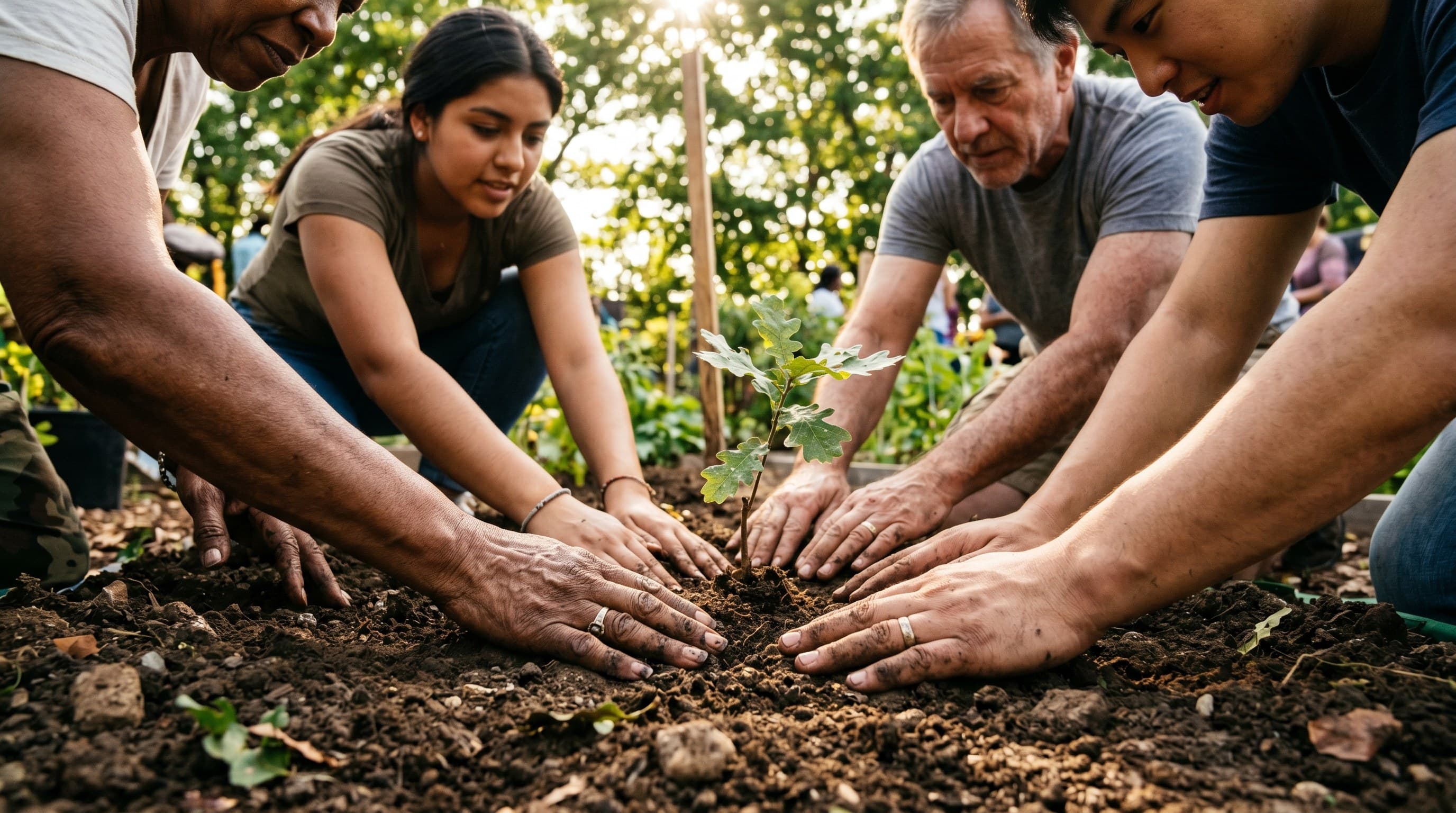
The GDC Africa Forum 2026 is meeting under the theme 'Democratic Resilience from the Ground Up.' The phrase is a thesis statement aimed at three decades of top-down democracy work. Resilience is not built from the constitution down. It is built from the union local, the women's savings group, the radio station — up.
Resilience From the Ground Up
The GDC Africa Forum 2026 is meeting under the theme "Democratic Resilience from the Ground Up." The phrase is the doctrine. The doctrine is the answer to the year we are in.
I. A Conference With a Thesis
The Global Democracy Coalition's Africa Forum, meeting in 2026, has chosen its working theme with care: "Democratic Resilience from the Ground Up."
The phrase is not decoration. It is a thesis statement aimed directly at the dominant pattern of how democracy has been discussed, financed, and supported by the international community for the last three decades.
The dominant pattern was top-down. International organisations designed frameworks. Donor governments funded programmes. Implementing partners delivered to populations. The flow of expertise, money, and legitimacy moved from north to south, from global to local, from credentialed institutions to communities.
The pattern produced some real gains. It also produced some structural failures. The most consequential failure was the assumption that a democracy financed and frameworked from elsewhere would put down roots that could survive when the financing stopped or the framework changed.
In country after country, that assumption proved wrong. The buildings remained. The institutions held formal title. The civic life that the institutions were supposed to express had often been thin to begin with, dependent on the external scaffolding, and could not sustain itself when the scaffolding was removed.
The GDC theme is the corrective. Resilience is not built top-down. It is built from the ground up. Where there is no civic ground, there is nothing on which to build.
II. The Ground Floor
What does "the ground" actually look like, operationally, in 2026?
It looks like the union local that meets in a community hall every Thursday evening. The women's savings group that has been meeting for fifteen years and now manages a substantial collective fund. The faith community that runs a free legal advice clinic on Saturdays. The neighbourhood association that has documented every act of municipal corruption in its district for the last decade. The radio station that broadcasts in the local language and covers stories that no national outlet will touch. The teachers' association that organises across school districts when education ministry policies are unworkable. The youth network that registers voters door to door before every election.
These are not auxiliary to democratic life. They are democratic life. The national institutions — the parliament, the courts, the executive branch, the press — only function as democratically as the civic substrate beneath them allows.
When the substrate is dense, deep, and interconnected, the national institutions can absorb shocks. Electoral disputes get resolved through institutions that the substrate respects, contests, and ultimately legitimises. Executive overreach gets pushed back by civic actors who have the standing and the organisation to push back. Judicial decisions matter because civic life accepts judicial authority as legitimate.
When the substrate is thin, the national institutions float above a population that has no operational stake in their authority. Crises hit and the institutions break, because there is no civic infrastructure underneath to absorb the impact and reconstitute legitimacy.
This is the operational meaning of resilience. It is not a quality of the constitution. It is a quality of the civic life.
III. The African Innovation
There is a reason the GDC is holding its Africa Forum under this theme rather than choosing a different framing. Africa, in 2026, is the continent where the most concentrated work on ground-up democratic resilience is happening.
This is not a sentimental claim. It is a structural one.
African civic actors have been operating, for decades, in environments where the national institutions are often weak, the international financing is volatile, and the political pressures are immediate. The conditions have forced a particular kind of innovation. The civic organisations that survive in those conditions are the ones that have learned to build institutional depth without depending on either reliable national-state support or reliable international donor flows.
The patterns of innovation are now visible enough to study.
Distributed leadership models. African civic organisations have, on average, more distributed and resilient leadership structures than their counterparts in more-stable contexts. The organisation does not depend on a single charismatic founder whose imprisonment or coercion would collapse the work.
Multi-pillar funding strategies. Successful African civic organisations diversify their funding aggressively — small-donor membership bases, social enterprise revenue, cooperative arrangements with sister organisations across borders, and selective international donor relationships. The diversification is the resilience.
Offline-online redundancy. African civic infrastructure routinely operates with both digital and offline modes. The election monitoring network has the WhatsApp group and the bicycle courier route. The legal aid clinic has the database and the paper records. The advocacy organisation has the social media presence and the radio relay. When one mode is shut down, the other operates.
Cross-organisational coordination. African civic ecosystems have developed coordination mechanisms — informal networks, formal coalitions, regional federations — that allow rapid mobilisation when any one organisation is targeted. The targeting of one becomes the visibility of all. The pressure cost rises for the regime that tries the targeting.
Community-embedded credibility. The most resilient African civic organisations have invested heavily in community embedding — running programmes that deliver direct value to community members, employing community-rooted staff, and partnering with traditional and faith-based local authorities where possible. The embedding produces the credibility that survives political pressure.
These patterns are not unique to Africa. Variations exist on every continent. They are most concentrated in Africa because Africa's conditions have most demanded them.
IV. What "From the Ground Up" Asks of the International Community
The doctrine is not anti-international. It is a different kind of international.
If democratic resilience is built from the ground up, then the international community's role changes from designer to amplifier, from architect to ally.
The change has practical implications.
Funding flows. Money should flow toward existing civic capacity rather than toward externally designed programmes. This means longer funding cycles, less rigid programme structures, lower compliance overhead for grantees, and more general operating support relative to project-specific support. Some international donors are moving in this direction. Most are still measuring their work in projects executed rather than capacity strengthened.
Technical assistance. Where technical assistance is appropriate, it should be peer-to-peer rather than expert-to-recipient. The civic actor in Kenya often has more transferable expertise for the civic actor in Nigeria than the consultant flown in from Geneva. The international architecture should be designed to amplify peer flows rather than centralise them through Northern intermediaries.
Visibility and protection. International visibility for at-risk civic actors is a real form of protection. It is also a form of recognition that strengthens the civic legitimacy of those actors at home. International convening — like the GDC Africa Forum itself — is one of the most effective tools available, when the convening puts the on-the-ground actors at the centre rather than treating them as case studies.
Long-term commitment. Civic resilience is built over decades. International commitment that operates on annual budget cycles or quadrennial political cycles cannot match the timescale of the work. Sustained commitment, including through political shifts in donor countries, is the rarest and most valuable form of international support.
V. The Mistake to Avoid
There is a temptation, when writing about ground-up resilience, to romanticise it. The temptation is dangerous.
Ground-up civic life is hard. It is underfunded. It is dangerous in many of the contexts that need it most. It runs on the energy and the persistence of human beings who are, in most cases, paying real personal costs for the work they do. Romanticising the resilience without supporting the resilience is a particular kind of failure that the international democratic ecosystem has been guilty of more than once.
The corrective is not less belief in ground-up work. It is more concrete support. Funding, visibility, protection, peer connection, and the long-term commitment that the work requires.
The GDC Africa Forum's framing — "Democratic Resilience from the Ground Up" — is the right framing because it points to where the actual work is happening. The framing only matters if it is paired with the actual work of supporting that work.
VI. The Global Implication
What is being demonstrated on the African continent is, increasingly, what will be required everywhere.
The pressures that have been most concentrated in less-stable democratic contexts are spreading to more-stable ones. The squeezed civic space, the contested elections, the institutional drift, the disinformation environments — these are not regional phenomena. They are the new global default.
The resilience methods being developed in the demanding contexts are the methods every civic context will need.
This is the deeper meaning of the GDC theme. It is not a regional conference about regional issues. It is a continental conversation that the rest of the world should be paying close attention to, because the lessons being generated are not parochial. They are the operating manual for democratic life under twenty-first-century pressure.
VII. The Standing Invitation
The Global Federation has, since its founding, located itself in the same theoretical space the GDC Africa Forum has now made explicit. The proposition is the same: civic life is built from the ground up, the international architecture is meaningful only if it amplifies that work, and the most credible democratic infrastructure of the twenty-first century will be one that respects the locality of civic capacity while connecting it across borders.
The forum is meeting. The conversations are happening. The lessons are being generated.
The standing invitation, from this platform to that conversation, is simple: tell us what you are learning. Tell us what you are building. Tell us what you need. The platform is yours as much as anyone else's.
The work is yours. The amplification is what we can offer.
That is the contract.
Published by The Global Federation Peace, Prosperity & Progress