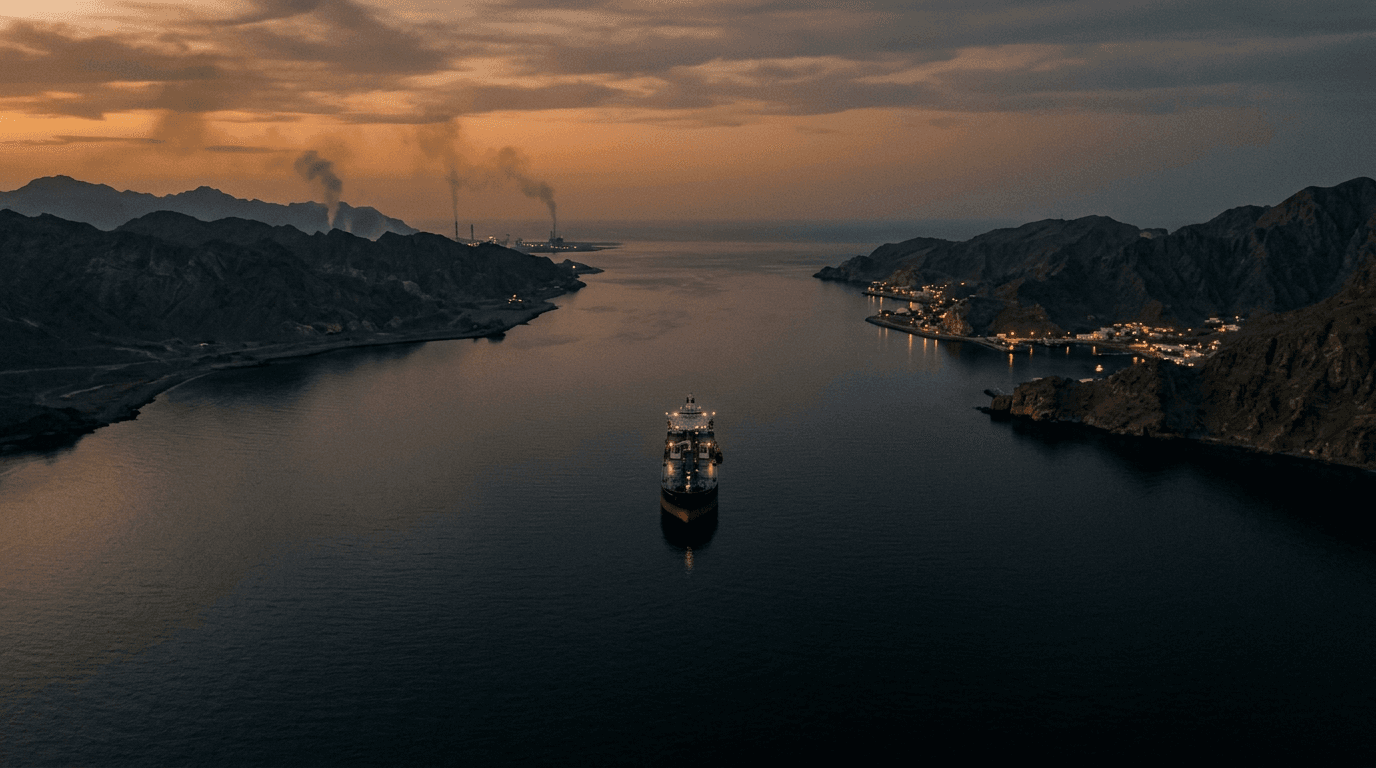
The Strait of Hormuz: When One Nation's War Becomes Every Nation's Crisis
A 33-kilometre corridor now holds the global economy hostage. 20% of global oil and one-third of fertiliser trade halted. The case for federated maritime governance.
The Strait of Hormuz: When One Nation's War Becomes Every Nation's Crisis
A 33-kilometre corridor now holds the global economy hostage -- and no parliament on Earth approved it.
By The Global Federation Editorial | March 3, 2026 Category: Global Strategy | Read Time: 9 min
Somewhere in the Indian Ocean this morning, a supertanker carrying two million barrels of Saudi crude is burning fuel on a detour it never planned to take. Its new route circles the southern tip of Africa, adding two weeks and hundreds of thousands of dollars to a journey that should have taken days. The ship's owner did not choose this. Neither did the farmer in Bihar whose fertiliser costs just doubled, nor the bus driver in Manila watching diesel prices climb past what his passengers can afford. The Strait of Hormuz -- a corridor of water narrower than the English Channel -- has been declared closed by Iran's Islamic Revolutionary Guard Corps, and with that declaration, the grocery bills of four billion people became collateral damage in someone else's war.
The Chokepoint That Feeds the World
The numbers are staggering in their simplicity. Roughly 20 million barrels of oil pass through the Strait of Hormuz every day -- about one-fifth of the world's total supply. Nearly one-third of all global liquefied natural gas trade flows through the same bottleneck. Half the world's sulphur shipments and a third of its urea -- the nitrogen fertiliser that underpins food production across South Asia and Sub-Saharan Africa -- transit this corridor. When the IRGC announced on March 2 that the strait was closed and threatened to set fire to any ship that attempted passage, it did not merely escalate a military conflict. It placed a hand on the throat of the global food system.
The closure followed days of intensifying US-Israeli strikes on Iranian territory, which have killed more than 787 people since Saturday. Israel struck Iran's Presidential Office. In response, Iran deployed the one weapon it has always held in reserve: geography. The strait, barely 33 kilometres wide at its narrowest navigable channel, sits between Iran and Oman. Every barrel of crude exported from Saudi Arabia, Kuwait, Iraq, Qatar, and the UAE must pass through it -- unless producers can find another way out.
Some can, partially. Saudi Arabia's East-West Pipeline, known as the Petroline, runs 1,200 kilometres to Red Sea terminals and can carry up to 7 million barrels per day. The UAE operates a 1.8-million-barrel-per-day pipeline from its onshore fields to the Fujairah terminal on the Gulf of Oman, bypassing the strait entirely. Reuters reported Monday that Saudi Aramco is already exploring expanded Red Sea export routes. But these alternatives handle a fraction of the volume that normally passes through Hormuz. They are escape hatches, not replacements.
The Domino Effect: From Tanker Rates to Table Prices
The market response has been swift and punishing. Brent crude surged more than 10 percent within hours of the IRGC announcement. The cost of chartering a supertanker from the Middle East to China hit a record $423,736 per day -- a 94 percent increase. Maersk, MSC, Hapag-Lloyd, and CMA CGM -- the four largest container shipping lines on Earth -- have all suspended crossings through the strait. Hapag-Lloyd imposed a War Risk Surcharge of $1,500 per twenty-foot container and $3,500 for refrigerated units. Insurance underwriters withdrew coverage effective March 5, making passage financially impossible even for captains willing to take the physical risk.
Ships are rerouting around the Cape of Good Hope, adding 10 to 14 days to journeys between the Gulf and Asia. That detour does not merely delay cargo. It removes ships from circulation, artificially shrinking the global fleet at a moment when demand for tonnage is surging. The result is a feedback loop: fewer available ships drive rates higher, which drives consumer prices higher, which drives inflation higher. Analysts warn that the disruption will collapse modern just-in-time inventory systems that depend on predictable transit windows.
The pain is not distributed evenly. Asia bears the sharpest exposure. India sources roughly 60 percent of its crude imports from the Middle East, and 42 percent of its liquefied natural gas comes from Qatar -- all of it routed through Hormuz. China, the world's largest crude importer, sends approximately 40 percent of its oil purchases through the strait and buys more than 80 percent of Iran's crude output. Japan and South Korea, both near-total energy importers, account alongside China and India for nearly 70 percent of all crude shipped through the corridor. For these nations, the Hormuz closure is not an abstract geopolitical event. It is a direct threat to heating, transport, manufacturing, and food production.
Fertiliser: The Quiet Catastrophe
Oil dominates the headlines, but the fertiliser disruption may prove more destructive over the coming months. Natural gas is the primary feedstock for ammonia and urea production. When gas prices spike, fertiliser prices follow -- and when fertiliser prices spike, planting seasons are compromised. The strait's closure simultaneously disrupts both the energy needed to produce fertiliser and the shipping lanes needed to deliver it.
Agricultural producers across South Asia, Sub-Saharan Africa, and parts of Latin America depend on steady fertiliser imports to sustain crop yields. These are the same regions where household food expenditure already consumes 40 to 60 percent of income. A sustained fertiliser shortage does not merely raise prices at the supermarket. It reduces the quantity of food that exists. The 2022 disruptions following Russia's invasion of Ukraine offered a preview: fertiliser price spikes contributed to acute food insecurity in dozens of countries. The Hormuz closure threatens a repeat, potentially at larger scale, because the chokepoint affects a wider range of commodity flows simultaneously.
No Parliament Voted for This
Here is the fact that should trouble every citizen reading this: not a single legislature outside the three belligerent nations -- the United States, Israel, and Iran -- deliberated or voted on the chain of decisions that produced this crisis. No Indian MP was consulted before the strikes that provoked the strait closure. No Japanese Diet session debated whether the risk to energy security warranted diplomatic intervention. No African Union resolution weighed the fertiliser implications for the continent's farmers. The decisions were made in Washington, Jerusalem, and Tehran. The consequences landed everywhere else.
This is the structural failure that the current international order cannot fix. The United Nations Security Council, the nominal guardian of collective security, includes two of the belligerents as permanent members or close allies. The International Maritime Organization, headquartered in London, can issue guidelines but cannot enforce passage through a sovereign nation's territorial waters during armed conflict. There is no institution on Earth with the mandate, the legitimacy, and the enforcement capacity to keep a global chokepoint open when a state actor decides to close it.
Proposals for shared ocean governance exist. The concept of a Maritime Community with a Shared Future has been floated in academic and diplomatic circles, advocating multi-level governance systems for critical sea lanes. The Eastern Tropical Pacific Marine Corridor offers a regional precedent for transboundary ocean management. But none of these frameworks address the core problem: chokepoint weaponisation by a sovereign state during armed conflict, and the absence of any democratic mechanism through which affected nations can respond collectively.
The Federation Perspective
The Global Federation was built on a premise now being tested in real time: that the decisions which affect all nations should be made by all nations, not by the three with the largest militaries. The Strait of Hormuz crisis is not a failure of diplomacy. It is a failure of architecture. The world has global supply chains but national decision-making. It has interdependent economies but independent foreign policies. It has shared vulnerability but no shared authority.
A federated approach to maritime corridor governance would not prevent wars. But it could establish binding protocols for critical chokepoints that no single belligerent can unilaterally shut down -- backed by multilateral enforcement, pre-positioned logistics, and insurance pools funded by the nations whose economies depend on passage. The precedent is not radical. The Danube Commission has governed navigation on a shared European river since 1856. The International Strait of Malacca and Singapore regime coordinates traffic through Southeast Asia's busiest waterway. What is missing is a democratic, binding framework for the handful of corridors -- Hormuz, Malacca, Suez, Bab el-Mandeb, the Turkish Straits -- through which the world's economy actually flows.
The Federation proposes that citizens, not only states, should have a voice in how these corridors are governed. Energy security is not a technical matter for admirals and oil traders. It is a bread-and-butter question for every family that heats a home, fuels a vehicle, or eats food grown with imported fertiliser. If the decisions that close a strait can be made by three governments, the decisions that keep it open should be made by all of them -- through structures that are transparent, accountable, and democratically legitimate.
What Can Citizens Do?
The Hormuz crisis will dominate the news cycle for days, perhaps weeks. But the structural problem -- the absence of federated governance over shared critical infrastructure -- will persist long after the shipping lanes reopen. Citizens can act now, not merely react.
On The Global Federation platform, you can draft and propose policy for a Federated Maritime Corridor Governance Framework. Join the active discussion thread on energy security and chokepoint diplomacy. Vote on existing proposals that address shared resource governance. Reach out to your national representatives and ask a direct question: what is your government's plan for the next time a chokepoint closes, and who at the table will speak for your interests? The answer, today, is no one. That can change -- but only if citizens demand it.