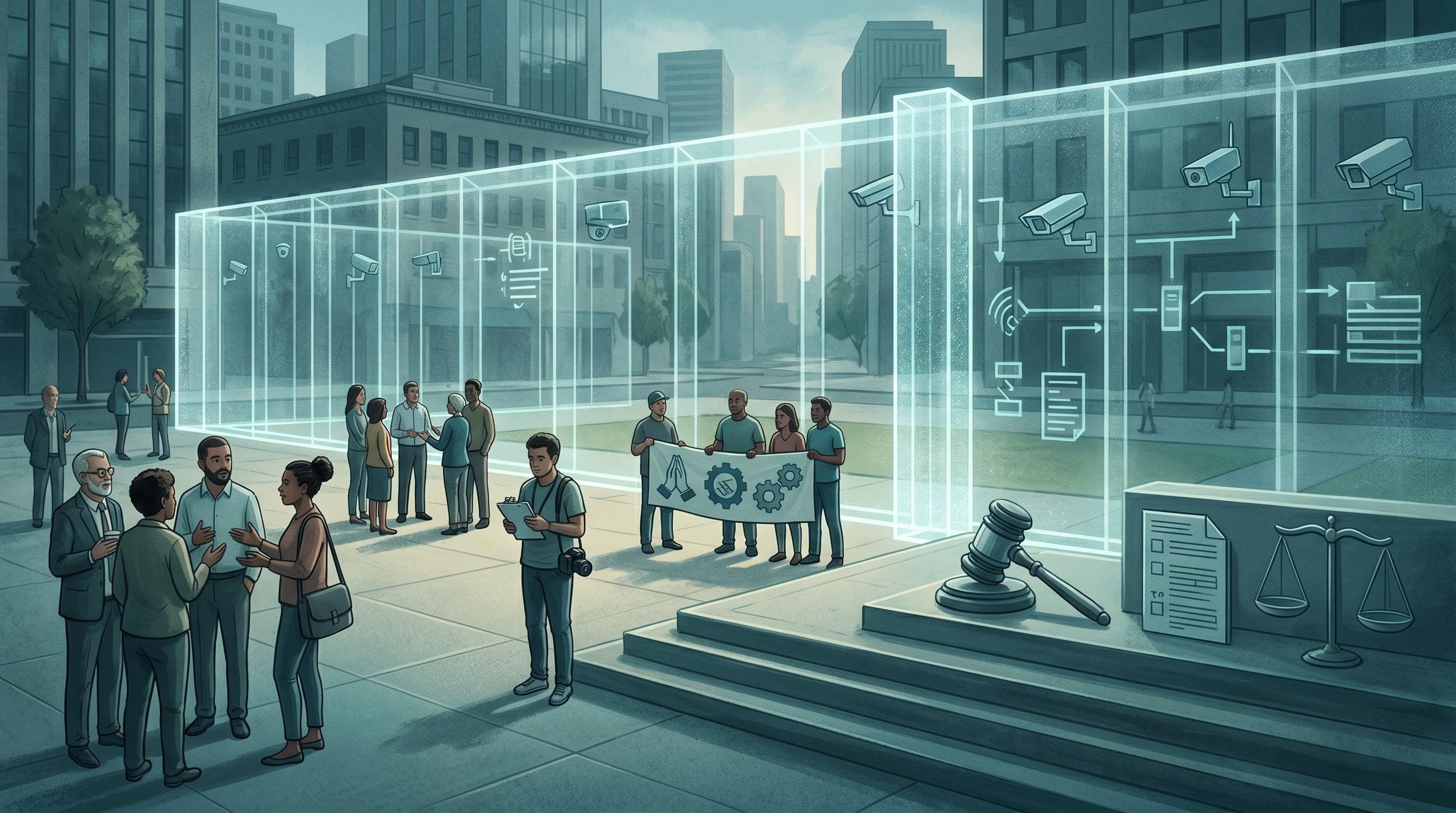
Security Surveillance Needs a Democratic Firewall
Surveillance is sometimes necessary for public safety. The democratic line is whether it protects citizens or becomes a weapon against lawful organising.
Surveillance is not automatically anti-democratic. Misused surveillance is.
Tech Policy Press reported Tuesday on the quiet erosion of collective action under digital surveillance. Americans for Responsible Innovation reported that civil society groups were urging Congress to close surveillance loopholes supercharged by AI. The concern is real. But a democracy should not pretend the answer is no surveillance at all.
Modern states need some surveillance capacity for crime prevention, counterterrorism, cyber defense and public safety. Citizens expect governments to detect threats, protect public spaces and respond before harm spreads. A state that cannot see any danger will fail its people.
The democratic line is different: surveillance for security must never become surveillance for state harassment.
The legitimate case
There are legitimate uses of surveillance. A court-authorized investigation into a violent network is different from broad monitoring of lawful protest. A camera system used to identify a bombing suspect is different from a database used to intimidate organisers. Cyber monitoring that protects hospitals from ransomware is different from spying on journalists.
Democracy cannot function if every security tool is treated as tyranny. It also cannot function if every security claim is accepted without limits.
The test is purpose, scope, law and remedy.
Surveillance should be targeted where possible, authorized by law, proportionate to the threat, limited in time, and subject to independent oversight. Data should be minimized, retained only as long as needed and protected from secondary use. Citizens should have routes to challenge abuse.
Those conditions are not bureaucracy. They are the firewall between public safety and political control.
Organising must not become suspicious
The right to organise is one of democracy's repair mechanisms. Workers organise when wages fail. Communities organise when services fail. Citizens organise when laws fail. Journalists, unions, churches, student groups, neighborhood associations and civil-society organisations all help a society correct itself before anger becomes rupture.
If people believe every meeting, message, donation, march or petition can be quietly recorded and used against them, the repair mechanism weakens.
That is the chilling effect. It does not require mass arrests. It only requires the fear that lawful association will place a person on a list, cost them a job, trigger tax harassment, delay a permit or draw police attention.
A democracy that chills lawful organising is damaging its own safety valve.
AI raises the stakes
AI changes the scale of the problem. Old surveillance required people to watch. AI can sort, flag, cluster and predict at speeds that make broad monitoring tempting. It can connect faces, phone metadata, location trails, posts, purchases and association patterns. It can turn ordinary civic life into a risk score.
That does not mean every AI security tool should be banned. It means the audit trail must be stronger, not weaker.
Any AI-assisted surveillance system used by the state should record who authorized it, what purpose it served, what data it used, how long the data was kept, who accessed it and what action followed. Independent bodies should be able to inspect the logs. Courts should be able to test misuse. Officials who use systems to harass citizens should face penalties.
The more powerful the tool, the clearer the remedy must be.
No harassment exception
The bright line is harassment.
Surveillance should not be used to profile political opponents, track peaceful protesters, intimidate minority communities, pressure NGOs, monitor journalists, punish whistleblowers or build dossiers on lawful organisers. National security cannot become a magic phrase that empties civil liberties of meaning.
This distinction is what should separate democracies from authoritarian systems. Democracies are not defined by having no surveillance. They are defined by whether surveillance is bounded by law and answerable to citizens.
The civic bargain
A workable democratic bargain would be simple to state and hard to enforce.
First, allow necessary surveillance for genuine security threats. Second, protect privacy through warrants, purpose limits, minimization and retention rules. Third, publish transparency reports where possible. Fourth, create independent oversight with real access to systems and logs. Fifth, protect journalists, unions, civil society and lawful political organising from surveillance-based intimidation. Sixth, punish misuse.
Citizens should not have to choose between safety and civic freedom. They need both.
The state may watch for danger. It must not watch citizens into silence.
The Global Federation treats democratic order as a design problem: rights, duties, institutions and public trust have to be built before crisis hands the future to fear.