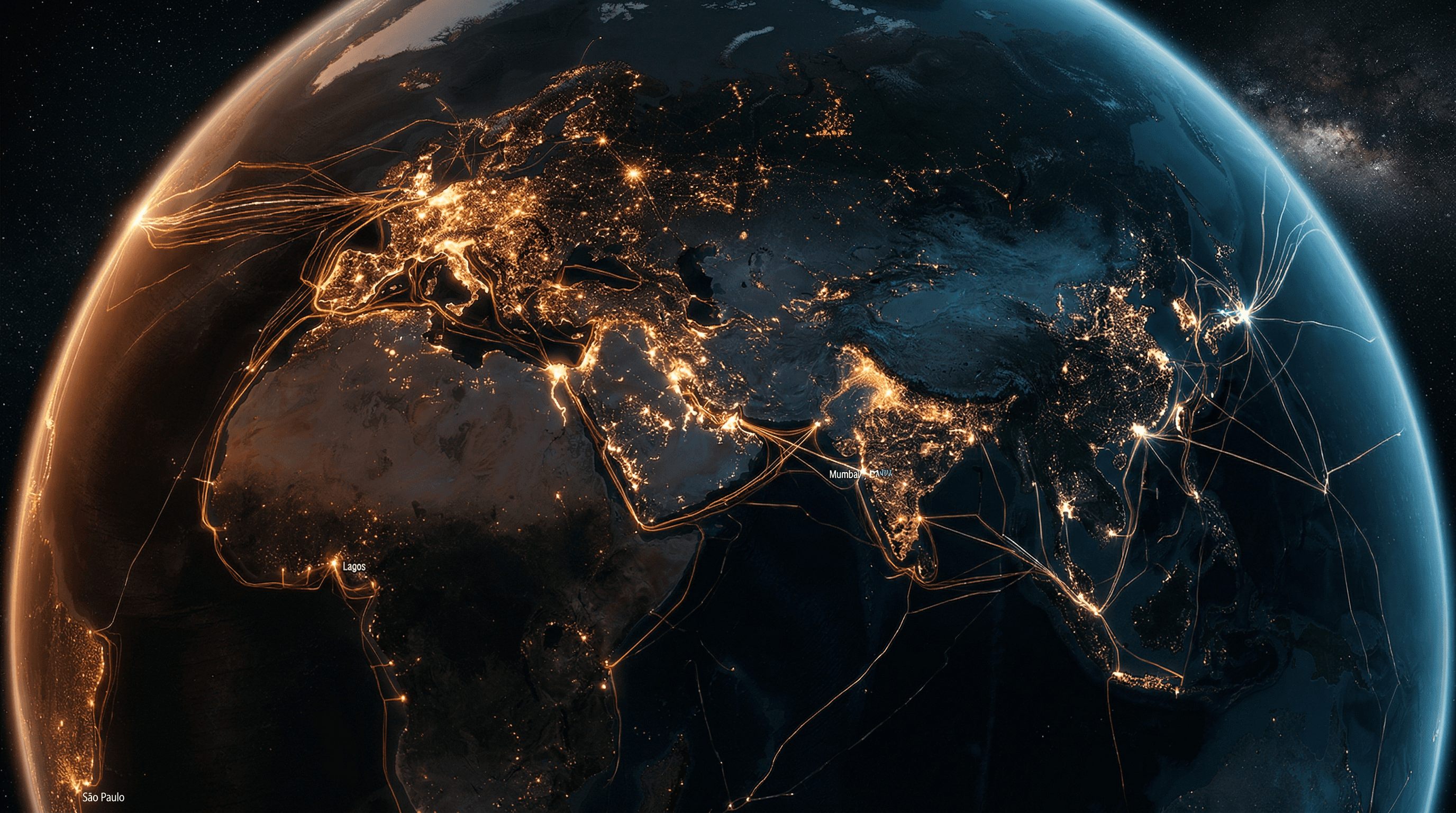
The Digital Net
The digital net is the first net in history that is both voluntary and inescapable. It carries liberation and surveillance through the same wires. The question is who architects it.
The Digital Net
The same technology that liberates the dissident empowers the dictator
I. The Newest Net
Humanity has been weaving nets for millennia. Tribal, familial, religious, racial, national -- each one built to organise, protect, and ultimately constrain. The manifesto traced their evolution from gift to cage.
But there is a net that did not exist when the manifesto was conceived in its first form. A net so new that its full shape is still emerging. A net that is, at this moment, simultaneously the most liberating and the most dangerous structure ever built.
The digital net.
It is not a metaphor. It is a literal network -- of fibre, silicon, satellites, and software -- that now connects more than five billion human beings. It carries their conversations, their commerce, their creativity, and their surveillance. It is the first net in history that is both voluntary and inescapable. You may choose to join it. But the economy, the government, and increasingly the social fabric around you have already joined on your behalf.
II. The Liberation Thread
Begin with what is genuine.
The digital net has achieved something no previous net could: it has made geography irrelevant to connection. The young woman in Chennai and the young man in Copenhagen that the manifesto imagined can now, in fact, find each other. They can share ideas, collaborate on projects, organise movements, and verify each other's humanity across ten thousand kilometres in real time.
This is not trivial. Every previous liberation movement required physical proximity. You had to march together, print pamphlets in the same city, risk your body in the same street. The digital net allows solidarity without co-location. A dissident under house arrest in Minsk can publish evidence on a platform hosted in California, verified by journalists in London, and read by citizens in Nairobi -- all before the net's censors can react.
Civil society organisations now use artificial intelligence to monitor elections, detect deepfakes, and identify propaganda campaigns. Digital forensic labs track disinformation in real time. Citizen journalists armed with smartphones have become the verification layer that institutional media alone cannot provide.
The thread of liberation is real. People have used this net to topple autocrats, expose corruption, and build communities of mutual support that transcend every traditional net -- family, caste, nation, religion. The digital net, at its best, is the closest thing humanity has built to the voluntary network of choice that the manifesto envisioned.
III. The Surveillance Wire
Now consider the wire that runs alongside the thread.
The same infrastructure that allows the dissident to publish allows the state to watch. The smartphone that connects you to the world also reports your location, your contacts, your browsing habits, and -- through voice assistants and predictive algorithms -- your likely intentions.
Authoritarian governments have learned to use the digital net with industrial efficiency. Facial recognition systems track citizens through cities. Social credit algorithms score behaviour and punish deviation. Censorship engines filter information at scale that human censors could never achieve. The Great Firewall is not a wall -- it is a net within the net, filtering reality for 1.4 billion people.
But authoritarianism is not the only threat. Democratic governments, too, have expanded surveillance capabilities in the name of security. Data brokers in nominally free societies compile profiles of citizens that no intelligence agency of the Cold War could have imagined. The digital net does not discriminate between democratic and authoritarian users. It offers its capabilities to anyone with the technical competence to deploy them.
And then there is artificial intelligence -- the accelerant. AI does not merely process data. It patterns it. It predicts from it. It automates decisions based on it. In the hands of a civic organisation, AI can strengthen election integrity. In the hands of a surveillance state, AI can identify, track, and suppress dissent at scale and speed that no human bureaucracy could match.
The same tool. The same technology. The same net. Two entirely different outcomes, depending on who holds the controls.
IV. The Question of Architecture
Here is the question the digital age forces upon anyone who cares about human freedom:
Who architects the net?
The tribal net was shaped by elders. The religious net by priests. The national net by constitutions and legislation. Each net had identifiable architects, and those architects could be held accountable -- imperfectly, often too late, but in principle.
The digital net is architected by a combination of private corporations, government agencies, and -- increasingly -- algorithmic systems that optimise for engagement, revenue, or control without any mandate from the individuals they affect. The architecture is not designed for liberation or surveillance. It is designed for throughput. What flows through it -- freedom or oppression -- depends on the intentions of whoever deploys it.
This is the fundamental vulnerability. A net without intentional architecture for human dignity will, by default, serve whatever power has the most resources to exploit it. And in the current configuration, that power is split between commercial platforms optimising for attention and governments optimising for control. Neither is optimising for the individual.
V. The TGF Lens
The Global Federation's proposition has always been surgical: keep the threads of connection, cut the wires of exclusion.
Applied to the digital net, this means:
Keep the capacity for global connection, citizen journalism, civic organisation, open-source collaboration, and the kind of human-to-human recognition that dissolves the boundaries of older nets. These are the threads. They are the reason the digital net matters.
Cut the wires of mass surveillance, algorithmic manipulation, data exploitation without consent, and the weaponisation of information systems by states and corporations alike. These are the attack circuits -- the mechanisms that turn a tool of liberation into an instrument of control.
This is not a technical challenge. The technology to build privacy-preserving systems exists. End-to-end encryption exists. Decentralised architectures exist. Open-source alternatives to surveillance-dependent platforms exist. The engineering is available.
The challenge is political. The wires of surveillance are profitable for the companies that sell the data and useful for the governments that consume it. Cutting those wires means confronting the economic and political incentives that maintain them.
VI. The Individual Node
The manifesto described the resurgent individual as a conscious node in a network of choice rather than compulsion.
The digital net is where this vision lives or dies.
If the net remains in its current form -- a surveillance-capable, algorithmically manipulated, commercially exploited system -- then the individual node is not conscious. It is processed. It is a data point generating revenue for platforms and intelligence for states. The net of choice becomes a net of extraction.
If the net is rewired -- with privacy as a default, transparency as a requirement, and human agency as the design principle -- then the individual node becomes what the manifesto imagined: a person who chooses their connections, curates their information, and participates in global civic life without surrendering their autonomy to do so.
This is the digital version of the manifesto's central question. The nets are visible now. The code is visible too, for those who read it. The question is whether we will architect the digital net for liberation or allow it to be architected for control by default.
The technology does not decide. We do.
Published by The Global Federation Peace, Prosperity & Progress 28 February 2026