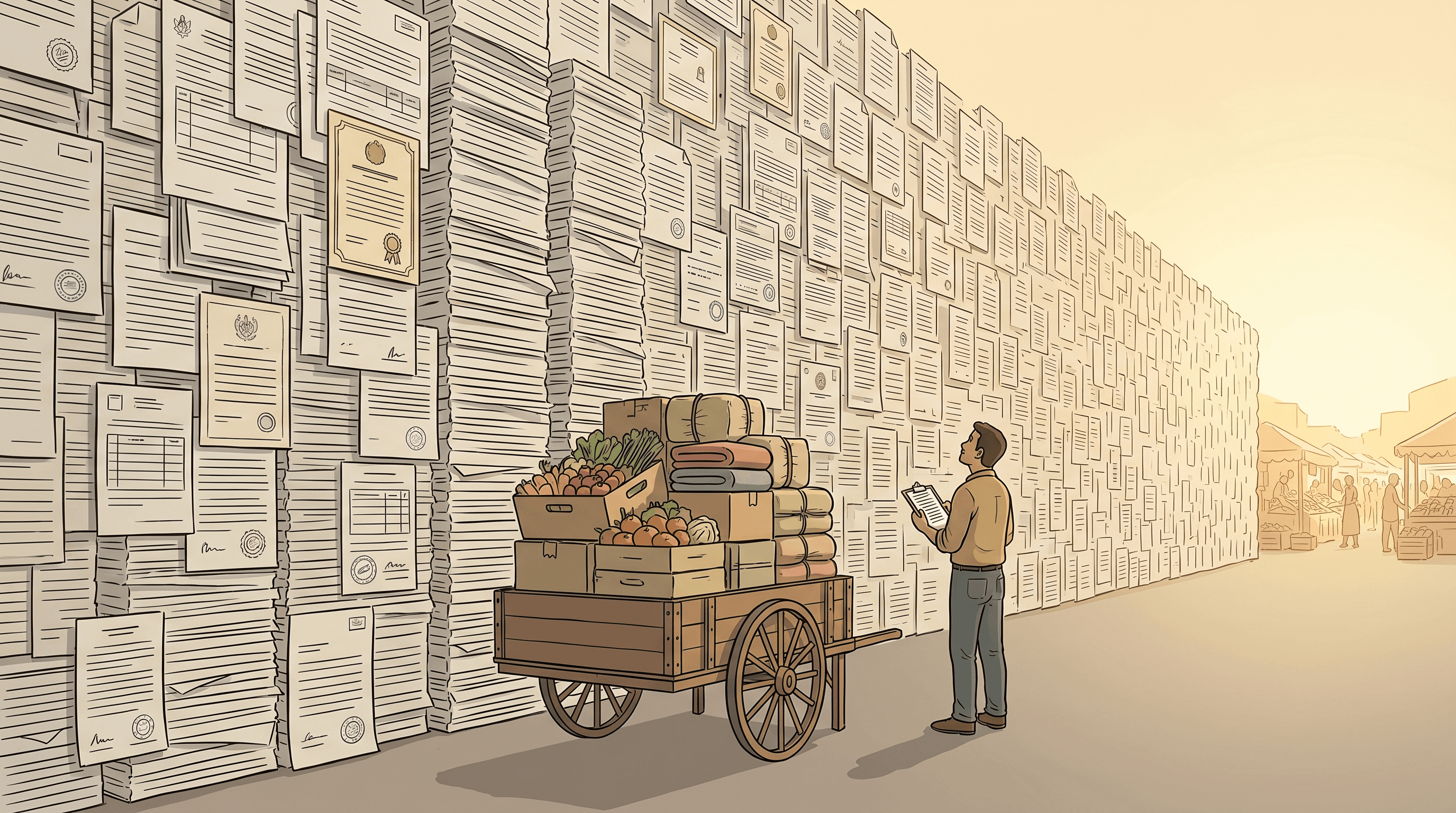
The Invisible Wall: The Trade Barrier No One Legislated and No One Owns
UNCTAD's May 2026 report finds least-developed countries lose 10% of G20-bound exports not to tariffs, but to non-tariff measures and a lack of transparency.
Imagine you grow a crop, process it, pack it, and ship it toward one of the world's largest consumer markets. At the other end, your goods are turned away — not because of a tariff, not because of any deliberate policy, but because the paperwork was wrong. The certificate was from the wrong body. The labeling standard had changed six months ago and nobody told you. The inspection fee arrived in a currency your bank does not handle easily. Your container sits. Your buyers move on.
This is not a hypothetical. It is the ordinary experience of small producers in least-developed countries trying to reach G20 markets. And according to UNCTAD's May 2026 Global Trade Update — titled "Invisible barriers: the costs of non-tariff measures" — it costs those countries roughly 10% of the exports they would otherwise make to those markets.
Ten percent, lost not to tariffs but to paperwork, opacity, and the quiet weight of requirements that were never designed to exclude anyone and yet reliably do.
What non-tariff measures actually are
Tariffs are visible. They are numbers printed in schedules, voted on in legislatures, argued about in trade negotiations, and protested in newspapers. They can be cut with a handshake between governments.
Non-tariff measures are different. They include sanitary and phytosanitary standards — rules about what pesticide residues are allowed, which testing laboratories are approved, what cold-chain documentation must accompany food. They include technical regulations: labeling formats, packaging materials, safety certification schemes. They include customs procedures, import licensing requirements, rules of origin documentation, and conformity assessment processes.
None of these are inherently protectionist. Most exist for legitimate reasons — food safety, consumer protection, environmental standards. The problem is not that the rules exist. The problem is that navigating them costs money, time, and expertise that large exporters from wealthy countries have and small producers from poor ones often do not.
A European food conglomerate has a compliance department. A farmer's cooperative in a least-developed country does not. That asymmetry, replicated across thousands of supply chains, is the invisible wall.
Transparency as a barrier in itself
UNCTAD's 2026 update identifies something that might seem surprising at first: lack of transparency is itself a trade barrier, separate from the measures themselves.
This matters because even if a requirement is technically reasonable, a small exporter cannot comply with a rule they do not know exists. When countries update their standards — and they do, frequently, in response to new science, new consumer preferences, or new political pressures — the change is published somewhere. But "published somewhere" is not the same as "communicated clearly to the producers most likely to be caught out."
A change to allowable pesticide residue limits in the European Union, announced in Brussels, may be picked up immediately by agribusiness multinationals. It will often reach a cooperative in a landlocked African nation months later, if at all — sometimes only when a shipment is rejected at the port.
The result is that the barrier is not just the rule. It is the information gap around the rule. And the information gap hits those with the fewest resources hardest.
The human cost behind the percentage
Ten percent sounds like a macroeconomic statistic. It is also a family's income.
Consider what that figure means at the level of a single exporter. A small processing business in a least-developed country that manages to produce goods of genuine quality — meeting, in substance, the standards that importing markets care about — loses a meaningful share of its potential market not to a competitor who does it better, but to a system it cannot afford to fully understand. It pays for rejected shipments, for recertification, for agents who claim to know the process and sometimes do not. It absorbs delays that larger competitors simply do not face.
Over time, the rational response is to stop trying. The visible effect is that least-developed countries remain underrepresented in the supply chains of wealthy consumer markets, not because their goods are inferior, but because the transaction costs of compliance are prohibitive.
This is how structural exclusion works: not through a single dramatic act of discrimination, but through the accumulated weight of friction that falls unevenly.
The broader context: a difficult year for trade
The UNCTAD report arrives during a difficult period for global trade. Higher energy prices are weighing on growth across much of 2026, with developing economies particularly exposed to the knock-on effects on food and essential goods. The World Bank projects growth in East Asia and Pacific slowing to around 4.4% in 2026, with Latin America growing at roughly 2.3%. Trade prospects through 2026 and 2027 are uneven across regions and generally subdued.
Within this environment, countries are nonetheless finding new trade partners and forming agreements that cut across traditional geopolitical lines. That adaptive activity offers some cause for measured optimism. But it also means that the countries least equipped to navigate complexity — the ones most dependent on export growth to fund development — are trying to find new partners while still shouldering the old compliance burdens.
The invisible wall does not lower itself in a difficult trade environment. If anything, it grows taller as standards proliferate and complexity increases.
What a constructive path looks like
The instinct, when confronted with a problem involving rules, is to call for fewer rules. That is the wrong response here. The sanitary standards that govern food imports in wealthy markets exist because consumers and regulators decided that food safety matters. Removing them would not help small producers — it would create a race to the bottom that they would lose just as surely.
The constructive path runs through three things.
The first is transparency. Trading nations — particularly G20 members — should make NTM changes available in machine-readable, multilingual formats through a common portal. The WTO's Trade Facilitation Agreement already contains notification requirements; the gap is in making those notifications genuinely accessible to small exporters in countries without the institutional infrastructure to monitor them. This requires political will more than budget: the cost of publishing clearly is close to zero.
The second is mutual recognition. Where two trading partners have standards that achieve equivalent outcomes by different means, recognizing each other's conformity assessment processes eliminates a layer of duplication. This already happens between wealthy trading partners. Extending it to relationships that include least-developed countries requires sustained negotiation, but the barrier it removes is real.
The third is capacity support. Producers in least-developed countries need access to accredited testing facilities, to timely information about standard changes, and to technical assistance in meeting certification requirements. Aid for Trade programs exist. They are chronically underfunded relative to the scale of the problem. Bringing them up to the level the problem demands is not charity — it is an investment in the supply-chain reliability that importing markets also benefit from.
None of this is technically difficult. The difficulty is entirely political: the invisible wall has no obvious owner, so nobody lobbies to take it down.
An unlegislated barrier needs an unlegislated solution
The wall that blocks small producers in least-developed countries was not voted on. No parliament passed a law to exclude them. No trade negotiator signed a treaty designed to deny them market access. The wall was built, brick by brick, through the ordinary operation of standards processes, administrative procedures, and information systems that were designed without them in mind.
That origin makes it possible to dismantle it through a different kind of action: not grand multilateral negotiations, but incremental improvements in transparency, recognition, and support that do not require a single actor to accept blame or make a headline sacrifice.
UNCTAD's 2026 report names the wall. The next step is to decide whether the countries that built it — however inadvertently — are willing to take it down.
The Global Federation Economy Desk covers international trade, development, and the rules that shape who benefits from global markets. The Federation's editorial position holds that open markets are only legitimate if their access is genuinely open.
Sources: