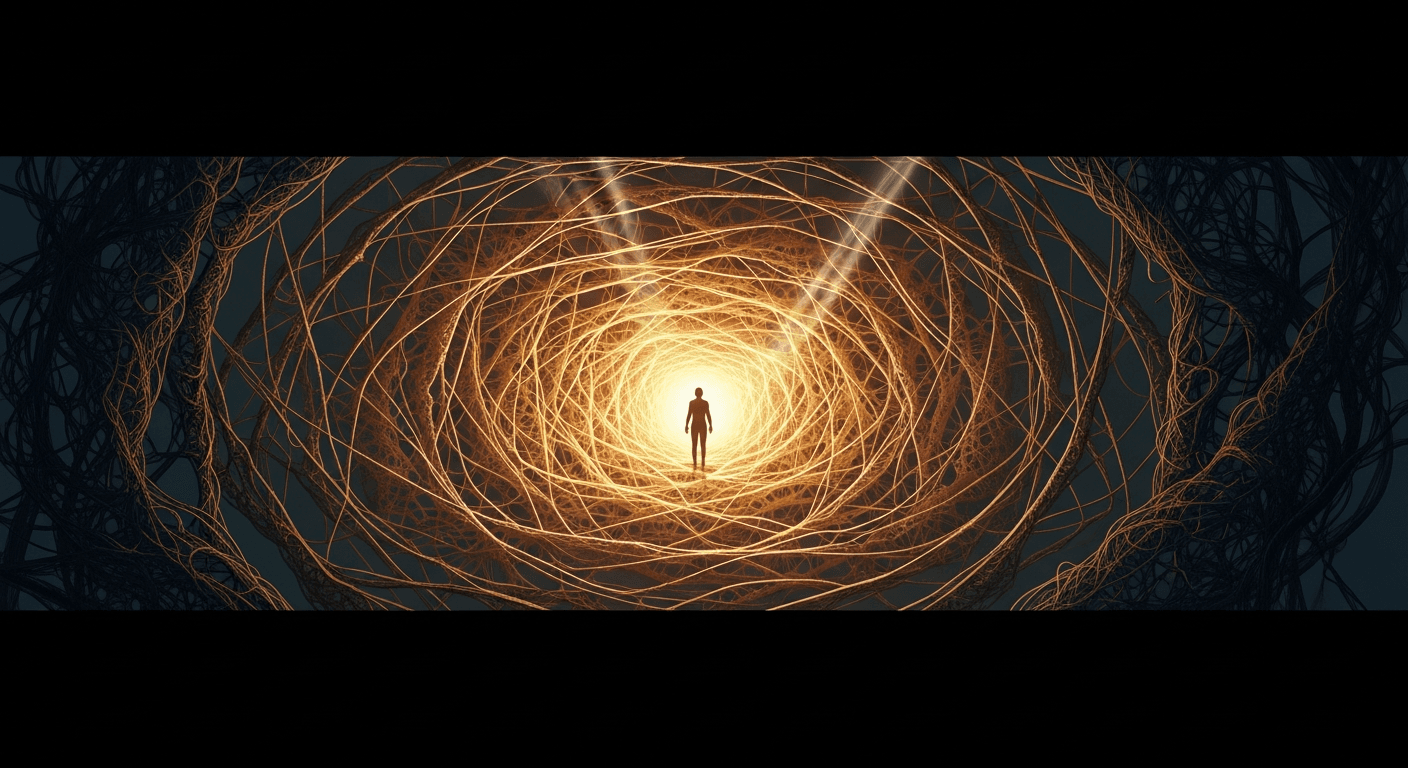
The Nets That Bind Us
From tribal shelter to national stranglehold -- and the resurgence of the individual. The nets that once protected us now squeeze us to extinction. What if we kept the love and cut the wire?
The Nets That Bind Us
From tribal shelter to national stranglehold -- and the resurgence of the individual
I. The First Net
In the beginning, the net was a gift.
When the first humans gathered around fire, they wove an invisible structure around themselves -- the tribe. It was small. It was warm. And it was necessary. Without it, the sabre-toothed cat won. The net of the tribe was protection at its purest: shared food, shared watch, shared survival. The individual existed because the group existed.
This was the original contract. Simple, honest, mutual. You contribute, you are sheltered. The net held you gently because it needed you alive.
II. The Expansion
Then the nets grew.
The tribe became the clan. The clan became the kingdom. Along the way, new nets were woven and layered over the first:
The Family Net -- the earliest and most intimate. It told you who to marry, what to worship, when to eat, how to mourn. It gave you identity before you had the language to question it. For millennia, this was enough. The family net was tight, but its threads were made of love as much as obligation.
The Society Net -- as settlements grew, so did the rules. Caste. Class. Profession as birthright. The potter's son was a potter. The priest's son was a priest. The net no longer asked what you wanted to become. It told you what you already were. In Bharath Varsha -- that ancient land of seekers -- the society net gradually transformed a civilisation of questioners into a civilisation of conformers. The seeker was replaced by the obedient.
The Religious Net -- perhaps the most paradoxical. Born from genuine wonder at existence, it crystallised into doctrine. The net of religion offered answers to the deepest questions -- but demanded you stop asking new ones. Sect divided from sect. The net that was meant to connect humanity to the infinite became a wall between human and human.
The Racial Net -- the crudest of all. It required nothing of you except the accident of your birth. It gave identity without achievement, belonging without contribution, and -- most dangerously -- an enemy without cause.
The National Net -- the modern masterwork. The nation-state took every previous net and wove them into a single, bureaucratic, militarised structure. It gave you a passport, a flag, a tax number, and -- should it require -- a uniform and a rifle. The national net is the most sophisticated cage ever built, because it convinced its inhabitants that the cage is freedom.
III. The Squeeze
Here is the truth that the twenty-first century forces upon us:
The nets are no longer protective. They are compressive.
Each layer was added with a promise of safety. But layer upon layer, the individual has been compressed to the point of suffocation. Consider the modern citizen:
- The family demands economic conformity -- earn, sustain, do not dream beyond your station
- Society demands behavioural conformity -- fit in, do not disturb the hierarchy
- Religion demands ideological conformity -- believe this, reject that
- Race demands tribal loyalty -- your people first, always
- The nation demands ultimate conformity -- die for the flag if asked
Each net, individually, might be manageable. Combined, they create a mesh so fine that the individual can barely breathe. The person who wants to think freely, love freely, work freely, believe freely, and belong to humanity rather than a subdivision of it -- that person finds every movement constrained.
And now, with the exponential acceleration of technology, the stakes have changed. Nuclear weapons. Autonomous drones. Surveillance states. Cyber warfare. The nets are no longer merely restrictive -- they are existentially dangerous. National nets armed with modern weapons do not merely squeeze their own citizens. They threaten every citizen of every other net.
Divisions that were once local tragedies are now global extinction risks.
IV. The Resurgence
But something is stirring.
Across the world, individuals are beginning to see the nets for what they are. Not because they are smarter than their ancestors -- but because technology has given them something previous generations never had: a mirror.
The internet, for all its failures and facades, showed humanity to itself. For the first time, a young woman in Chennai could see that a young man in Copenhagen shared her questions, her frustrations, her dreams. The nets told them they were different. The mirror showed them they were the same.
This is the resurgence of the individual. Not as an isolated atom -- that is the loneliness that social media exploits. But as a conscious node in a network of choice rather than compulsion. The individual who says: I choose my connections. I do not inherit my enemies.
This resurgence is not revolution. Revolution merely replaces one net with another. This is something quieter and more powerful: the refusal to let inherited nets define the boundaries of human possibility.
V. The Proposition
The Global Federation does not propose the abolition of nets. That would be naive, and worse -- dangerous. The family net, at its best, gives love. The community net, at its best, gives belonging. Even the national net, at its best, gives infrastructure and order.
What TGF proposes is surgical:
Remove the attack circuitry.
Every net has two types of threads: those that connect its members to each other, and those that connect its members against others. The family that loves its own is beautiful. The family that teaches its children to hate the neighbour's children is a weapon. The nation that builds roads is a service. The nation that builds walls is a prison.
The proposition is simple:
- Keep the threads of connection, belonging, and mutual support
- Cut the threads of exclusion, superiority, and organised hostility
- The individual retains their identity -- family, faith, culture, language -- but without the wiring that turns identity into ammunition
You may love your country. You may not use that love as a reason to destroy another's.
You may practise your faith. You may not use that practice to deny another's humanity.
You may honour your ancestors. You may not use that honour to claim superiority over another's descendants.
This is not utopia. This is engineering. The same species that wired the nets can rewire them.
VI. The Three Barriers
Three obstacles stand between the world as it is and the world as it could be:
Inequality -- when survival is uncertain, the individual clings to whatever net promises bread. You cannot ask a hungry person to think globally. Prosperity must be the foundation, not the aspiration.
Educational Impotence -- systems that teach obedience instead of inquiry produce citizens who cannot imagine alternatives. The net persists because the school never taught you to see it. Education must evolve from conformity-training to curiosity-enabling.
Economic Disparity -- when a child in one net has clean water and a child in another does not, the argument for universal brotherhood sounds like a luxury. It is not a luxury. It is a prerequisite. Without shared baseline prosperity, every other aspiration is theatre.
VII. The Path
The path is staged, not sudden:
Awareness -- see the nets. Name them. Understand which threads protect and which threads strangle. This is the work of BharathVector, of TGF's editorial voice, of every conversation that dares to ask: why do we accept this?
Acceptance -- accept that the nets will not vanish overnight, and that not all of them should. Accept that the individual and the collective must coexist. Accept that the enemy is not identity itself, but the weaponisation of identity.
Action -- build the alternative. Not in theory, but in practice. A platform where humans meet as humans. Where a citizen of the world is not a fantasy but a login. Where proposals are debated on merit, not origin. Where the constitution is written by the people it governs.
This is not a dream. The infrastructure exists. The technology is ready. The question is whether the will exists.
The nets are tightening. The squeeze is accelerating. The individual must rise -- not against community, but beyond the boundaries that community has become.
The Global Federation is not the answer. It is the question, asked at scale:
What if we kept the love and cut the wire?
Published by The Global Federation Peace, Prosperity & Progress