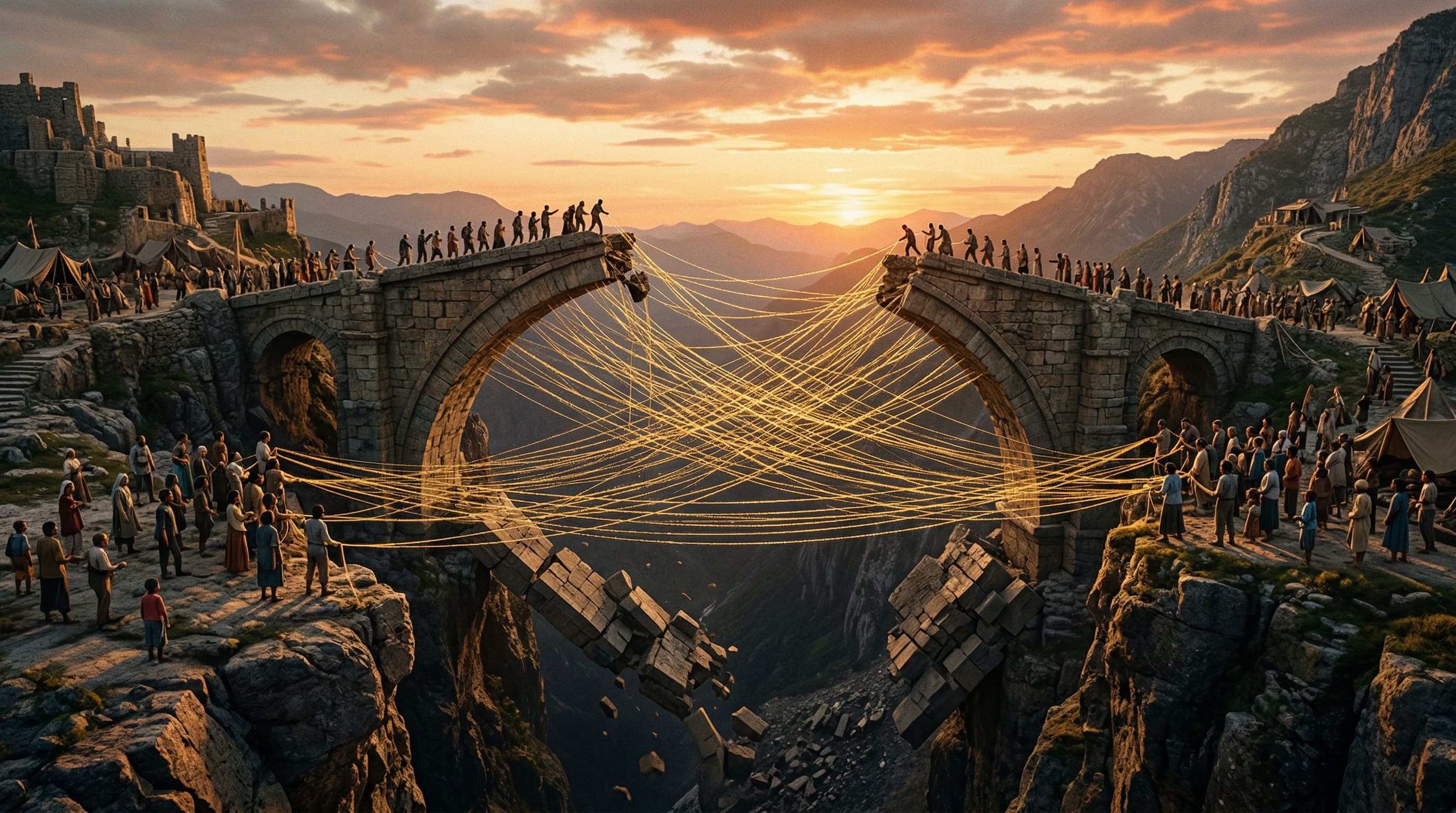
The Only Alliance That Cannot Be Revoked
NATO is fracturing. The UN is being defunded. Trade wars have replaced trade agreements. The era of government alliances as guarantees of stability is over. What replaces it must be built not between governments, but between people.
The Only Alliance That Cannot Be Revoked
Every treaty has a withdrawal clause. Every alliance has an expiry date. The only dependency that endures is the one built between people who have more to gain together than apart.
By Ramachandran Rajeev Kumar
On April 1, 2026, the President of the United States called NATO a "paper tiger" and stated that American withdrawal from the alliance was "beyond reconsideration." This was not a leak, not a misquote, not an aide speaking out of turn. It was the elected leader of the nation that founded the most successful military alliance in history, announcing -- on the record, in public -- that the promise his country made in 1949 was no longer operative.
Five days earlier, reports had emerged that the administration was considering stripping Article 5 collective defence protections from allies that failed to meet new spending targets. The mutual defence guarantee -- the single sentence that has underwritten European security for seventy-seven years -- was being reframed as a conditional benefit, payable only to those who met the latest invoice.
This is not an aberration. It is the logical conclusion of a structural flaw in how the world has organised its dependencies for the past eight decades.
The anatomy of a fickle promise
A government alliance is a promise made by a leader, on behalf of a nation, to another leader, on behalf of another nation. It is ratified by parliaments, codified in treaties, and enforced by institutions. It is, by the standards of international law, among the most solemn commitments a state can make.
It is also a promise that can be revoked by the next election.
The history of the twenty-first century is a catalogue of revoked promises. The United States withdrew from the Paris Agreement in 2017, rejoined in 2021, and the current administration's commitment remains ambiguous. It withdrew from the Iran nuclear deal in 2018, a multilateral agreement that took twelve years to negotiate. It halted military aid to Ukraine in March 2025 -- a 99 percent reduction from the previous year -- while a European ally was fighting a war that the United States had pledged to support. In January 2026, a presidential memorandum directed withdrawal from sixty-six international organisations, including agencies of the United Nations, the World Health Organisation, and de facto suspension of World Trade Organisation funding.
These are not the actions of a rogue state. They are the actions of a democracy -- one whose electoral cycle is four years, whose foreign policy establishment can be replaced overnight, and whose strategic commitments are only as durable as the attention span of its electorate.
And the United States is not unique. It is merely the most consequential example of a universal problem: the promise of a nation is only as reliable as the person who holds office. And that person can be voted in, voted out, impeached, incapacitated, or simply uninterested in the commitments made by their predecessor.
The dependency that broke
Europe is learning this lesson in real time, and the tuition is expensive.
For seventy-seven years, the European security architecture rested on a single assumption: that the United States would defend Europe against aggression. NATO was the institutional expression of that assumption. Article 5 was its theological core -- an attack on one is an attack on all. The American nuclear umbrella made conventional military spending optional for most European nations. France maintained strategic autonomy. Everyone else sheltered under the umbrella and spent the peace dividend on healthcare, infrastructure, and social programmes.
The umbrella is now being folded.
In March 2025, the European Commission launched ReArm Europe -- later diplomatically renamed "Readiness 2030" -- activating Stability Pact escape clauses to permit deficit spending on defence. In May 2025, the Council adopted SAFE, a 150 billion euro loan instrument for missile defence, drones, and cyber capabilities. European defence spending hit a record 381 billion euros in 2025. The Eastern Flank Watch network is being activated. A Defence Readiness Roadmap targeting strategic autonomy across air, land, sea, cyber, and space has been adopted.
All of this is necessary. None of it would be happening if the dependency had held.
The dependency broke not because of a military failure, but because of an electoral one. The American people chose a leader who views alliance obligations as transactional. The European people -- who had no vote in that election -- must now spend hundreds of billions of euros to build the military capacity they outsourced for three generations. The cost is not merely financial. It is the cost of misplaced trust in a dependency that was always, structurally, one election away from dissolution.
The dependency trap
But the fracture in NATO is only the most visible thread in a much larger unravelling.
China has weaponised its dominance in rare earth minerals -- the materials without which no modern economy can manufacture electronics, electric vehicles, or precision weapons. In April 2025, Beijing imposed export controls on seven heavy rare earth elements. By October, it expanded the controls to encompass holmium, erbium, thulium, europium, and ytterbium, reaching into components and assemblies manufactured anywhere in the world using Chinese-sourced materials. Nations that had built their green energy transitions on the assumption of Chinese supply discovered that the supply came with conditions.
The Kurds of Syria -- who lost eleven thousand fighters defeating ISIS on behalf of a coalition led by the United States -- were told in January 2026 that their role as a primary counter-terrorism force had "largely expired." A hundred and thirty-four thousand people were displaced. The dependency on American protection, which had been the foundation of Kurdish strategic calculations for a decade, was withdrawn in a single diplomatic statement.
Russia's weaponisation of gas exports to Europe in 2022 remains the defining case study. European pipeline imports from Russia fell from 137 billion cubic metres in 2021 to 32 billion by 2024 -- not because Europe chose to diversify, but because Russia chose to squeeze. The dependency that was supposed to make conflict economically irrational was used, instead, as a weapon.
In each case, the pattern is identical. A nation builds its security, its economy, or its energy system around a dependency on another nation. The dependency works, for years or decades, as long as the interests of both parties remain aligned. The moment the interests diverge -- the moment a new leader takes office, a new geopolitical calculation is made, or a new leverage opportunity presents itself -- the dependency becomes a vulnerability. And the nation that trusted the dependency pays the price.
The paradox
And yet. The world cannot function without dependencies.
No nation can manufacture every component its economy requires. No nation can defend every border without allies. No nation can feed its population, power its cities, and educate its children using only the resources within its own borders. Autarky -- complete self-sufficiency -- is not a strategy. It is a fantasy, and a dangerous one. Every nation that has attempted it has impoverished its people. North Korea is not a model. It is a warning.
The question, then, is not whether dependencies should exist. It is what kind of dependencies can be trusted.
The dependencies that have failed us share a common architecture: they are agreements between governments, negotiated by officials, signed by leaders, and revocable by their successors. They exist at the level of the state. They are mediated by diplomats, enforced by institutions, and subject to the electoral cycles, political calculations, and personal temperaments of whoever happens to hold power.
The dependencies that have endured share a different architecture entirely. They exist at the level of people.
The dependency that holds
In 1950, Robert Schuman -- the French Foreign Minister -- proposed something that seemed, at the time, absurd. He proposed that France and Germany pool their coal and steel production under a joint authority. Not as a trade agreement. Not as a diplomatic gesture. As a structural dependency so deep that war between the two nations would become, in his words, "not only unthinkable but materially impossible."
This was not a treaty between leaders. It was a wiring of economies that made millions of French and German workers, managers, and families dependent on the same productive base. It was a dependency that no single election could revoke, because it was embedded not in a document but in the daily economic life of ordinary people.
It worked. France and Germany -- nations that had fought three devastating wars in seventy years -- have not fired a shot at each other since. Not because their leaders agreed to peace, but because their people could not afford war.
The Erasmus programme, often dismissed as a student exchange scheme, has sent 1.44 million Europeans across borders in a single year. A generation of professionals now holds friendships, business partnerships, and personal relationships in countries their grandparents fought against. The empirical debate about whether Erasmus creates "European identity" misses the point. What it creates is personal stake. A French engineer whose closest collaborator is German, whose university roommate was Polish, whose partner is Spanish, experiences a European war not as a geopolitical abstraction but as the destruction of their own life. That is a dependency no referendum can dissolve.
The Peace Corps -- 220,000 volunteers across 139 countries since 1961 -- has produced a statistically measurable effect: each additional volunteer correlates with a shift in the host country's UN voting alignment and a measurable increase in favourable public opinion toward the United States. Not because the volunteers lobbied. Because they were present. Because they were human beings who lived alongside other human beings and created the kind of mutual understanding that no diplomat can manufacture and no president can revoke.
The architecture we need
The lesson is not sentimental. It is structural.
Government-to-government alliances are fragile because they depend on the continuity of political will, and political will is the most volatile commodity in human affairs. A leader who builds an alliance can be replaced by a leader who dismantles it. A parliament that ratifies a treaty can elect a successor that withdraws from it. An institution that enforces norms can be defunded by a member state that no longer finds the norms convenient.
People-to-people dependencies are durable because they are distributed. No single election can sever millions of economic relationships. No single leader can unmake the friendships, partnerships, and mutual obligations that form when human beings from different nations work together, trade together, and build together over years and decades. The dependency is held not by a signature on a treaty but by the accumulated weight of a million individual decisions to cooperate.
This is not idealism. It is the most hard-headed realism available. The Kantian Peace research programme -- spanning data from 1885 to 1992 -- demonstrates that trade between nations is a stronger and more consistent predictor of peace than military alliance membership. Economic interdependence reduces the probability of militarised disputes, and the effect is strongest between neighbouring, historically conflict-prone pairs. The mechanism is straightforward: firms, supply chains, and workers cannot easily unwind mutual dependency without absorbing the cost themselves. The incentive to maintain peace is not abstract. It is personal.
But here is the critical caveat: interdependence must be symmetric. When one nation controls the supply and another depends on it -- as with Russian gas, Chinese rare earths, or American military guarantees -- the dependency becomes leverage. It can be weaponised. The solution is not less dependency, but mutual dependency: arrangements where both parties are equally vulnerable to disruption, and therefore equally motivated to sustain cooperation.
The case for a global federation
This is the architecture that The Global Federation exists to build.
Not an alliance of governments. Not a treaty organisation. Not a club of leaders who meet annually, issue communiques, and return home to pursue their national interests. A network of citizens who are engaged with each other directly -- across borders, across cultures, across the artificial boundaries that governments draw and redraw according to the political weather.
The institutions of the twentieth century -- NATO, the UN, the WTO, the WHO -- were built on the assumption that governments represent their people and that agreements between governments are therefore agreements between peoples. That assumption was always fragile. It is now visibly false. The American people did not vote for the abandonment of Ukraine. The European people did not vote for dependence on Russian gas. The Kurdish people did not vote for the withdrawal of the coalition that their fighters died to support. In each case, the people bore the consequences of decisions made by leaders they either did not choose or could not control.
A global federation -- a genuine, democratic, people-to-people engagement platform -- addresses this structural failure at its root. It does not replace governments. It does not override sovereignty. It creates a parallel layer of global civic life in which citizens engage directly with each other on the issues that their governments have failed to manage: climate, trade, security, migration, technology governance, and the equitable distribution of the prosperity that globalisation was supposed to deliver.
The European Coal and Steel Community did not replace the governments of France and Germany. It made war between them structurally impossible by creating dependencies that existed below the level of government, in the daily economic lives of ordinary people. That is the model. Not a world government. A world dependency -- mutual, symmetric, and distributed across millions of individual relationships that no single leader can sever.
The urgency
The drama unfolding before us is not subtle. It does not require interpretation. NATO is fracturing in public. The United Nations is being defunded by its largest contributor. Trade agreements are being replaced by tariff walls. Intelligence-sharing relationships that took decades to build are being strained by transactional demands. The institutions that were supposed to guarantee a rules-based international order are discovering that rules are only as binding as the willingness of the powerful to observe them.
And waiting in the wings is a set of challenges that no nation can address alone: climate change that respects no border, artificial intelligence that outpaces every regulatory framework, pandemic preparedness that requires cooperation between nations that are busy building walls against each other, and nuclear proliferation in a world where the non-proliferation regime depends on the credibility of guarantors who are busy withdrawing from their guarantees.
The old model -- trust your government to form the right alliances with the right partners -- is not merely failing. It is being dismantled in real time, by the governments themselves.
What replaces it must be something that cannot be dismantled by a single election. It must be a dependency that is held not at the level of the state but at the level of the citizen. It must be built not on the promise of a leader but on the accumulated investment of millions of people who have chosen, deliberately and individually, to stake their future on cooperation rather than isolation.
That is not a utopian vision. It is the lesson of the European Coal and Steel Community, the Erasmus programme, the Peace Corps, and every successful people-to-people initiative in history. The dependencies that survive are the ones that belong to the people, not the politicians.
The Global Federation is not an alternative to government. It is the architecture for a world in which the failure of any single government cannot collapse the cooperation that human survival now requires.
The dependencies between nations are fickle. The dependencies between people are not.
It is time to build the ones that last.
Ramachandran Rajeev Kumar is Chief Executive of Aarksee Group of Companies, a Saudi Arabia-based conglomerate operating across carbon markets, green sciences, technology, and media. He writes on geopolitics, democratic reform, and global governance for The Global Federation.
Editor's Note: This article reflects the editorial position of The Global Federation. All geopolitical events cited are sourced from major news organisations and institutional publications as of April 1, 2026.