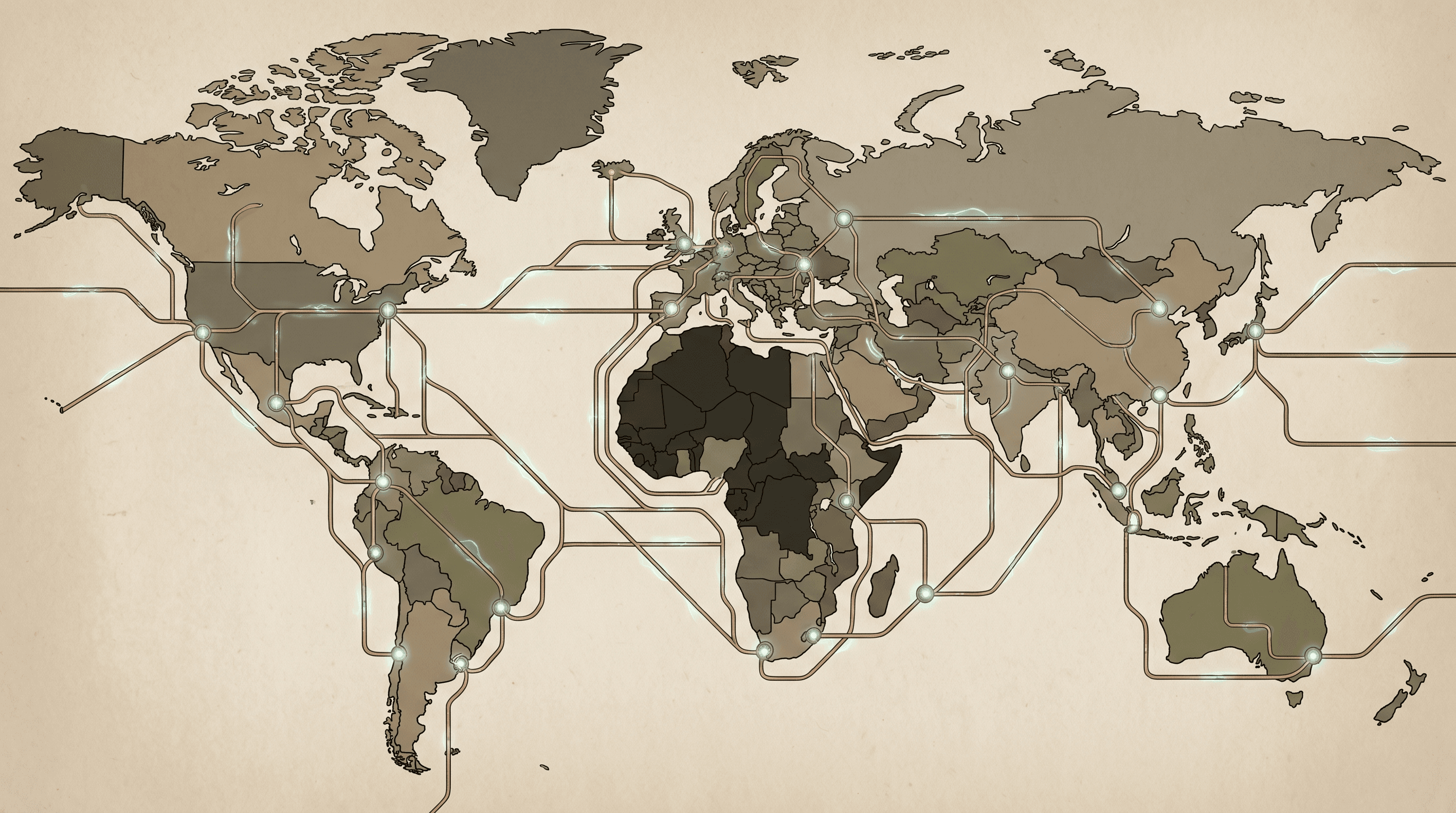
The Plumbing of Cooperation: While One Nation Walks Out, Sixty-Four Build the Climate's Quiet Architecture
While the US exited the Paris Agreement in January 2026, 64 countries quietly signed 108 bilateral carbon-credit agreements under Article 6 — climate cooperation built without a hegemon.
The news editors of the world gave the United States the headline. Fair enough: when the largest historical emitter of greenhouse gases formally exits the international climate framework, that is a fact worth recording. The US now stands alongside Iran, Libya, and Yemen as the only countries not party to the Paris Agreement. The absence is notable. The absences have been noted.
What received far less attention happened in the same period, across dozens of foreign ministries, negotiating rooms, and treaty registries: the quiet completion of international carbon-market plumbing. Article 6 of the Paris Agreement — the provision that establishes rules for trading carbon credits across national borders — became fully operational in 2026. As of this writing, 108 bilateral agreements have been signed across 64 countries, and authorisation and tracking arrangements are underway in 86. This is not a symbolic gesture. It is infrastructure.
The story of 2026 climate politics, told honestly, is two stories at once. One is about a hegemon's exit. The other is about dozens of smaller actors deciding that exit does not end the project.
What Article 6 actually does
The Paris Agreement, adopted in 2015, asked every country to set its own targets for cutting emissions. It did not dictate the method. Article 6 was always the provision that would allow countries to work together across borders — one nation helping finance a clean-energy project in another, then claiming part of the resulting emissions reduction toward its own national target.
The logic is straightforward. If Norway funds a solar project in Senegal, both countries benefit: Senegal gets cleaner electricity; Norway gets a carbon credit that counts toward its climate commitment. The credit should represent a real tonne of carbon that would otherwise have entered the atmosphere. Whether it actually does depends entirely on the quality of the accounting — the tracking, the authorisation, the verification.
For years, the rules governing that accounting were contested. Different countries wanted different standards. Private carbon markets had developed in parallel, with widely varying rigour and a well-documented history of overestimated reductions and outright fraud. Article 6 was the attempt to create a credible, government-backed alternative — a system where credits crossing borders would be tracked, double-counted credits would be prevented, and the numbers would mean something.
Getting those rules agreed took until 2021 at COP26 in Glasgow, and operationalising them took longer still. The 108 bilateral agreements now in place represent the first real-world deployment of that framework.
64 countries and what they chose to build
The 64 countries engaged in bilateral agreements are not a monolithic bloc. They include major emitters working to meet ambitious domestic targets, smaller island nations acutely vulnerable to sea-level rise, and middle-income countries that see Article 6 as a way to attract private capital for clean-energy transition. Their motivations differ. Their participation does not.
What connects them is a decision — taken without an American counterpart at the table — to treat international cooperation on climate as a practical necessity rather than a political luxury. Carbon markets are not the whole answer to the climate problem. No serious analyst claims they are. But they represent one mechanism for moving money toward decarbonisation in places where it would not otherwise go, and for making national climate targets financially more achievable.
The tracking arrangements underway in 86 countries add a further layer: not just agreements to trade, but the domestic infrastructure to account for what is traded. Every country that builds that infrastructure is harder to pull back from international climate commitments than it was before. Bureaucracies develop, procedures embed, careers align. This is not cynicism — it is how international cooperation works. Agreements become systems; systems develop constituencies; constituencies resist reversal.
Colombia's offer in April 2026 to host a ministerial meeting for countries committed to accelerating a just energy transition fits this pattern. It was not a grand summit. It was a working meeting, an invitation to a sub-group willing to move. The offer itself tells you something: the centre of climate diplomacy is no longer defined by who attends the largest table. It is defined by who builds the smaller ones.
The gap the plumbing cannot hide
None of this is cause for satisfaction. The infrastructure of cooperation exists. The ambition it currently carries does not match what the science requires.
The UN's Global Stocktake process — the formal assessment of collective progress under the Paris Agreement — found that while 95 percent of countries have submitted climate action plans, current policies would reduce emissions by roughly 2 percent below 2019 levels by 2030. The target, for a realistic chance of limiting warming to 1.5 degrees Celsius, is a 43 percent reduction. The gap between what governments have promised and what those promises add up to is not a rounding error. It is the central challenge of climate policy.
The Global Stocktake called for tripling renewable-energy capacity and doubling energy-efficiency improvements by 2030. Those are specific, measurable asks. Meeting them requires not just international frameworks but domestic policy decisions — electricity grid upgrades, building codes, fuel standards, industrial regulation — that remain largely in the hands of national governments making choices shaped by local politics, industrial lobbies, and the short time horizons of electoral cycles.
Article 6, however well-designed and however carefully administered, cannot substitute for that domestic ambition. Carbon credits can lower the cost of reaching a target. They cannot substitute for raising the target. The 64 countries building bilateral agreements still need to go home and make harder choices in their own parliaments.
What cooperation without hegemony actually looks like
There is a version of the 2026 climate story that reads as pure loss: the world's wealthiest economy, its largest historical emitter, exits the framework precisely when that framework needed to gather speed. Finance flows would have been larger with the US inside. Political cover for other governments to act would have been greater. The diplomatic signalling function of American participation — whatever its practical limitations — is real, and its absence is real.
But the story of what did not collapse matters too. The Paris Agreement did not fall. Article 6 became operational. Bilateral agreements multiplied. Colombia stepped forward to convene the willing, with no American counterpart expected at the table. The multilateral system absorbed the shock and kept moving — not smoothly, not at the speed science demands, but kept moving.
This is not a uniquely 2026 phenomenon. The pattern is older: international cooperation on climate has never depended entirely on any single actor. The countries building carbon-market infrastructure now are mostly countries that were building it before the US entered and before the US exited. Their participation was not conditional on American leadership. It will not be reversed by American absence.
The Federation's interest in this pattern is direct. Voluntary cross-border cooperation — built on mutual interest, transparent rules, and shared accountability — is what the climate framework is. It is also the model of international relations this publication argues for, not as ideology but as the approach most likely to produce outcomes for people who live in Chennai, Copenhagen, Nairobi, and Monterrey alike. The mechanisms are imperfect. The alternative — waiting for a hegemon to lead — has a documented track record of waiting.
The honest summary
Article 6 works. It is not sufficient. The countries building it are doing necessary work. They are not doing enough of it, fast enough, with strong enough domestic backing. The US exit matters. The 108 bilateral agreements also matter. Both things are true. Neither cancels the other.
The question for the countries currently building climate infrastructure is not whether to continue — that much seems settled. It is whether they can convert the operational machinery they have built into political pressure on themselves: higher targets, faster timelines, domestic policies that match the external commitments. The plumbing is in place. What flows through it is still the decision that will determine what the next stocktake finds.
The Global Federation Environment Desk covers international climate governance, ecological systems, and the cross-border mechanisms shaping collective responses to environmental change. The Federation holds no brief for any national government; it holds a brief for the planet's inhabitants.
Sources: