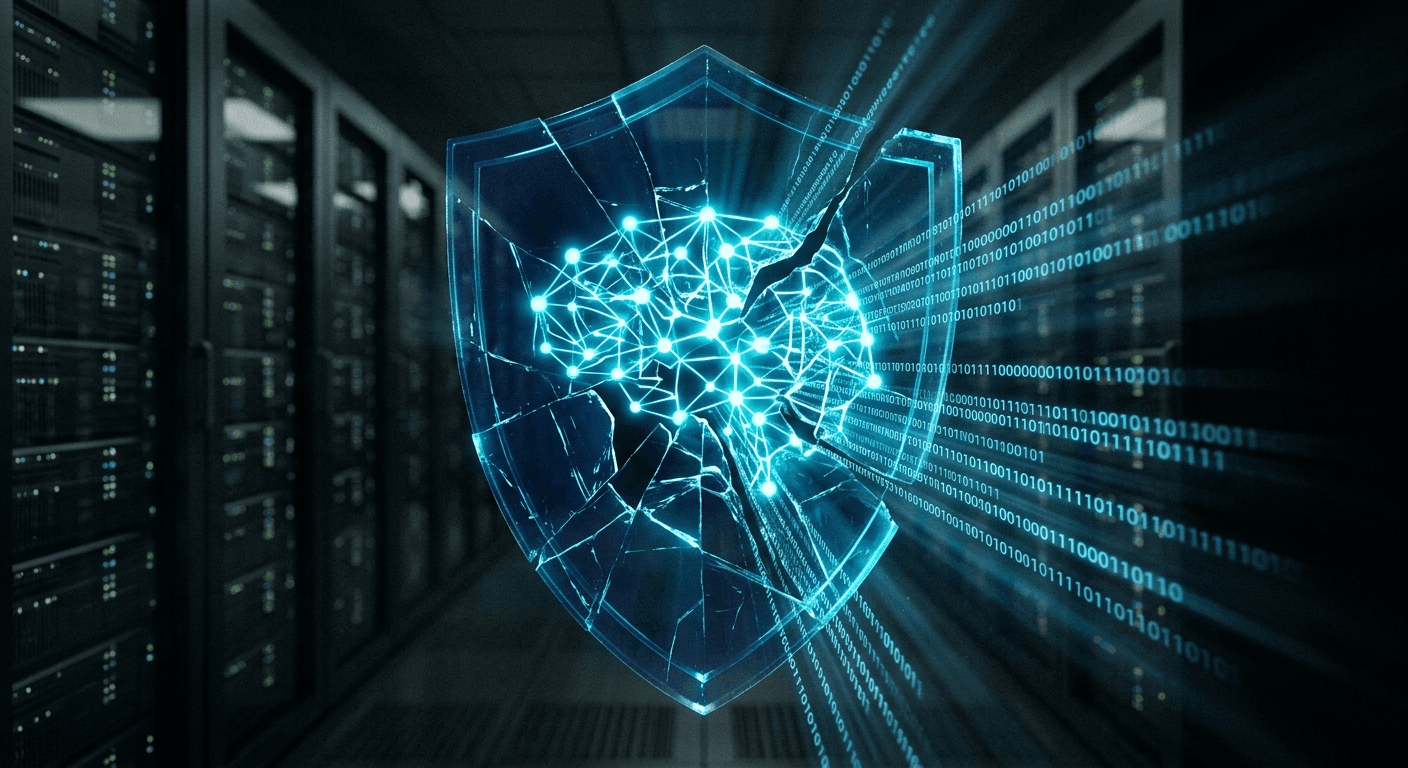
When AI Fails to Secure Itself, Democracy Pays the Price
The same AI tools reshaping governance, public services, and civic infrastructure are being weaponised by adversaries who move faster than any regulator. The industry's reckoning will not be political. It will be criminal.
When AI Fails to Secure Itself, Democracy Pays the Price
The AI industry's security reckoning will not start in a boardroom. It will start in the systems citizens depend on.
By Ramachandran Rajeev Kumar
There is a pattern in every technology gold rush. The pioneers move fast. The regulators move slow. The criminals move at exactly the right time.
We are in the third act of that pattern now. And the curtain is about to lift on something that extends far beyond the AI industry -- into the civic infrastructure that increasingly depends on it.
Governments across the world are deploying AI into public services at pace. Tax processing, welfare eligibility, immigration case assessment, urban planning, healthcare triage, election security monitoring. These systems are being built on the same foundation as enterprise copilots -- the same models, the same APIs, the same architectural patterns. And they carry the same vulnerabilities. But the consequences of a breach in civic infrastructure are not measured in quarterly earnings. They are measured in public trust, democratic legitimacy, and the social contract itself.
The AI industry's security crisis is not just a corporate problem. It is a democratic one.
The velocity problem
Every major AI company is shipping changes at a pace that would have been considered reckless five years ago. New models drop every few weeks. APIs are deprecated before the documentation is finished. Features ship in preview, graduate to general availability, and get replaced -- all within a single quarter. OpenAI, Google, Anthropic, Meta, Mistral, and a dozen well-funded startups are locked in a sprint where second place is indistinguishable from irrelevance.
This is not a criticism. Competition drives progress. But it also drives corners. And in software, corners cut on security are corners that bleed later.
The architecture of modern AI applications is dauntingly complex. A single enterprise deployment might involve a frontier model accessed via API, a retrieval-augmented generation layer querying internal documents, a vector database holding embeddings of proprietary data, an orchestration framework stitching together tool calls, and a thin application layer serving it all through a browser. Each layer has its own attack surface. Each connection between layers is a potential gap. And the entire stack was assembled in months, not years, by teams whose primary metric is capability -- not hardening.
No one is testing the seams. Not properly. Not at the speed the seams are being welded.
The symmetry of weapons
The industry's marketing departments would prefer you not dwell on this: the same tools that make a junior developer three times more productive also make an amateur attacker three times more dangerous.
Large language models can generate phishing emails that are indistinguishable from legitimate correspondence. They can write polymorphic malware that mutates to evade signature-based detection. They can analyse codebases for vulnerabilities faster than any human security researcher. They can construct social engineering scripts tailored to specific targets by ingesting publicly available data -- LinkedIn profiles, conference talks, GitHub contributions -- and synthesising a conversational approach designed to extract credentials or plant trust.
This is not speculative. It is documented. Security researchers at multiple firms have demonstrated that off-the-shelf language models, with minimal prompt engineering, can replicate attack chains that previously required years of specialised knowledge. The barrier to entry for offensive cyber operations has collapsed.
And it has collapsed at precisely the moment when the defensive perimeter has never been more porous.
The fatigue behind the firewall
Talk to anyone running a security operations centre in 2026. Not the executives who give keynotes about "zero trust architecture." The analysts. The ones reading the alerts at 3 a.m.
They are exhausted.
The volume of threats has exploded. The sophistication has increased. The tooling has improved, yes -- AI-powered detection, automated triage, behavioural analytics -- but every new defensive tool introduces its own attack surface, its own false positives, its own integration headaches. The security stack has grown so complex that securing the security infrastructure is itself a full-time speciality.
And beneath the exhaustion, something more corrosive: fatigue. A slow, grinding erosion of vigilance. When everything is a priority, nothing is. When every vendor claims AI-powered protection, the signal drowns in noise. When the model you are defending against gets a major update every six weeks, the threat model you built last quarter is already wrong.
This fatigue extends beyond enterprise security teams. It has crept into the ethical hacking community -- the penetration testers, the bug bounty hunters, the red teamers who are supposed to be the immune system of the digital economy. They are struggling to keep pace. The attack surface expands faster than they can map it. The models change faster than they can test them. The pressure to ship reports -- to produce results, to justify budgets -- pushes them toward the same shortcuts they are supposed to catch in others.
"A bit careless" is how one veteran described the industry's collective posture to me. "Not negligent. Just a bit careless. Just enough."
That "just enough" is the gap an adversary needs.
The guardrail illusion
Every AI company has a safety team. Every model has an acceptable use policy. Every API has rate limits and content filters. These are real investments, made by serious people, and they matter.
But they are not enough. And the industry knows they are not enough.
Jailbreaks are discovered weekly. Prompt injection remains an unsolved problem at the architectural level -- not at the policy level, at the architectural level. Models can be coerced into revealing system prompts, ignoring instructions, generating harmful content, and executing unintended tool calls. Multimodal models introduce new vectors: images that contain encoded instructions, audio that carries hidden payloads, video that exploits frame-level processing assumptions.
The guardrails are policy overlays on a fundamentally permissive substrate. They are painted lines on a road with no barriers. They work when everyone agrees to stay in lane. They fail when someone does not.
And the someone who does not is not going to announce themselves at a conference. They are not going to publish a responsible disclosure. They are going to move quietly, at scale, and by the time anyone notices, the extraction will be complete.
The scenario that keeps CISOs awake
A coordinated attack that exploits LLM-powered automation to simultaneously breach dozens -- perhaps hundreds -- of enterprises. Not through a single zero-day, but through a combination of techniques: AI-generated spear-phishing to establish initial access, automated reconnaissance of internal systems using the same AI tools the company bought for productivity, data exfiltration disguised as normal API traffic, and lateral movement guided by models that can read network architectures faster than the defenders monitoring them.
The attacker does not need to be a nation-state. They need a subscription to a frontier model, a few thousand dollars in compute, and a weekend.
This is not a scenario drawn from a thriller novel. This is a risk assessment that multiple cybersecurity firms have published, with varying levels of alarm, over the past 12 months. The consensus is not whether, but when.
And when it happens -- when the breach is global in scope, affecting companies that publicly staked their transformation strategy on AI, exposing data that was supposed to be protected by the very intelligence that enabled its aggregation -- the backlash will be severe.
Not a regulatory slap. Not a congressional hearing. A full corporate retreat.
The democratic exposure
Here is where the corporate security crisis becomes a civic one.
Governments do not move at the speed of enterprise. They do not have the budgets of Big Tech. But they are deploying the same AI architectures -- often through the same vendors, using the same APIs, built on the same models. A municipal government using an LLM to process building permits. A national tax authority using AI to flag fraudulent returns. An election commission using machine learning to detect disinformation. A public health system using AI triage to route patients.
These systems are running on the same vulnerable substrate. But when an enterprise is breached, the cost is financial. When civic infrastructure is breached, the cost is legitimacy. A government that cannot secure the AI it uses to serve citizens will lose the mandate to govern with AI at all. And unlike a corporation, a government cannot pivot to a new product strategy. The retreat from AI in public services would set back digital governance by a decade.
The citizens who depend on these systems -- for welfare, for justice, for democratic participation -- have no fallback. They cannot switch providers. They cannot opt out. They are captive users of infrastructure they did not choose and cannot audit.
This is the democratic dimension of AI security that the industry's conversation almost entirely ignores. The breach will not only destroy shareholder value. It will erode the civic trust that democracies require to function.
The trust collapse
Boards of directors have short memories for innovation and long memories for liability. The moment a major AI-enabled breach makes the front page -- and it will not be one company, it will be a wave -- the calculus changes overnight.
CIOs who championed AI adoption will face questions they cannot answer. "You connected our proprietary data to an external model accessible via API? You allowed an AI agent to execute code on production systems? You gave an LLM access to our customer database for 'summarisation'?"
The reaction will not be nuanced. It will not distinguish between responsible AI deployment and reckless experimentation. It will be a blanket prohibition. AI will be banned from enterprise environments the way personal devices were banned after the first wave of BYOD breaches -- reflexively, comprehensively, and for years.
This is the bubble. Not the valuation bubble, though that will pop too. The trust bubble. The collective assumption that AI can be deployed faster than it can be secured, that speed-to-market is a proxy for competitive advantage, and that security is a problem that can be bolted on after the fact.
Security is never bolted on. It is built in, or it is absent.
The winner's criterion
The AI companies that will survive the reckoning are not the ones shipping the most features. They are not the ones with the biggest context windows or the fastest inference times or the most impressive benchmarks on contrived evaluation sets.
They are the ones whose customers are still standing after the breach wave.
The winner in this race will not be determined by who delivers the most cookies. It will be determined by who delivers the safest cookies. The ones that do not crumble when someone shakes the jar.
This requires a fundamental reorientation of priorities. Not safety theatre -- not another blog post about responsible AI principles, not another advisory board of ethicists who have no engineering authority. Actual security engineering. Formal verification of tool-calling architectures. Adversarial testing at a scale that matches the adversary's capabilities. Investment in defensive AI that is funded as generously as offensive capability research. And -- critically -- a willingness to slow down.
To ship less. To harden more. To choose reliability over novelty.
No company wants to hear this. Every investor will resist it. The market rewards speed, not caution.
But the market has never priced in a global AI breach. When it does, the discount will be permanent for those who were not ready. And the premium will be extraordinary for those who were.
The clock is not metaphorical
This is not a warning about a distant possibility. The tools are available. The attack surfaces are exposed. The defenders are stretched. The adversaries are motivated. The only missing ingredient is timing -- and timing, in cybersecurity, is the one variable you never control.
The AI industry has about 18 months to get serious about security. Not "we take security seriously" serious -- the kind of serious that involves shipping fewer features, hiring more red teamers than product managers, and accepting that the model your competitor shipped this week does not need to be matched by Friday.
Perhaps less.
The companies that use that time to harden their infrastructure, to pressure-test their deployments, to build genuine security into the architecture rather than painting guardrails on the surface -- those companies will own the next decade.
The governments that demand this of their AI vendors -- and audit them with the same rigour they apply to defence contractors -- will be the ones whose citizens still trust digital governance when the dust settles.
The rest will be case studies.
Ramachandran Rajeev Kumar is the CEO of Aarksee Group of Companies, a technology and sustainability conglomerate. He writes on the intersection of technology, governance, and environmental stewardship.