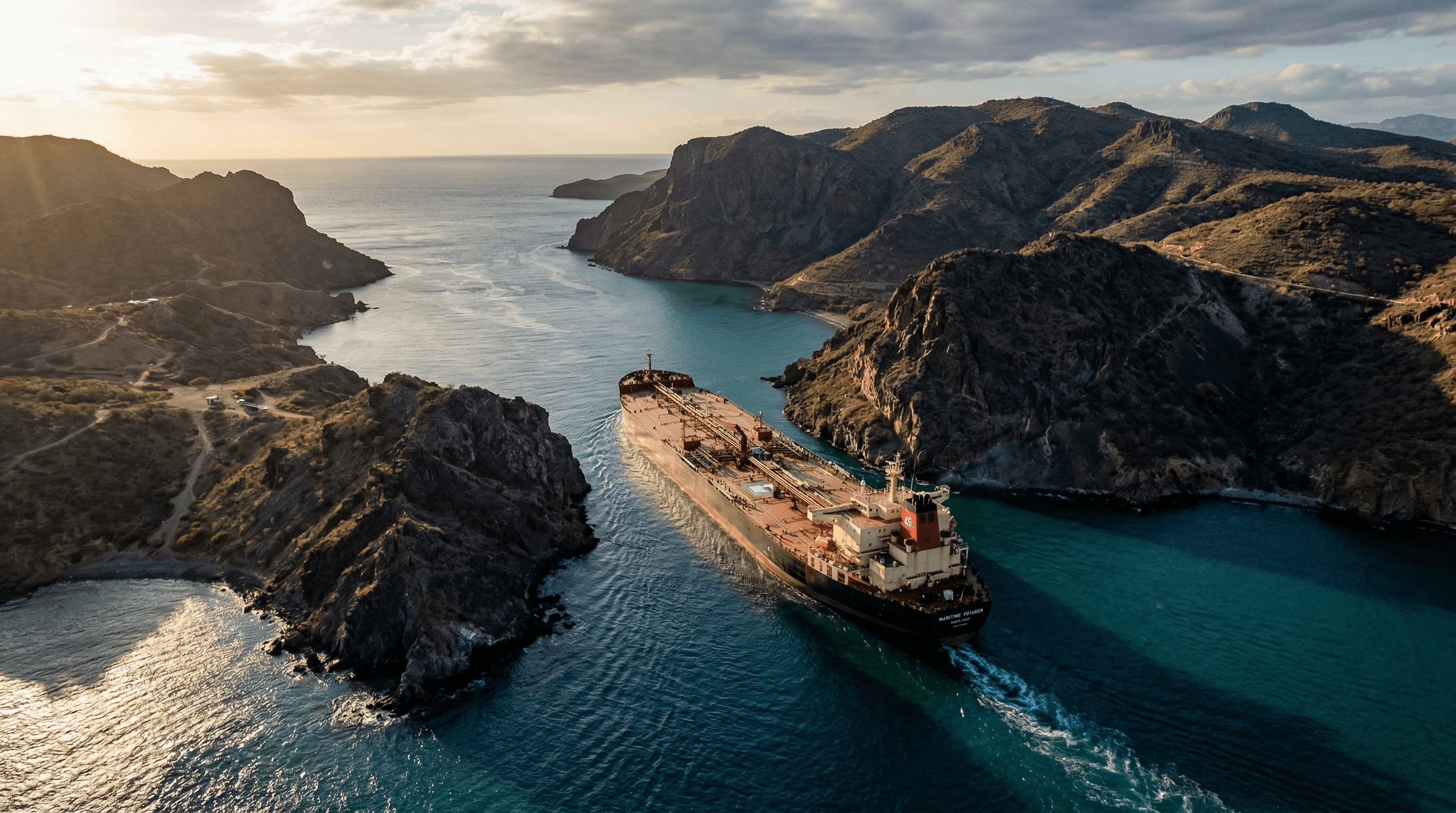
The Strait of Our Prosperity
Through the Strait of Hormuz passes twenty per cent of the world's oil. When military operations begin in these waters, a sliver of salt water becomes the single most consequential bottleneck in the global economy.
The Strait of Our Prosperity
How a 33-mile waterway connects your kitchen to a war zone
I. The Narrowest Point
The Strait of Hormuz is thirty-three miles wide at its narrowest. A competent swimmer could, in theory, cross it. It is not much -- a sliver of salt water between Iran and Oman, barely visible on a globe.
Through this sliver passes roughly twenty per cent of the world's oil. Every day, tankers the length of football pitches navigate its shipping lanes, carrying the liquid that becomes the petrol in your car, the diesel in the truck that brought your food, the kerosene in the aircraft that connected you to another city. Hormuz is not a geopolitical abstraction. It is the supply chain of ordinary life.
When military operations begin in the waters around this strait -- as they have today -- the abstraction collapses. The sliver becomes one of the most consequential bottlenecks in the global economy. And every individual on the planet who heats a home, drives a car, or buys bread delivered by a fuel-burning vehicle becomes a stakeholder in a conflict they did not start and cannot stop.
II. The Invisible Wire
The manifesto spoke of threads that connect and wires that divide. Hormuz is both.
The thread: a global energy system that, for all its flaws, delivers power to hospitals, warmth to homes, and mobility to billions. This is prosperity in its most physical form -- not stock prices or GDP figures, but the ability to cook dinner, commute to work, and keep medicine refrigerated. The thread is real. It is tangible. And it passes through thirty-three miles of water.
The wire: the same waterway is now a theatre of military confrontation. Carrier groups patrol it. Missiles arc over it. The nations that control its banks are in conflict. The wire of national competition runs alongside the thread of global necessity, and today, the wire is carrying current.
This is the paradox of the modern economy. We built a system of extraordinary interdependence -- a system in which a disruption in the Persian Gulf raises the price of heating oil in Finland -- and then we allowed national nets to threaten the very infrastructure that interdependence requires.
We wired ourselves together for prosperity. And then we wired ourselves for war through the same channels.
III. The Ripple
When the strait tightens, the world feels it in layers.
The first layer is price. Oil futures respond within hours. Insurance premiums on tankers spike. Shipping companies reroute around the Cape of Good Hope, adding weeks and fuel costs to every journey. These are numbers on screens, but they translate directly into numbers at petrol pumps and checkout counters.
The second layer is supply. Nations that depend on Gulf oil -- which includes most of Asia, significant parts of Europe, and virtually every developing economy with limited reserves -- face the prospect of shortages. Shortages do not distribute themselves equally. The wealthy stockpile. The poor queue.
The third layer is cascading consequence. Higher energy costs raise the price of everything that requires energy to produce or transport -- which is everything. Agriculture. Manufacturing. Pharmaceuticals. Construction materials. The cost of building a school in Nairobi rises because a carrier group deployed in Hormuz. The connection is invisible, but the wire is real.
The fourth layer is political. Governments facing angry citizens at fuel pumps make rash decisions. Subsidies they cannot afford. Alliances they would not otherwise accept. The energy shock becomes a political shock, and the political shock feeds back into the geopolitical system that caused the disruption in the first place.
This is not theory. It has happened before -- in 1973, in 1979, in 1990. Each time, the lesson was the same: when national nets clash where the threads of global prosperity converge, everyone pays. And the poorest pay first.
IV. The Prosperity Pillar
The Global Federation was built on three pillars. Today, the Prosperity pillar is under direct assault.
Prosperity, in TGF's framework, is not wealth for its own sake. It is the baseline condition without which peace and progress are impossible. You cannot ask a family choosing between fuel and food to contemplate democratic reform. You cannot ask a nation rationing electricity to invest in education. Prosperity is the floor. Without it, everything else is performance.
The Strait of Hormuz is, in physical terms, the floor's foundation. Twenty per cent of global energy transits a waterway that is now a conflict zone. The prosperity of billions is held hostage by the strategic calculations of a handful of national nets.
This is not an argument against national sovereignty. It is an argument against the pretence that national sovereignty operates in isolation. When your military decisions reshape the price of bread in a country you have never visited, sovereignty has become externality. Your net has reached beyond its borders without consent.
V. The Engineering Question
The manifesto proposed that the nets could be rewired -- that the threads of connection could be preserved while the wires of destruction were cut. Hormuz is the test case.
The thread to keep: a global energy system that, despite its carbon costs, currently sustains modern civilisation. Transition it, yes. Decarbonise it, certainly. But in the immediate term, protect its function.
The wire to cut: the ability of any single national conflict to hold that system hostage. This requires diversification -- of energy sources, of transit routes, of strategic reserves -- and it requires something deeper: the recognition that shared infrastructure demands shared governance.
No single nation should be able to disrupt the energy supply of the planet through unilateral military action. This is not a moral argument. It is an engineering one. A system with a single point of failure is a badly designed system. Hormuz is a single point of failure for global prosperity.
The answer is not to militarise the strait further -- that is adding wires to wires. The answer is to design a global energy architecture that does not concentrate existential risk in thirty-three miles of water.
VI. What You Can Do
This article will not stop a military operation. But it can do something smaller and more important: it can make the invisible wire visible.
The next time you fill a tank, heat a home, or buy food that was trucked from a distribution centre, know that your prosperity is connected -- by a thread that is also a wire -- to a body of water where carriers and missiles are currently deployed.
Know that your comfort is not separate from the conflict. It is downstream of it.
And know that this connection -- this involuntary, unchosen, non-consensual economic linkage between your kitchen and a war zone -- is precisely the kind of wire that The Global Federation exists to name, examine, and ultimately rewire.
The strait is narrow. The implications are not.
Published by The Global Federation Peace, Prosperity & Progress 28 February 2026