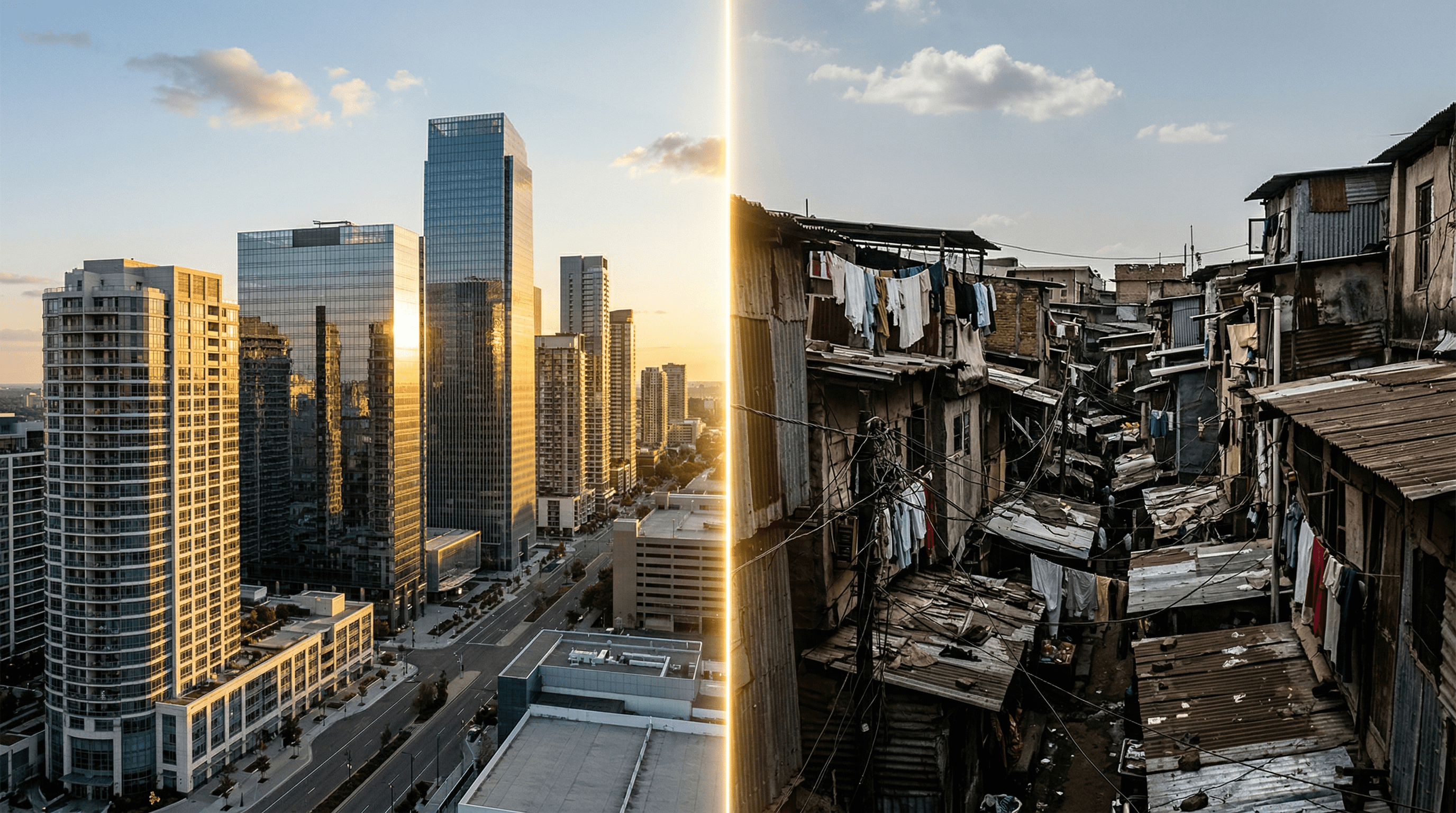
The Two Percent World
The bottom fifty per cent of humanity hold two per cent of global wealth. The economic net is the tightest cage -- and the most invisible.
The Two Percent World
When half of humanity shares a sliver and the nets call it normal
I. The Number
The World Inequality Report 2026 contains many numbers. Most of them are numbing in the way that large numbers tend to be -- billions and trillions that the human brain was never designed to process. But one number is small enough to feel:
Two.
The bottom fifty per cent of humanity -- nearly four billion people -- hold two per cent of global wealth. Not twenty. Not twelve. Two. Meanwhile, the top ten per cent hold three-quarters of everything.
Sit with that for a moment. Half the species, two per cent of the resources. One-tenth of the species, seventy-five per cent. The remaining forty per cent occupy the gap between, holding just enough to feel neither secure nor desperate -- the anxious middle, close enough to poverty to fear it, far enough from wealth to never feel safe.
This is not an aberration. This is the architecture of the economic net working precisely as designed.
II. The Net Nobody Sees
The manifesto identified five major nets: family, society, religion, race, and nation. But there is a sixth net that the manifesto touched upon without naming directly. It is the most pervasive of all, and the most invisible.
The economic net.
Unlike the others, the economic net does not announce itself with flags, scriptures, or borders. It does not require your loyalty or your belief. It does not ask you to salute. It operates through a quieter mechanism: the distribution of possibility.
The child born into the two per cent does not lack intelligence. She does not lack ambition. She lacks starting position. The school is underfunded. The water is unreliable. The nearest hospital is hours away, and the road to it is unpaved. Every step she takes requires twice the energy of the child born into the seventy-five per cent, because her terrain is steeper, her tools are fewer, and the net she was born into offers no trampoline -- only a floor.
The child born into the seventy-five per cent does not necessarily possess more talent. But he possesses something that functions identically to talent in the modern economy: access. Access to education that develops capability. Access to networks that convert capability into opportunity. Access to capital that converts opportunity into outcome. Access is not merit. But the economic net rewards it as if it were.
III. The Inheritance Machine
Wealth is not merely accumulated. It is inherited. Not only in the legal sense -- though that matters enormously -- but in the structural sense. The economic conditions into which you are born determine, with statistical reliability, the economic conditions in which you will die.
The World Inequality Report makes this plain. The concentration of wealth at the top is not a snapshot. It is a trajectory. It has been steepening for four decades. The mechanisms that concentrate wealth -- compound returns on capital, tax architectures that favour the already-wealthy, inheritance systems that transmit advantage across generations -- are not accidental features of the economy. They are the threads of the economic net, and they hold tight.
The manifesto asked whether the nets could be rewired. In the economic net, the rewiring question is specific: can we preserve the threads that incentivise productive work, innovation, and enterprise -- the threads that genuinely create prosperity -- while cutting the wires that transform temporary advantage into permanent dynasty?
Because that is what two per cent versus seventy-five per cent represents. Not a market outcome. A dynastic outcome. The economic net is not distributing resources based on contribution. It is distributing them based on position -- and position, overwhelmingly, is inherited.
IV. Why This Is a Peace Problem
The manifesto's first pillar is Peace. What does wealth inequality have to do with peace?
Everything.
When a young man in a disadvantaged community has no realistic path to dignity through legitimate work, the net of extremism offers an alternative. When a nation cannot feed its citizens but sees its neighbours flourish, the net of nationalism offers a scapegoat. When inequality within a society reaches levels that make social mobility a statistical fiction, the net of revolution begins to look rational.
Inequality does not cause violence directly. But it builds the infrastructure of resentment upon which every violent net depends. The preacher who recruits a bomber does not start with theology. He starts with grievance. The politician who starts a war does not start with strategy. He starts with a population angry enough to follow.
Two per cent is not merely an economic statistic. It is a measure of how much combustible material the global system is storing. And today, with missiles flying over the Gulf, we are watching what happens when that material finds a spark.
V. The Taxing Question
The Report proposes solutions. Progressive taxation. Wealth taxes. Global minimum tax floors. Redistribution through education, healthcare, and infrastructure investment. These are technical proposals whose implementation involves economic trade-offs beyond the scope of this article. But the philosophical question is simpler:
Is a world where half of humanity holds two per cent of the wealth the world we intend?
If yes, then the current architecture is working. Maintain it.
If no, then the economic net must be rewired. Not destroyed -- the manifesto never argues for the abolition of nets, only for the removal of their attack circuitry. The economic net, at its best, incentivises innovation, rewards effort, and allocates resources with tolerable efficiency. These threads should remain.
But the wires -- the mechanisms that convert temporary advantage into permanent caste, that allow a vanishingly small elite to hold more wealth than half of humanity combined, that treat inherited position as earned merit -- these wires can be cut without collapsing the structure.
Taxation is wire-cutting. Done clumsily, it severs threads and wires alike. Done surgically, it preserves the incentive to create while removing the mechanism to hoard across generations.
The question is not whether to cut. The question is whether the net's architects will permit the scissors.
VI. The Individual Test
TGF speaks to the individual, not the tribe. So here is the individual test:
If you are reading this, you are probably not in the two per cent. You have a screen. You have connectivity. You have literacy. These alone place you above billions.
But you are also probably not in the top ten per cent. You work for your position. It is not guaranteed. You worry about costs. You calculate before you spend.
You are in the anxious middle -- the forty per cent who hold enough to function but not enough to feel free. You are close enough to the two per cent to understand their constraints, and close enough to the seventy-five per cent to see how the threads lift those above you into a different experience of life.
This is the vantage point from which the world changes. Not from the bottom, which is too busy surviving. Not from the top, which has no incentive to change. From the middle -- where you can see both floors clearly, and where the wiring of the economic net is most visible to those who pay attention.
The manifesto asked: what if we kept the love and cut the wire?
The economic version of that question is: what if we kept the engine of prosperity and cut the wires that ensure its output flows upward, always upward, into the hands of those who already hold the most?
Two per cent. It is a number small enough to feel. It should be small enough to change.
Published by The Global Federation Peace, Prosperity & Progress 28 February 2026