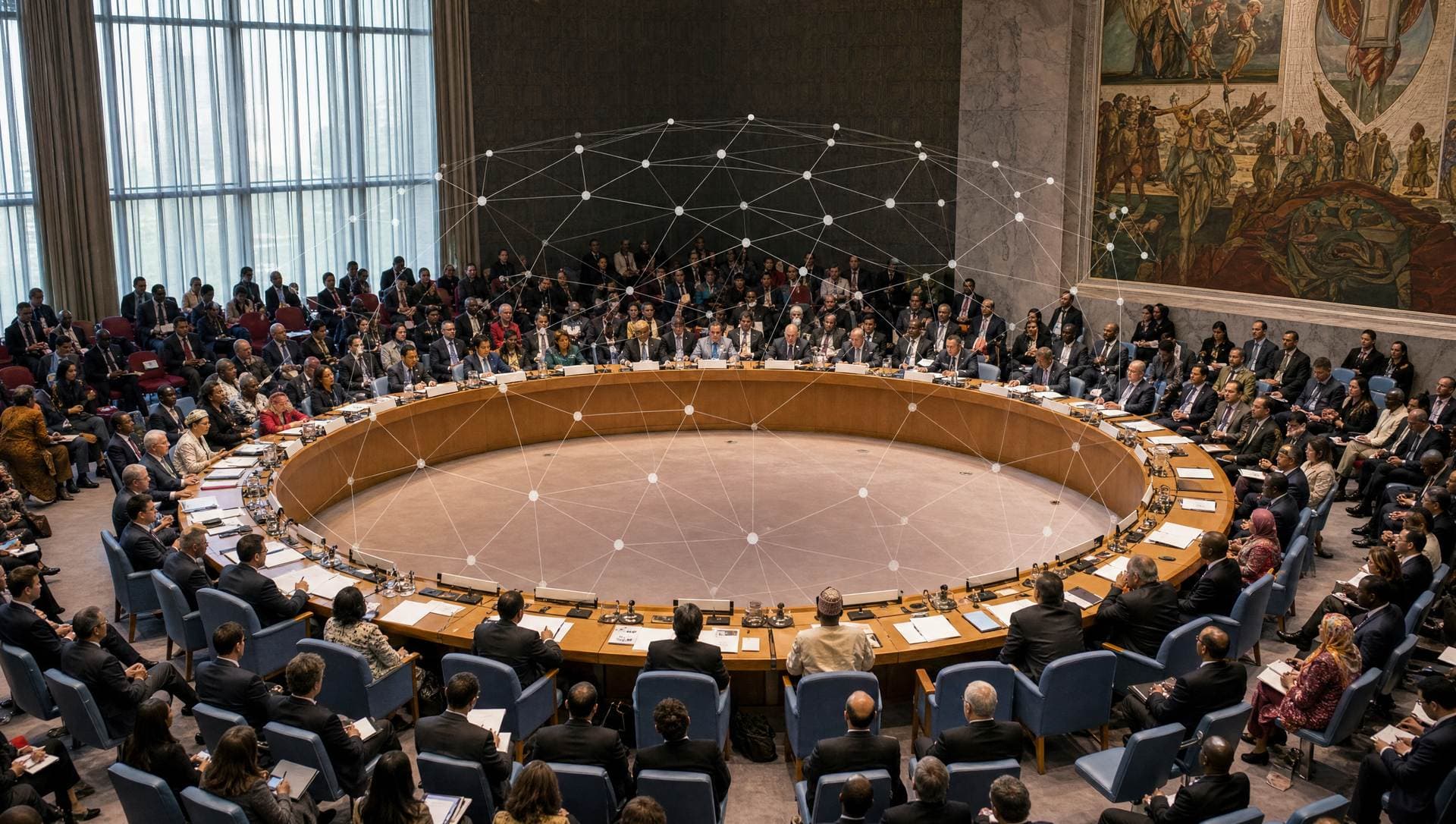
The UN AI Table Should Belong To Everyone
AI is neither a demon nor a deity. It is a powerful human instrument, built from imperfect human data and deployed by imperfect human institutions. That is exactly why the rules for it cannot be written only by the countries, companies, and labs already holding the most power.
The argument over artificial intelligence has become strangely theatrical. One camp sells AI as an approaching miracle, a machine that will cure disease, tutor every child, discover new materials, remove drudgery, and lift productivity into a new golden age. Another camp speaks of it as a civilisational threat, a job-eating, truth-breaking, society-weakening force that must be slowed before it consumes the world that built it.
Both stories contain a piece of the truth. Both become dangerous when mistaken for the whole truth.
AI is not the devil. It is already helping doctors read images, farmers manage crops, programmers write code, students learn faster, translators cross language barriers, and public agencies process information at a speed no bureaucracy could have imagined twenty years ago. It is one of the great technical strides of this century.
But AI is not an angel either. It is built on data assembled by human beings, through institutions with human incentives, from societies with human blind spots. Its outputs are probabilistic, not sacred. Its training material contains error, omission, prejudice, hierarchy, fashion, propaganda, bad measurement, old injustice, and the simple messiness of human life. The flaws will not vanish in a hurry, because the material underneath them is not perfect and never has been.
That is why AI governance cannot be left to mythology. It must be built like public infrastructure: with participation, audit, limits, repair, and democratic consent.
In July, the world gets a chance to test whether it understands that. On 6 and 7 July 2026, the first United Nations Global Dialogue on AI Governance will convene in Geneva. The UN describes it as a forum where all governments and stakeholders can shape how artificial intelligence is governed worldwide. Its official themes include bridging AI divides, building capacity in developing countries, supporting open-source software and open data, protecting human rights, improving transparency and accountability, and ensuring human oversight.
That may sound procedural. It is not. It is constitutional politics at planetary scale.
The rules written now will decide who builds, who buys, who is watched, who is excluded, who profits, who is automated, who can appeal, who receives public services through a machine, and who is forced to live inside systems they never helped design. If the table is narrow, the future will be narrow. If the table is wide, the technology has a chance of becoming something closer to a public good.
The question is legitimacy
The first mistake is to ask whether the UN can "control" AI. It cannot, and that should not be the goal. No single institution can command a technology that is built across private labs, national research agencies, open-source communities, cloud providers, chip supply chains, universities, militaries, and millions of users.
The better question is whether the UN can give AI governance something the current system lacks: universal legitimacy.
The global AI conversation has been crowded for years. Bletchley Park in 2023 put frontier AI safety on the diplomatic agenda. Seoul in 2024 strengthened the network of AI safety institutes. Paris in 2025 shifted toward investment and adoption. New Delhi in 2026 moved the language from safety alone toward impact, inclusion, and development. Each summit mattered. Each made the conversation larger.
But summits are not a system. They are moments. They often reflect the priorities of the host, the attending powers, and the companies with the resources to appear in the room. The result is useful attention, but uneven authority.
That is where the UN matters. Not because it is efficient. It often is not. Not because it is free from power politics. It never has been. The UN matters because it is still the only global forum where every country can claim a formal seat. For AI, that universality is not diplomatic decoration. It is the difference between rules made for the world and rules merely exported to the world.
The Council on Foreign Relations put the stakes plainly in its recent assessment of the Dialogue: if the UN effort fails, governance will continue to fragment along geopolitical and economic lines, with rules set by those best able to project influence. That is already the direction of travel. The United States, China, the European Union, major cloud companies, chip producers, and frontier model labs are not waiting for consensus. They are building standards, markets, dependencies, and default behaviours now.
For everyone else, the danger is not simply exclusion from a meeting. It is adoption without authorship.
The countries that arrive late pay longer
History is full of systems that were designed by the powerful and then presented to the rest of the world as neutral. Trade rules. Debt architecture. Tax treaties. Development finance. Climate obligations. Digital platforms. In each case, the countries that entered late often spent decades trying to correct terms they never shaped at the beginning.
AI could repeat that pattern at higher speed.
The technical dependencies are already visible. Compute is concentrated. Advanced chips flow through narrow supply chains. Large models are costly to train. Cloud access depends on contracts and jurisdictions. Language coverage is uneven. Safety research is concentrated. Evaluation capacity is expensive. The public sector in many countries is being asked to adopt AI tools faster than it can independently inspect them.
Stanford's 2026 AI Index captures part of this imbalance. It finds that national AI strategies are expanding quickly, especially among emerging economies that had no formal AI policy five years ago. It also notes that AI sovereignty has become a central policy theme, even as the infrastructure underneath it is unevenly distributed. Europe and Central Asia expanded state-backed AI supercomputing clusters sharply between 2018 and 2025, while South Asia, Latin America, and the Middle East and North Africa remain far behind.
This is the uncomfortable truth: many countries are writing AI strategies while lacking the compute, data infrastructure, expert regulators, public testing capacity, and local language resources needed to make those strategies real.
That does not make them passive. It makes the Geneva table more important.
Countries that cannot build every layer of the AI stack still need bargaining power. They need shared testing standards. They need access to public-interest models. They need procurement rules that prevent dependency traps. They need transparency about model limits. They need the right to ask whether an imported AI tool works in their languages, their schools, their hospitals, their legal systems, and their local realities.
Above all, they need to stop being treated as future consumers of systems designed elsewhere.
The citizen must be present, not only the state
There is a second legitimacy problem. A universal table of governments is necessary, but not sufficient.
AI does not only affect states. It enters the life of the person. It may screen a job application, recommend a loan decision, detect fraud in a welfare system, guide policing, shape news feeds, translate a court document, triage a patient, grade an essay, or produce a synthetic video that misleads voters. It can help an individual act with more knowledge. It can also quietly reduce that individual to a score.
This is why the UN Dialogue cannot become a polite exchange among ministries, companies, and experts while ordinary people appear only as "users" in the background. The person affected by AI must be treated as a rights-holder.
That means several principles should travel into every serious AI governance forum.
First, people should know when AI is being used in decisions that affect their lives.
Second, they should be able to challenge consequential automated outcomes.
Third, there should be a named accountable party, not a chain of vendors pointing at one another.
Fourth, systems should be tested in the places and languages where they are deployed, not only in benchmark environments convenient to their builders.
Fifth, public institutions should not buy black-box dependency with public money.
None of this is anti-innovation. It is the minimum architecture for trust. The companies that want AI adoption at scale should understand this better than anyone. They cannot exist in isolation. They need consumers, and consumers also need consumers. A society with frightened workers, depressed households, collapsing trust, and declining purchasing power is not a market. It is a warning.
If AI creates broad prosperity, people will adapt. If it creates mass insecurity while wealth pools upward, society will push back. In democratic systems that pushback will come through voters, courts, unions, regulators, local governments, consumer behaviour, and public protest. In non-democratic systems, it may be delayed or suppressed, but not abolished. When the common good is damaged deeply enough, legitimacy cracks. Technology does not repeal that law of politics.
The false choice: acceleration or obstruction
The AI debate is often trapped in a childish binary. Either accelerate everything, because regulation will kill innovation, or slow everything, because innovation will kill society.
TGF should reject that binary.
The question is not whether AI moves forward. It will. The question is whether the institutions around it move with equal seriousness. A society that cannot adjust its schools, labour protections, public procurement, infrastructure planning, competition rules, privacy law, and democratic safeguards will experience AI as a shock. A society that prepares those systems can experience it as a tool.
The UN Dialogue should therefore avoid two traps.
The first trap is panic language. If AI is framed only as catastrophe, governments will either perform symbolic restriction or use fear to centralise control. Neither outcome serves the citizen.
The second trap is promotional language. If AI is framed only as opportunity, the public will eventually notice that the costs are real and that the promises are unevenly distributed. Once trust breaks, the backlash will be wider than the original risk.
The honest position is stronger: AI is powerful, useful, flawed, and socially disruptive. It requires rights, rules, investment, education, competition, infrastructure, and human oversight. It requires democratic bargaining.
That is not a timid position. It is the only durable one.
What Geneva should produce
The July Dialogue will not produce a world AI constitution in two days. It should not pretend to. But it can do something more useful than issue another statement of concern.
It can begin converting inclusion into mechanisms.
The first mechanism should be public capacity. Developing countries need support not only to "adopt AI," but to inspect it. That means public-interest technical expertise, shared evaluation tools, regulator training, local-language benchmarks, and access to independent scientific evidence. The UN's Independent International Scientific Panel on AI can help if its work is accessible to countries that do not have their own large AI safety institutes.
The second mechanism should be a standing voice for affected communities. Civil society, labour organisations, educators, disability advocates, privacy groups, local-language communities, migrant groups, and public-service users should not be occasional guests. They should have structured channels into the Dialogue process and its follow-up work.
The third mechanism should be transparency around dependency. Countries should be able to compare the long-term public risks of cloud contracts, model procurement, data-sharing agreements, and vendor lock-in. If a government adopts AI for public services, citizens should know what system is being used, where data flows, who can audit it, and how errors are corrected.
The fourth mechanism should be practical interoperability. The world does not need every country to copy one regulatory model. It does need rights, safety, audit, and accountability frameworks that can speak to one another. Otherwise, the same AI system will produce different obligations across borders, allowing harm to travel faster than responsibility.
The fifth mechanism should be a development compact. AI governance must include labour transition, education, local innovation, public digital infrastructure, and access to compute. A country told to regulate AI without being helped to build AI capacity is being invited into dependency with a legal manual.
Inclusion is not charity
The strongest argument for a wider AI table is not moral sentiment. It is practical legitimacy.
AI systems will fail if they do not work across the world as it actually exists. They will fail in languages poorly represented in training data. They will fail in public services whose records are incomplete. They will fail in societies where users do not trust institutions. They will fail when deployed as cost-cutting magic over problems that require human care, local knowledge, and political judgment.
Inclusion is how those failures are discovered before they become structural harm.
India's 2026 AI Impact Summit made this point by shifting the summit conversation toward people, planet, and progress. Carnegie India's analysis of that summit notes that the gap between those who shape AI systems and those expected to adopt them runs through governance frameworks, compute concentration, environmental costs, and linguistic foundations. That gap is not an abstract equity complaint. It is a design flaw.
An AI system that understands only the world of its builders is not global intelligence. It is provincial intelligence with global distribution.
The UN Dialogue has a chance to make that point institutionally. It can say that frontier capability is not the only measure of AI progress. A useful AI future must also be measured by whether public agencies can audit it, whether workers can transition with dignity, whether teachers can use it without surrendering judgment, whether small countries can negotiate fair terms, whether local languages survive the next platform shift, and whether citizens can appeal decisions made about them.
That is what democratic AI governance should mean.
The table before the rules harden
The most important moment in any governance system is the beginning, because that is when defaults become invisible.
If the default is that a few powers build and the rest adopt, the world will spend years trying to soften dependency after it has already become normal. If the default is that public systems may buy opaque AI without explanation, citizens will learn about the cost only when errors reach their lives. If the default is that language inclusion means scraping communities rather than investing in them, culture will be mined before it is respected. If the default is that workers should simply adjust while firms quietly capture the productivity gains, the social contract will fray.
Geneva cannot solve all of that. But it can decide whether those concerns belong at the centre or at the margins.
AI will be governed. By companies, by states, by standards bodies, by procurement contracts, by courts, by military doctrines, by trade restrictions, by app stores, by cloud terms, by defaults buried inside products. Governance is already happening.
The question is whether it will be democratic enough to deserve public trust.
The UN AI table should belong to everyone because AI will touch everyone. Not equally, not at the same time, and not with the same consequences. That inequality is exactly the point. Those with the least power to shape the technology may carry some of its heaviest costs.
AI is not a monster to be slain, and not a saviour to be obeyed. It is a human-made force entering human society. The responsible response is neither fear nor worship. It is citizenship.
And citizenship begins with a seat at the table.
The Global Federation covers artificial intelligence as a civic question: not whether the technology advances, but whether the institutions around it keep enough power with the people it touches.