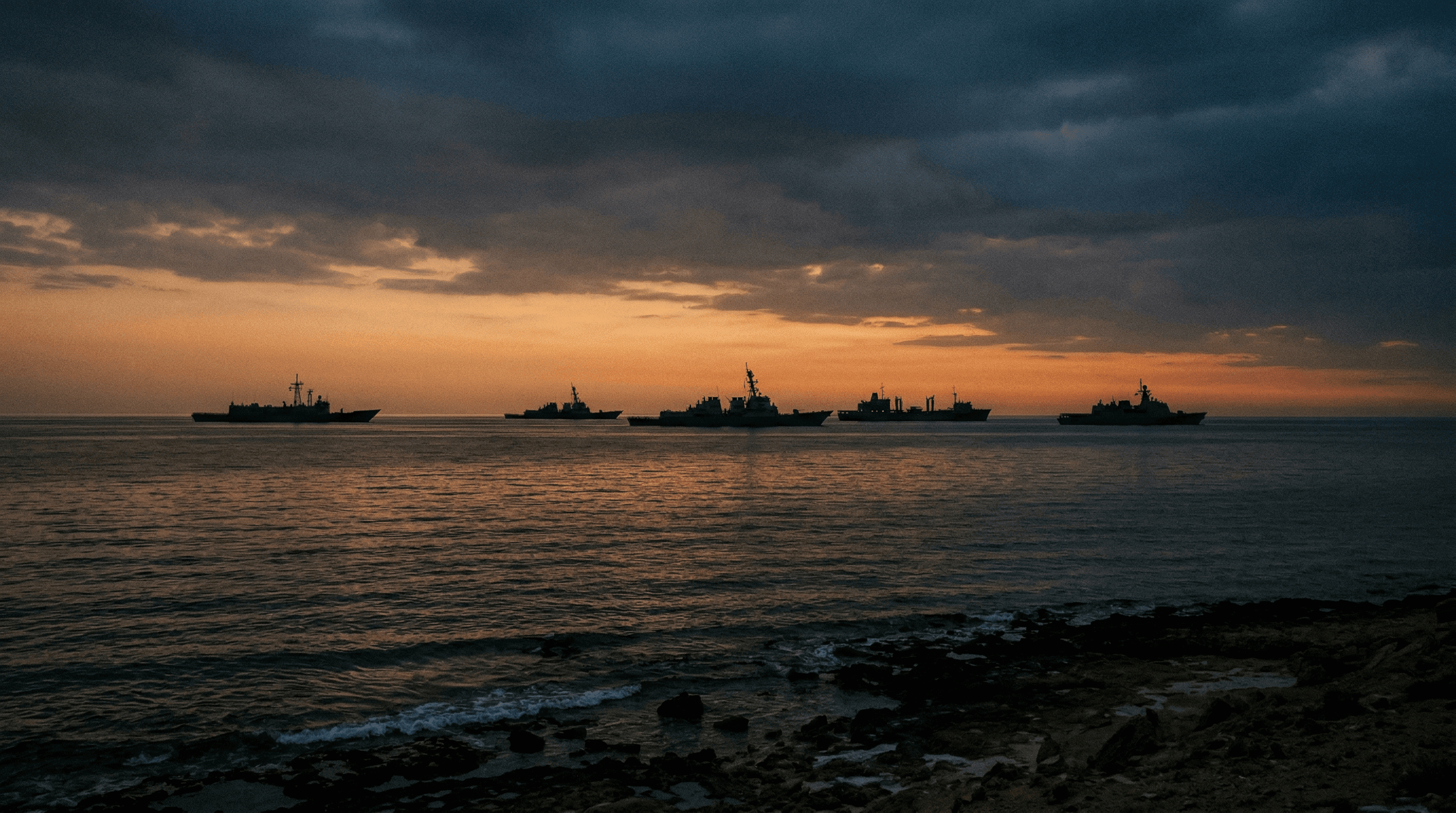
When the Nets Go to War
On 28 February 2026, the United States and Israel launched strikes on Iran. Iran struck back. Between the arcs of the missiles: individuals who did not choose this.
When the Nets Go to War
Iran, America, and the individual who did not choose this
I. The Wire Went Live
On 28 February 2026, the wires inside two national nets carried current.
The United States and Israel launched military strikes against Iran. Iran launched missiles at American bases across the Gulf -- in Qatar, Kuwait, the Emirates, Bahrain. The mediators in Oman had barely closed their notebooks. Three rounds of indirect talks, each described as progress, each ending without a deal. And then the machinery that was always waiting behind the diplomats did what machinery does. It moved.
The operation was given a name. The fleets had already been gathered -- the largest American military deployment in the Middle East since the invasion of Iraq in 2003. Aircraft carriers. Missile destroyers. The infrastructure of persuasion-by-force that nation-states assemble when they have decided that language has failed.
But language did not fail. Language was never given enough time.
II. The Individuals
Somewhere in Tehran tonight, a young engineer who builds bridges -- actual bridges, concrete and steel -- is calculating whether his family should leave the city. He did not vote for enrichment. He does not attend rallies. He designs load-bearing structures. He is not a geopolitical position. He is a person.
Somewhere in Norfolk, Virginia, a twenty-two-year-old sailor who joined the Navy because it offered a path out of debt is learning that her carrier group has been rerouted. She did not design the foreign policy. She does not understand the enrichment thresholds. She was promised education. She was given coordinates.
Somewhere in Manama, Bahrain, a Filipino nurse working at a hospital within range of the retaliatory strikes is wondering if her contract includes evacuation. She has no stake in any of these nets. She came for a salary. She stayed for her children's tuition.
These are the people the nets forget.
Every national net has a story it tells its citizens: we protect you. And in that protection is the unspoken clause: and we may require your life as collateral. The net that builds roads also builds missile silos. The net that funds hospitals also funds operations with names like fury. The individual consents to the first and inherits the second.
III. The Anatomy of Escalation
How did two nations arrive at the point where diplomacy and destruction ran on parallel tracks?
The answer is structural, not personal. It is tempting to blame leaders -- and leaders bear responsibility -- but the machinery of escalation is older than any president or supreme leader. It is woven into the net itself.
The enrichment question was never merely technical. Uranium is physics. But the argument about who may enrich it is the argument about who may join the club of ultimate power. The net of nuclear capability is the smallest, most exclusive, most dangerous net ever built. Those inside it decide who enters. Those outside it resent the gatekeeping. This tension is not a bug. It is the design.
The proxy question -- armed groups operating under the umbrella of a national net but beyond its borders -- is the net extending its threads where it has no legitimate reach. When a nation funds, trains, and directs armed groups in another sovereign territory, it is not security. It is the attack circuitry that the manifesto warned about: the threads that connect members against others.
The missile question is the question of reach. A nation that can strike another from a thousand kilometres away has transformed its defensive net into an offensive one. The argument is never about the missile. It is about the intention the missile represents.
Each of these questions had diplomatic answers. None of them required ordnance. But the nets are wired for escalation because escalation consolidates power within the net. External threats silence internal dissent. A nation at war does not tolerate questions about its roads, its hospitals, its inequality. The wire goes live, and the citizens stand to attention.
IV. The Gulf That Connects
Consider the geography. The strikes and retaliations span the Persian Gulf -- a body of water that a fast boat can cross in hours. On its shores sit nations that had no voice in this decision but will bear its consequences.
Qatar hosts both an American airbase and diplomatic ties to Iran. The Emirates have commercial partnerships with both sides. Kuwait remembers 1990. Bahrain hosts the Fifth Fleet. Oman mediated the very talks that failed.
These nations -- and the millions of expatriate workers within them -- are caught in the crossfire not because they chose sides, but because geography placed them between nets. The Filipino nurse in Bahrain. The Indian accountant in Dubai. The Pakistani construction worker in Kuwait. They are citizens of no net that is fighting, yet they are within range of every net that is.
This is the anatomy of modern war. It is not two armies on a field. It is two national nets clashing across a region where millions of other people live, work, and hope for ordinary lives.
V. The Three Pillar Test
At The Global Federation, every piece of content must serve at least one pillar: Peace, Prosperity, or Progress.
This conflict offends all three.
Peace dies first. Not the abstract peace of treaties, but the lived peace of the engineer designing his bridge, the sailor repaying her debt, the nurse caring for her patients. Their peace was not consulted.
Prosperity follows immediately. The Strait of Hormuz -- through which twenty per cent of the world's oil transits -- sits at the centre of this conflict. When the strait contracts, fuel prices expand. When fuel prices expand, the cost of bread in Cairo rises. The cost of heating in Helsinki rises. The net that fights in one place squeezes wallets in every place.
Progress is the deepest casualty. Every dollar, riyal, and rial spent on this operation is a dollar not spent on clean water, functional education, or the kind of infrastructure that lifts individuals beyond survival. Progress requires sustained investment in human capability. War is the opposite of sustained. War is the interruption of everything.
VI. What TGF Sees
We do not take sides. We take the side of the individual against the machinery that treats individuals as expendable inputs.
We see two national nets, each convinced of its own righteousness, each deploying the language of security to justify the instruments of destruction. We see a region of nations caught between, their sovereignty a polite fiction when carriers and missiles arc overhead. We see millions of people -- Iranian, American, Gulf expatriate, civilian all -- who are not positions on a chessboard but humans with mortgages, school runs, and ageing parents.
We see the attack circuitry doing precisely what it was designed to do.
And we ask the question the manifesto asked:
What if we kept the threads of connection and cut the wires of destruction?
Iran and America share no border. They share no language. But they share a planet, an atmosphere, an ocean, and the same fragile hope that their children will inherit something other than the wreckage of nets at war.
The wires went live today. The nets are pulling tight. The individual must not disappear inside them.
Published by The Global Federation Peace, Prosperity & Progress 28 February 2026